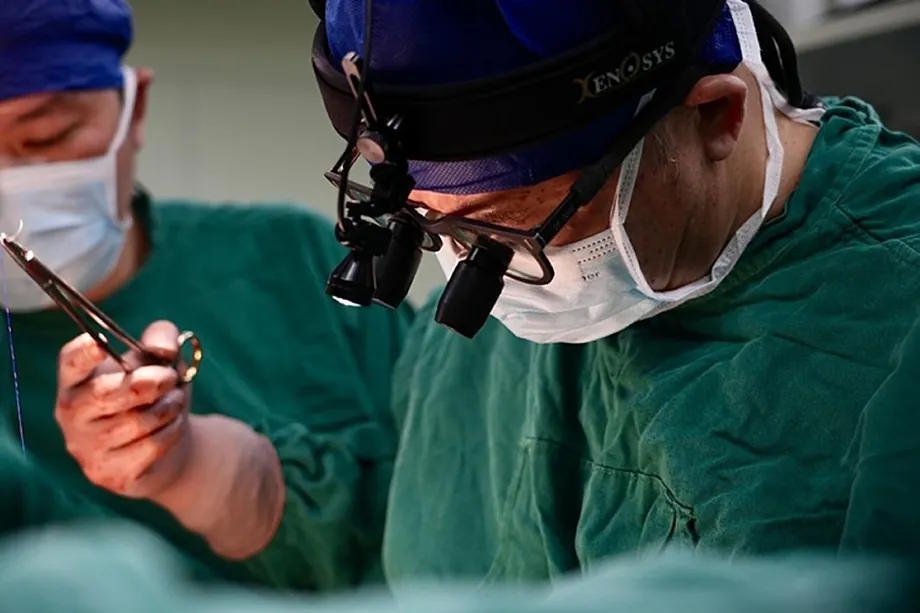
At 12:11 PM on January 12, 2024, surgeon Dong Nianguo was preparing a heart for transplantation at Union Hospital in Wuhan, central China. By 12:45, the organ was already beating in the chest of a 60-year-old patient. The institution celebrated the intervention as a medical success. Dong, one of the country's most prestigious cardiac specialists, heads the transplant center and is a member of a major American thoracic surgery society. However, his career carries a shadow that dates back nearly two decades. In 2005, his name appeared in two scientific publications that described procedures violating one of the fundamental principles of medicine: no one can die as a result of organ extraction for transplantation.
He is not the only renowned doctor associated with those publications. He Jianxing, director of the National Respiratory Medicine Center in Guangzhou, is also listed, distinguished with scientific awards and linked to international medical societies.
Both represent one of the contradictions that now again places the Chinese transplant system under suspicion: professionals who have reached the pinnacle of their careers appear as authors of studies that described operations in which donors may not have been dead when the extractions began.
An investigation by the International Coalition to End Transplant Abuse in China (ETAC), an organization based in Australia, has traced the careers of professionals linked to those publications. According to the collected data, more than a hundred doctors remained active between 2020 and 2025, spread across 40 hospitals in 16 provinces and municipalities in China. Among them, explains researcher Sarah Cook, author of the report, are university professors, department heads, and directors of transplant centers.
The origin of this controversy lies in the surgeons' own publications. In 2022, Matthew Robertson, a researcher at the Australian National University, and Jacob Lavee, an Israeli cardiac surgeon, published a study titled Execution by Organ Extraction in the American Journal of Transplantation. After examining thousands of Chinese medical papers, they identified 71 articles, published between 1980 and 2015 from 56 hospitals, that contained descriptions incompatible with international protocols for certifying brain death.
The conclusions were as follows: in the described operations, the extraction of vital organs could have been the immediate cause of the donors' death.
The key to that accusation lay in the timing of when doctors declared donors dead. Before extracting a heart or lungs, it is mandatory to confirm that the person has died. However, several articles described that donors were intubated to receive oxygen even when the operation had already begun. According to the researchers, donors may have remained alive when surgeons began extracting their organs.
An article published in 1995 by specialists from Wuhan described how, upon opening a donor's chest, they found that his heart was still weakly beating. Only then did they proceed to intubate and ventilate him. Another study from 2005 recounted operations involving five young male donors who were intubated after the supposed declaration of brain death.
The new investigation does not prove that the professionals who signed the articles participated directly in the interventions. What it does is recover the names of those doctors and examine their careers.
The report's author, Sarah Cook, acknowledges in conversations with this newspaper that it is not possible to determine which doctors personally participated in the extractions simply by examining the signatures on the articles. "Our accusation goes beyond establishing individual responsibilities: we question how these procedures could be documented in scientific publications, circulate for years among hospitals and professionals, and not lead to known public investigations," she explains.
The suspicions date back to one of the darkest chapters in Chinese medicine. For decades, the authorities themselves acknowledged that a significant portion of the organs used in transplants came from death row inmates. In 2006, investigations began to emerge that also denounced the forced extraction of organs from prisoners, especially practitioners of Falun Gong, a spiritual movement that emerged in China in 1992 and has been persecuted by the regime since 1999, which considers it a dangerous cult.
In 2019, a people's tribunal convened in London concluded that forced organ extraction had been practiced on a large scale in China for years. In 2021, UN experts expressed alarm over credible reports of blood tests and organ examinations conducted without consent on prisoners belonging to religious and ethnic minorities, particularly Uyghur Muslims.
Beijing claims that its transplant system has been profoundly reformed. In 2015, it announced that it would stop using organs from executed prisoners and that voluntary donations would become the only authorized source. A new regulation, effective from May 2024, strengthened consent requirements, oversight mechanisms, and penalties for irregularities.
Sarah Cook argues that the reforms announced by Beijing have not eliminated the conditions that made past abuses possible. "Many of the same doctors continue to lead transplant programs, even in hospitals linked to articles that described problematic extractions," she warns. In her view, reforms that keep the same professionals in the same institutions, without clarifying their possible responsibilities, deserve to be examined with skepticism.
The researcher also questions the independence of the bodies responsible for overseeing the transplant system. According to her investigations, the oversight structures that the authorities present as independent are dominated by the Communist Party and by officials subject to its mechanisms of discipline and confidentiality.
"This framework would allow, at least in theory, to maintain a clandestine source of organs alongside the official system of voluntary donations without being detected from the outside," she asserts. "The absence of Chinese whistleblowers does not prove that abuses are not occurring."