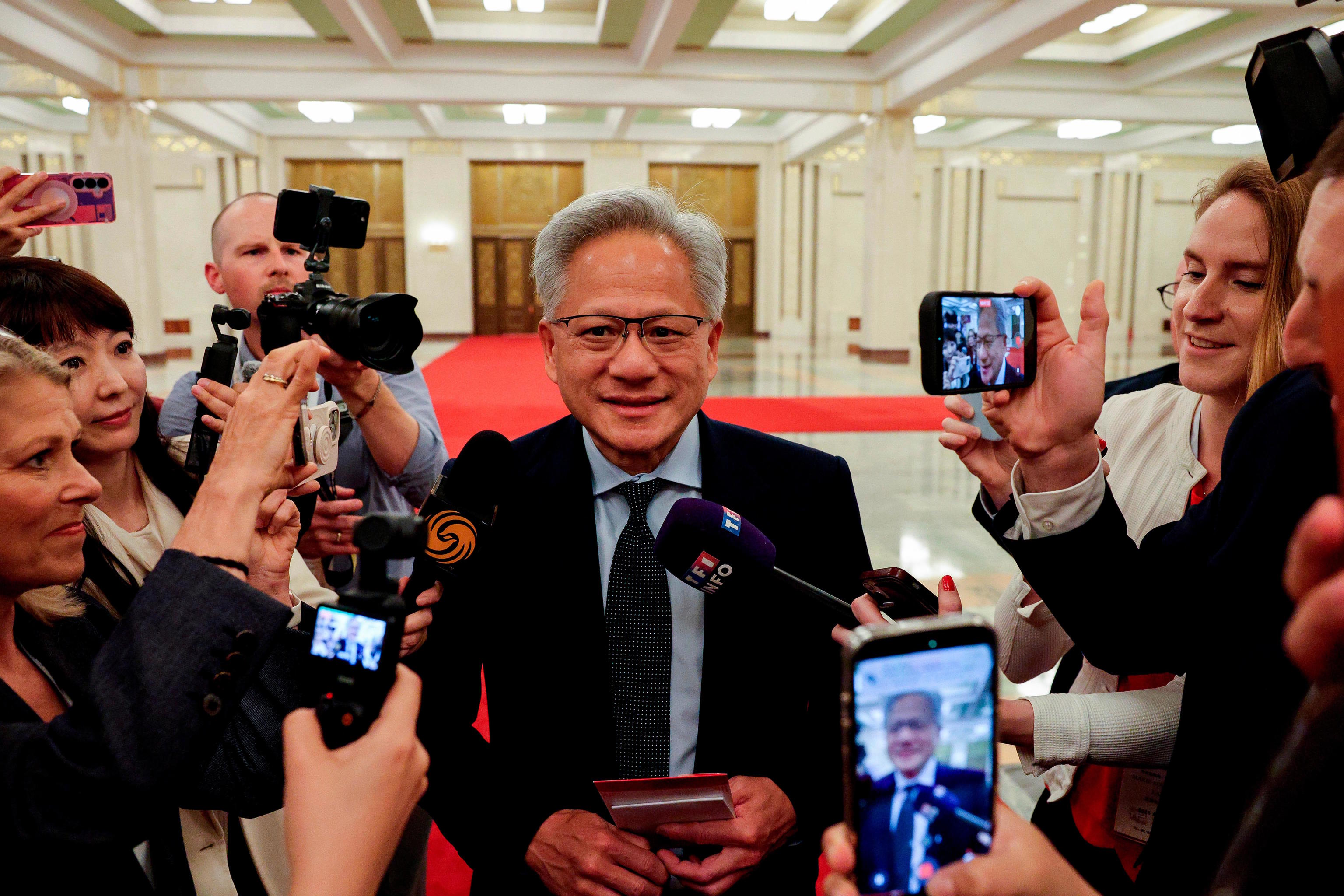
Jensen Huang, CEO, chairman, founder, and the man who turned a chip company specializing in video games into the world's most valuable company, surpassing five trillion dollars, has been forced to resign from all his positions at Nvidia this Thursday after a series of scandals involving his infidelities, including a relationship with an alleged Chinese spy, has cost the company almost a third of its value in the last month.
Additionally, a Republican senator confirmed this Thursday that Huang has been summoned to testify before U.S. lawmakers. "Recent reports raise serious concerns about our national security and the protection of sensitive U.S. technology. I am requesting that Nvidia CEO Jensen Huang and Secretary of Commerce Howard Lutnick testify before the Senate Banking Committee," wrote the committee's chairman, Tim Scott, on X.
The Board of Directors, which forced his exit less than 24 hours after U.S. media revealed a second extramarital affair, notably with a company executive, announced that Colette Kress, the CFO, will assume the role on an interim basis while a replacement is sought. "Jensen's contributions to Nvidia are monumental. Nvidia is one of the most influential tech companies in the world. The Board and the company thank Jensen for his invaluable contributions to the company and the industry," the statement reads in a sterile tone. A lifetime dedicated to the company he built, making millionaires of many who now close the door, dismissed in two cold lines.
Huang's departure, whose children and even his son-in-law hold significant positions, went from being unthinkable to unavoidable. In five years, he has become a global celebrity, the face of the race ignited by Artificial Intelligence. He has created an iconic look with his leather jackets, reminiscent of Steve Jobs. He is an idol in his native Taiwan, signing autographs at conventions worldwide, his talks sell out quickly, and his podcast interviews have millions of downloads. He regularly speaks with Trump and is the only person whom figures like Elon Musk or Larry Ellison of Oracle plead with to accept their money and provide more chips. With over 3.5% of the shares, he is the largest shareholder. And there is absolutely no obvious, suitable, or natural replacement.
President Trump, who described the businessman as "an honorable person" earlier this week and maintained ties even after being informed months ago of espionage suspicions, has proposed a name. "Now that Nvidia CEO Jensen Huang, who has done a fantastic job, has resigned, there is only one man to take his place: Tim Cook of Apple. A legend replaces a legend!", he wrote on social media.
The shockwave he has caused is immense. On Wednesday night, a holiday in the U.S., Nvidia's shares plummeted by up to 12% before the market opened. When Wall Street, highly sensitive to anything related to AI, reacted, losses rose to 14%, before stabilizing around -10%, an unsustainable destruction of wealth. The scandal of the second infidelity was the final straw, but what led to his downfall was the long-standing relationship with Alice Huang, a senior executive at Megaspeed, a data company based in Singapore and one of Nvidia's most important clients. The story emerged months ago but had little impact until it was reported weeks ago that U.S. intelligence agencies believed the woman worked for Chinese intelligence and had been influencing him and his decisions.
That someone with such wealth, power, contacts, and influence in U.S. politics in recent years was so exposed to Beijing was unacceptable. The blow to Nvidia is enormous for many reasons. Huang has been the brain behind the strategy, responsible for all the successes and the bet on AI. His figure is also the reason many of the major Asian players in the semiconductor business have invested in the U.S. and are building plants. His personal relationship with suppliers, especially in Taiwan, is impossible to replicate with another CEO.
Likewise, the scandal and his exit have huge repercussions in the ongoing debate about export control measures that will be included in the National Defense Authorization Act (NDAA). Upcoming bills include the AI Oversight Act, the Chip Security Act, and the MATCH Act, all aimed at limiting the flow of advanced chips to U.S. adversaries. Huang had been the most successful lobbyist against tough measures, but everything that has happened strengthens the arguments for U.S. lawmakers to seek stricter restrictions on China's access to advanced AI chips, coming just days before the scheduled meeting between President Donald Trump and Xi Jinping.
The case leaves many unanswered questions far beyond corporate management. This Thursday, the Singapore government lamented that U.S. authorities had not been very helpful in investigating Alice Huang's role. They explained that the Asian country confiscated the Megaspeed executive's passport, preventing her from leaving the country between June 2025 and February this year. In the end, they returned it with a "stern warning" and prohibited her from re-entering Singapore. According to their account, by then President Trump had already been informed of the Nvidia founder's relationship and the suspicions that he was a Chinese intelligence agent.
Last May, Trump traveled to Beijing to meet with the Chinese president. During the flight, Secretary of State Marco Rubio informed him of the intelligence suspicions, but the evidence did not prevent Trump from including Huang in the trip or treating him as a key advisor for meetings with Xi. Neither then nor afterward did Trump take action or sever ties with Huang, who had donated 25 million dollars for the construction of his long-desired ballroom in the White House. The New York Times has reported that Taiwan began monitoring the alleged spy Huang in 2024 under the direction of the U.S. government, then under Joe Biden.
Complaints from the Asian country point to the U.S. administration in more areas. Singapore claims it contacted Supermicro, a U.S. manufacturer that integrates Nvidia's AI chips into servers for data centers (and is implicated in several investigations regarding chip smuggling to countries that should not receive them), but the company, which in turn is a supplier to Megaspeed, refused to cooperate. Therefore, they requested the intervention of the U.S. Department of Justice and the FBI, no less than in July 2025. "Despite these repeated requests, Singapore has received limited information or assistance regarding the company to date," the statement released this Thursday notes.
There is another angle. According to Axios, at least three different occasions—in May, August, and November 5—Trump approved taking action against the alleged diversion of Nvidia chips to China. "But Secretary of Commerce Howard Lutnick and his deputy Jeffrey Kessler resisted pressure from Bessent and others to act. In May, a highly classified memorandum warning about Jensen Huang's relationship with Alice Huang was shared with the president and other officials. In a subsequent meeting, Bessent, National Intelligence Director Jay Clayton, Hegseth, and White House officials pressed Lutnick and Kessler to act, according to the source, 'but they refused'." This allowed Megaspeed, and ultimately China, to access chips worth over 5 billion dollars.
The Information has reported in recent hours that companies linked to Alice Huang have recently invested in DeepSeek "so that the Chinese AI lab could receive a steady flow of Nvidia Blackwell chips, the sale of which is prohibited to China. Alice Huang's companies invested through special purpose vehicles, and as a result, do not appear directly on DeepSeek's shareholder list."