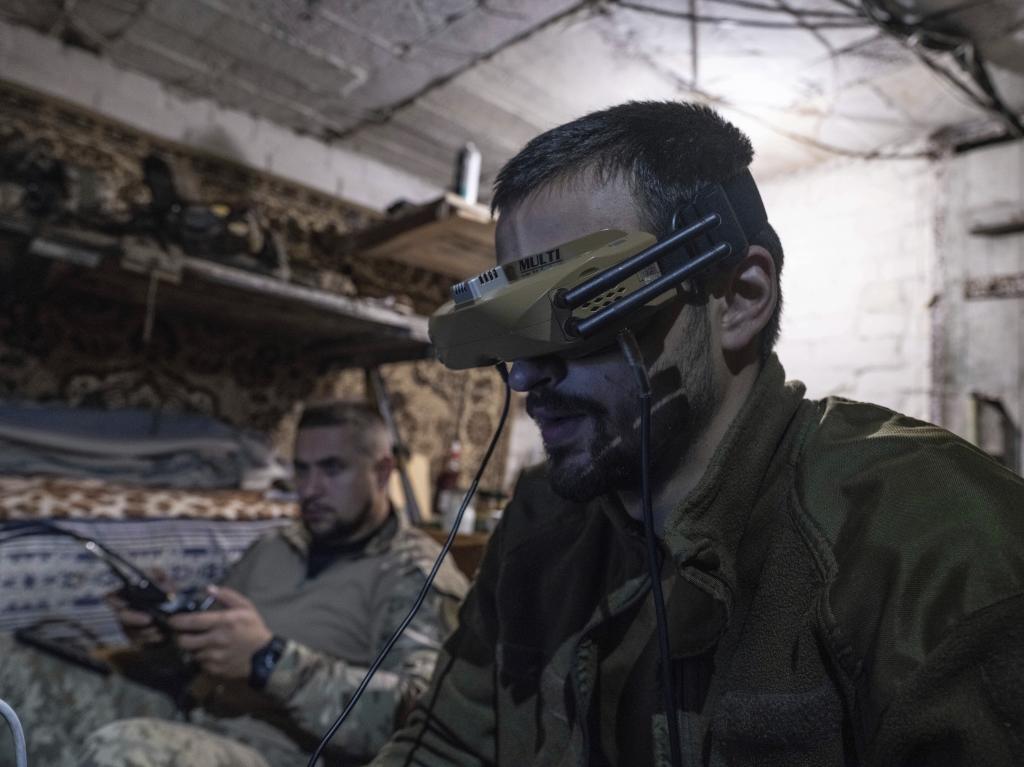
The first information journalists receive directs them to a specific city at a certain time. Once they confirm their arrival, they are given a location: a desolate parking lot where no one is waiting for them. Only a few minutes later, a van appears with windows covered by black curtains.
"Please, you must give us your phones, watches, and any device that has GPS," explains one of the interlocutors. The devices are placed in a plastic bag. It resembles one of those Faraday bags that block electronic signals.
After a ride in the vehicle without being able to discern the route, the door opens in an underground parking lot that leads, after passing through several security doors, to another chamber also below ground.
"This is one of our command and control centers", indicates the young spokesperson for Magyar Brovdi, head of the Unmanned Systems Forces of the Ukrainian Armed Forces (USF).
The complex is filled with computers and plasma screens, as well as works of art. Brovdi admits to being a devotee of painting and sculpture. In fact, he has sponsored an art foundation in his name since 2017. The artistic creations—he has so many that several paintings are stacked against a wall in his office—intermingle with military paraphernalia, including two large Russian Shahed drones and several anti-tank missile casings.
The security measures surrounding Robert Yosypovych Brovdi—Magyar ("Hungarian") is just his nickname, referring to his origin from that minority in the west of the country—are justified by a simple axiom: he is one of the most sought-after Ukrainian military leaders by Russian intelligence services.
Last March, he was sentenced to life in prison by a Russian court, and the newspaper The Wall Street Journal reported that Moscow is offering $20 million for information on his whereabouts.
At 51, Magyar commands a dozen elite units that represent "2.5%"—he says—of the 800,000 to 900,000 Ukrainian soldiers, "but we kill one in every three" Russian soldiers fallen in this war.
For Brovdi, numbers are everything. "Mathematics," he says. "Everything we have built is based on mathematics." Another legacy of his previous life. Before donning the uniform, he earned a degree in Business Economics in his hometown, Uzhorod. He later became a successful grain trading entrepreneur.
software system I used in my business for tracking grain, transportation, logistics, and the ships [that exported it] and crop varieties."
Instead of grain, he began crunching numbers with drones. "The system started doing calculations for us, generating the necessary models to plan and analyze this revolution."
The term he uses—"revolution"—is not an exaggeration. It is enough to remember that many of his subordinates, with the rank of lieutenant, now lead brigades with thousands of men. "Something unthinkable in the Soviet era," he adds, when that position was reserved for generals. Brovdi himself is just a commander and leads one branch of the Armed Forces.
To emphasize his attachment to calculations, he displays the screen of an iPad showing real-time accounting of his forces' operations. On the table, there is also a white counter that tallies the dead. These are the Russian soldiers his forces eliminate every few minutes. It was 222 at the beginning of the conversation. By the end, two hours later, the device read 281.
The entire setting of the underground complex is as atypical as the USF. Brovdi has the typical machine gun in his office, but also one of those pinball machines that became iconic in the 70s. A gift from his family. The bathrooms look like they are from a boutique hotel. Scented and with stacks of small blue towels, perfectly arranged.
The military keeps another memento on one of the shelves. The drone that fell beside him without exploding. It happened in 2023, in the Donbas region, in eastern Ukraine.
The rules for enlisting in the forces under his command are as strict as his surveillance system. Alcohol is prohibited, and candidates must pass a polygraph test before being accepted. His own wife, Natalia—nicknamed Kryla ("wings" in Ukrainian)—is responsible for analyzing the results of the lie detector. "Nothing escapes her," Brovdi notes with a smile.
The couple has been married for 30 years. They both enlisted together in 2022. "She is responsible for security protocols. Thousands of soldiers have passed through her unit [to undergo her control system]," he adds.
An hour later, the commander will abruptly interrupt the conversation to refer to another being that constitutes a vital reference in his existence. "Let's talk about cats," he proclaims with another chuckle. "The main cat in my life is Mavic 13" [the name of a well-known Chinese drone]. Brovdi may be one of the most feared military figures by the Russians, but he admits with irony that he is "subdued" by his wife and his cat.
The military conglomerate led by Brovdi is as peculiar as its chief. He claims that 95% come from the civilian sector. They were not military personnel before 2022. "It is precisely this phenomenon that makes us strong. We have come this far thanks to a brain and collective intelligence."
When Brovdi joined the Territorial Defense forces—which were made up of volunteers in those early days—the systematic nature of their current operations was not even imaginable. He describes those days as very "disorganized" and admits they suffered "considerable losses."
The background of his subordinates, many of whom have management training, led them to quickly identify "errors and propose solutions." "When the invasion began, we were only given kalashnikovs [assault rifles] and shovels, so we decided to model the battlefield with our own hands and brains. The first step was to build a drone to observe enemy positions. The next was a logical evolution. We attached a bomb or a grenade," he recalls.
The Magyar Birds—that was the name of his initial unit—was established in the spring of 2022. At first, there were 27 men. They fought in the Battle of Kyiv. Later, they moved to the front in Kherson, in the south of the country. Over time, they would fight in the bloodiest confrontations of this conflict: Bakhmut, Pokrovsk, Krinki, or the invasion of the Russian territories of Kursk and Belgorod.
Ukraine became, in February 2024, the first country in the world to add a fourth branch to the traditional ones that have shaped European Armed Forces since the early last century: the aforementioned Unmanned Systems Forces. In June of last year, Brovdi took command of the USF.
Initially, however, the commander acknowledges that they had to somewhat challenge the Soviet legacy in which local uniformed personnel had been trained for decades.
"From the very first moment, we acted completely outside the system [military]. We did not wait for authorizations from the central command; as soon as we saw something working, we began to use it and deploy it on a large scale. And if it worked [the commanders] were forced to make it the norm."
Magyar's drone operators began experimenting with tasks entirely outside their official remit, he notes. They specialized in intercepting and analyzing electronic signals and communications, as well as in disciplines like mine-laying—tasks typically reserved for combat engineer units.
Magyar's subordinates have a knack for improvisation. Their expertise in mine deployment, he recounts, came about by chance: a Russian Tornado rocket landed in the Dnipro River but failed to detonate.
"It's a rocket designed to scatter anti-tank mines. My team went into the river and opened it up; it was packed with PTM-3 mines. Once we discovered all that junk, we were dying to send it right back to them. Google lent a hand. The mines' built-in timers were set to detonate after a few hours, so we removed them and replaced them with a new design—created by our own engineers—that kept the devices active for up to 30 days. We mounted one on a drone and sent it back to the Russians."
The operation was a complete success, and Brovdi received a decoration. From there, they began replicating the device's design in their own workshop. To secure a supply of explosives, they continued dismantling munitions found on the battlefield or those left to rust in storage depots. "We've produced over a million of them," he notes.
The Russians eventually discovered that "Magyar's Birds" were attacking them with copies of their own mines. "So, we started camouflaging them—hiding them inside a jar, an old shoe, or even the carcass of a dead cat lying on the road."
This initiative eventually led to the creation of an official "demolitions" expert role within every unit of the Ukrainian Armed Forces. This task was complemented by the work of technicians who designed these types of devices, distinct from standard-issue ammunition.
"We don't use regulation-issue ammunition. Right now, we are producing over 100,000 units [explosives or mines] across 50 different types, adapted for various drone models. All of this is yet another example of how the system must adapt."
His penchant for statistics leads him to be completely open even about the casualties sustained by the 12 units operating under the USF umbrella. "They account for 0.38% of the total [casualties within the Armed Forces]. As for my own brigade—'Magyar's Birds'—we have lost 84 men. Over the past two years, they have eliminated 64,500 enemies. So, for every one of our men who died, they have paid the price with approximately 750 of their own soldiers."
-Every Ukrainian military officer I've spoken with has pointed out that the primary danger their forces face in the near future is the deployment of the "Rassvet" satellite system, which would grant Moscow capabilities on par with those that Starlink provides to your side. Do you agree with that assessment?
-Russia has virtually unlimited access to technology and components from China. And let's be realistic: by using alternative mechanisms, they can even secure suppliers from allied nations. It is a real and enormous threat—though I'd prefer not to go into specifics.
For months, Brovdi has been sounding the alarm about the lag he perceives in the Western strategy for addressing this new era. He believes that while the West has finally grasped the monumental challenge at hand, it remains unable to adapt to the pace of the change we are witnessing.
"They are preparing for the wars of the past. Warfare has shifted so radically that it is a profound error—a completely misguided notion—to believe that being prepared for a previous type of conflict will be of any use. It's not a matter of lacking technology or funds; fundamentally, it's about the speed of decision-making. It comes down to the ability to adapt rapidly and to update one's approach as the nature of the challenge evolves," he remarks.
The officer is fond of using analogies drawn from the world of art. In this instance, he refers to the legend surrounding Pablo Picasso's father, who—upon discovering his 13-year-old son's talent after asking him to finish painting the legs of a dove on one of his own canvases—decided to symbolically set aside his own brushes. "NATO needs to reform its doctrine. There are turning points when it becomes necessary to abandon what is becoming obsolete. They must move past old paradigms, such as the dominant role of tanks. Asymmetric tactics demonstrate that all these highly expensive weapons are vulnerable. In this war, more than 90% of targets have been eliminated by drones," he adds.
The conversation touches upon recent military projects by superpowers like the United States. A prime example is the announcement made by President Donald Trump in December 2025 regarding the construction of a fleet of nuclear-capable battleships, with a total cost of $275 billion.
"No matter how powerful a vessel may be, actual combat has shown that it can be destroyed with relative ease using asymmetric methods—specifically, Ukrainian drones. This has been clearly demonstrated in the Sea of Azov and the Black Sea," the commander notes.
According to the Ukrainian General Staff, their drones and missiles have, to date, sunk or damaged at least 35 warships of various types, as well as two submarines—including the flagship of the Black Sea Fleet, the cruiser *Moskva*, which went down in April 2022.
But the Ukrainian qualifies his statement. He clings to irony. "I'm not here to sell you drones," he clarifies. His vision of the future conflict combines traditional weaponry and unmanned systems. "The future belongs to whoever manages to combine those two elements into an effective system. It's like an ecosystem."
The decor in Magyar's office in the bunker includes scale models of the sculptures he has purchased to create an art park he cannot visit. "I have them here because I can't go see them," he says with a hint of resignation.
For Brovdi, art, his family, and "Mavic 13" seem to be the final anchors in an existence that forces him to remain in hiding for most of the day.
He is not your typical soldier. In fact, he refers to "Rambo-style" soldiers with a certain disdain. He may well be—as a local media outlet described him—the "man who changed the way war is waged," but he is fully aware of the risks inherent in the very technological system he is championing. "Imagine approaching the Sagrada Família with a drone. You wouldn't be stopped—unlike if you were carrying a firearm. That's a problem, because a drone can fall into anyone's hands without triggering any alarms. When you look at a drone, you can't tell what it's doing; you don't know if it's just filming the Sagrada Família or if it's about to kill people and sow panic. Drones are the scourge of the third millennium—especially when you consider the growing influence of artificial intelligence," he concludes.