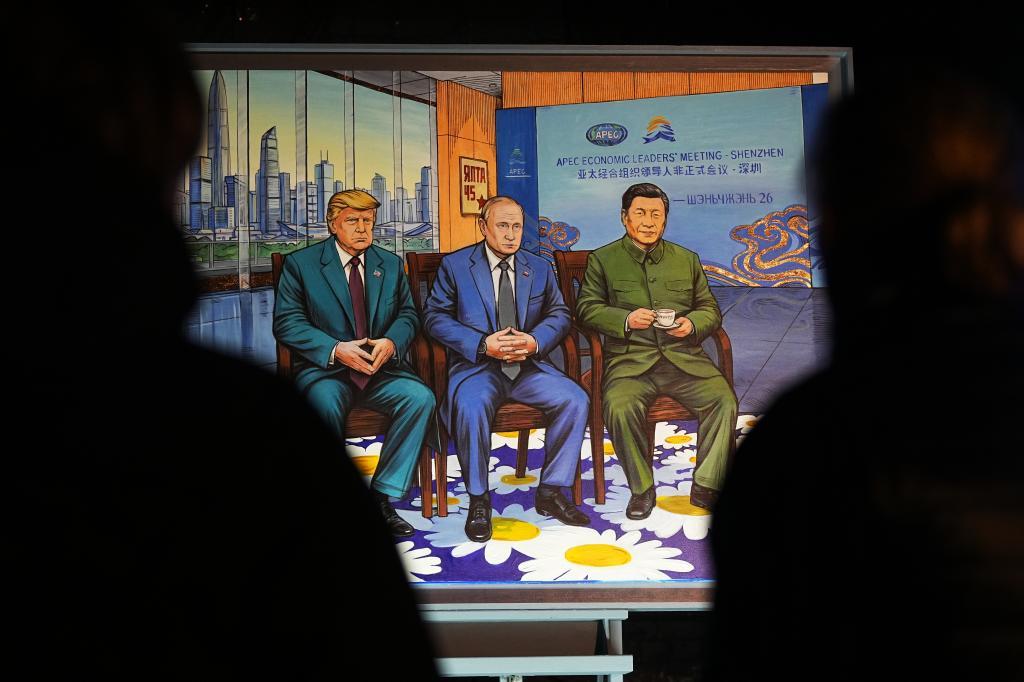
Donald Trump, Xi Jinping, and Vladimir Putin will meet privately next Thursday on the sidelines of the Asia-Pacific Economic Cooperation (APEC) summit, which is being held in Shenzhen, China's tech hub. Although brief, informal, and not expected to lead to any significant decisions or agreements, it will be the first meeting of the heads of state of the three major nuclear powers on the planet and comes at a time of chaos, uncertainty, and repositioning of international relations.
In mid-October, the Russian leader proposed to the American a sort of re-edition of the Yalta Conference, the legendary 1945 meeting where Stalin, Churchill, and Roosevelt began to outline a map for the world after World War II. The Kremlin's suggestion, which aimed to sidestep the Ukrainian issue without the presence of Volodymyr Zelensky, envisioned a division of the globe into something resembling spheres of influence, as The Wall Street Journal reported at the time. However, the proposal did not resonate in Washington or Beijing. Not directly, at least.
The three-way formula, however, will take place, as confirmed by the White House on Friday. Ukraine will not be on the agenda, but the Iran war and the aspiration for a possible, albeit very unlikely, trilateral agreement on their nuclear arsenals will be discussed. The nuclear issue has been one of Trump's major obsessions (and fears) since the 1980s. The last agreement on the matter between Russia and the United States, New START, expired in February, effectively removing for the first time in over half a century the limits on the two largest nuclear arsenals. At that time, Washington rejected the Russian proposal to simply extend it for another year and announced that it would seek a "new, improved, and modernized" agreement that included China.
According to White House sources, the Shenzhen meeting will not yield any results; the process is far from that. But it could be a starting point. China's arsenal, with over 600 nuclear warheads, according to Pentagon estimates, is much smaller than the arsenals of the United States and Russia, each estimated to possess over 5,000 warheads, according to AP. It is precisely because of this enormous imbalance that Beijing has had no interest in discussions about a nuclear pact that would entail reductions in absolute or relative terms, and it hopes to reach 1,000 warheads by 2030.
During Trump's second term, the United States has moved away from a more or less liberal global leadership strategy that had traditionally guided its foreign policy in favor of a model based on the division of spheres of influence among major powers. Trump is very comfortable with Putin, Xi, Erdogan, or Modi, but not with Europeans or Canadian Mark Carney. He likes strongmen, raw power. That is why he has adopted a policy of pressure and force, especially in the Western Hemisphere, where he resorts to threats and intimidation, particularly against his neighbors and allies, while appearing willing to grant Russia and China greater leeway in their respective spheres of influence.
This shift is accelerating the formation of a new tripolar international order, where strategic interests and ambitions of major powers prevail over the rules, principles, and institutions that upheld the international system that emerged after World War II. Few words summarize this better than those spoken on Friday night by Secretary of State Marco Rubio at a dinner organized by the leading conservative legal association in the U.S. Speaking about the International Criminal Court, and quoting Pompeo, he said: "If they are foolish enough to try to impose their decrees on paper on Americans, our response will likely be the same as that of the Roman general when he told those trying to invoke the laws of their city against his legions: 'Stop citing laws to men with swords.'
That said, each party has different objectives for the meeting. For Trump, it is an opportunity to continue trying to build a personal relationship with Xi (this will be their third face-to-face meeting this year), one of the few on the planet who has stood up to him, does not yield to his threats and sanctions, and maintains distance. They will discuss rare earths and minerals. But to avoid friction, the White House assures that the president will not bring up the topic of possible espionage involving Jensen Huang, former CEO of Nvidia, due to his mistress, whom U.S. intelligence considers an agent of Beijing. Likewise, the Republican president has been claiming for a decade that no one understands Putin better than he does, and that they have a special and deep relationship of trust, so he will want to project an image of understanding and good rapport.
For Moscow, a scenario where the rules of a global order are set without the EU present, and Ukraine has no voice, is ideal. Putin continues to court Trump while trying to destabilize his neighbors and break the alliance that bothers him the most, NATO. Anything that creates new forums that weaken the architecture of the current international system benefits him.
Kremlin spokesman Dimitri Peskov has mocked references to Yalta, stating with admirable audacity that his vision is one where "no one attempts to impose a particular vision of it, and that it must be based entirely on mutual benefit and respect." All while the documents distributed this week by Russia during negotiations with Trump's envoys (one of whom is his son-in-law) demand the withdrawal of NATO troops to the positions they occupied in 1997 or even toy with the possibility of Finland exiting the Atlantic Alliance.
China, for its part, is in a delicate and intermediate position. Its bet (especially for a very nuanced multilateralism) is more long-term, but it may now see the opportunity to strengthen its global role a step beyond mediation. It does not want to be dragged into either side, nor alienate those who buy its products around the world. But it also does not want to remain in the background indefinitely.
The trilateral summit, even if it lasts only two hours on the sidelines, will inevitably overshadow the APEC meeting. All reports will focus on that, overshadowing an event that brings together 21 economies and aimed to be the grand showcase for China to showcase the development of one of its most modern cities, a global tech hub that was just a few decades ago a small fishing village. The U.S. will not send a business delegation, but Elon Musk will accompany the president.