The cyberwar has arrived in Europe. In just five years, since Russia invaded Ukraine, the possibility of large disruptive attacks on the daily lives of countries has shifted from a theoretical possibility to, first, a source of isolated incidents and, since October, a daily reality on the continent.
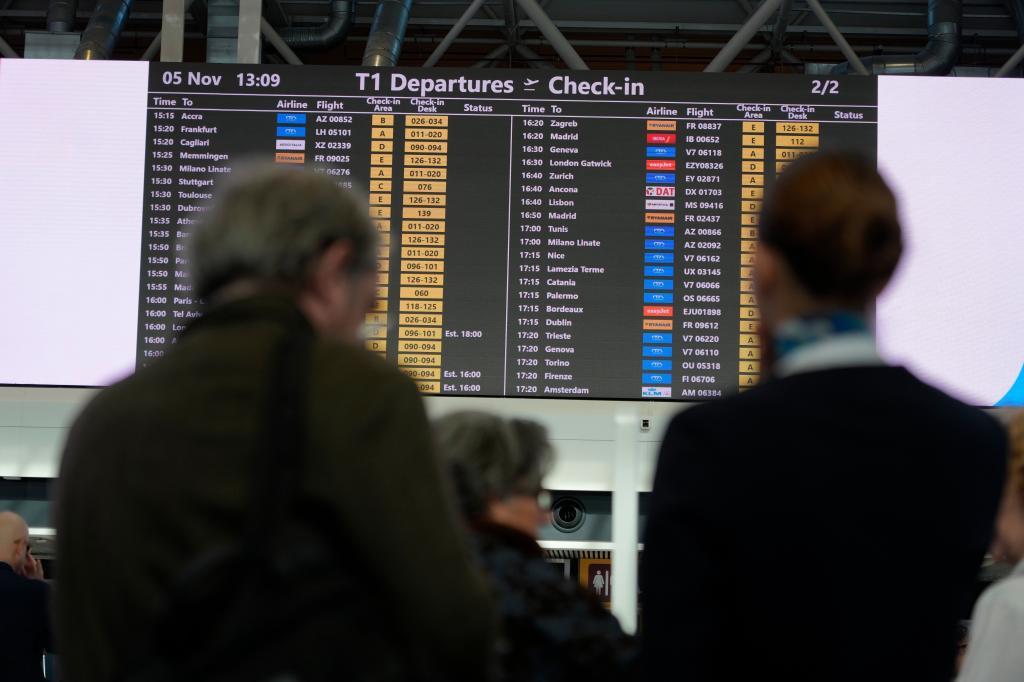
After two major cyber-actions against supermarkets and blood banks, the last week has seen an unprecedented 'online' offensive in at least a dozen countries, primarily consisting of false bomb threats to targets unrelated to defense or security, but central to the daily life of any modern society. Among the targets are at least 34 domestic flights in Europe, a minimum of 7,600 schools, media outlets, train stations, hundreds of supermarkets, and even three blood banks.
Several EU governments have attributed these actions of genuine 'low-intensity cyberterrorism' to Russian, Chinese, and Iranian groups: three totalitarian countries where it is impossible for any criminal organization to carry out such actions without the blessings - if not the active collaboration - of the states. Moscow, Beijing, and Tehran also collaborate very closely in the wars in Ukraine and the Middle East.
The cyberwar is thus a reality. This includes the advice given to the UK population on October 22 by Jan Darvis, the Secretary of State for Security, to stockpile enough food and water for three days. Darvis did not justify this demand due to fears of a conventional military operation, but rather a cyberattack that could suspend the basic services a country needs to function.
Attacks have actually been occurring since 2022, when Russia attempted to soften Ukraine's resistance in the days leading up to the invasion. However, their intensification is forcing European countries to adopt more aggressive measures to defend their critical facilities from online assaults. As the threat grows, the UK - the European power with the most overtly hardline stance towards Russia - has begun to publicize a type of cyberwarfare activity that unsettlingly brings these conflicts closer to the real world: 'hunt forward' operations, a term difficult to translate into Spanish, but whose equivalent could be "advanced hunting," or the more faithful, yet more convoluted, "hunting ahead."
These operations involve the deployment of specialized cyberwarfare and electronic warfare soldier groups to countries suffering from these attacks - like Ukraine - or even behind enemy lines. The first option increases the effectiveness of allied countries' defenses and also brings the online battlefield closer to the enemy's operational centers. Operating in hostile territory multiplies the chances of carrying out preventive or retaliatory actions and opens new avenues of access to the adversary's systems. Because not everything in cyberwar is virtual. Geography matters enough for armies to accept the risk of violating state sovereignty.
"To access Wi-Fi networks, one must be physically close to the buildings where they are operating," explained Tim Stevens, a professor of International Security at the British university King's College, to this newspaper yesterday. And those networks have already been victims of attacks. In 2018, Russian intelligence parked a car full of electronic systems next to the building in The Hague that houses the multilateral organization for the Prohibition of Chemical Weapons (OPCW), aiming to access its Wi-Fi network. The attempt failed due to police intervention. Four years later, Russian cyber-spies managed to access the Wi-Fi network of an organization in Washington whose name has not been disclosed using devices placed in the adjacent building, according to the security firm Volexity. In Ukraine, Russian agents have managed to interfere with Wi-Fi networks simply by approaching the buildings where they are located.
However, as far as is known, these advanced teams typically remain in allied territory - in the current case, in countries like Ukraine or Moldova - often near the Russian border. This offers two advantages. On one hand, geographical proximity. On the other, the ease of defending the host state's systems. "It's much easier to monitor or protect a network when you are physically inside the building where the systems of that network are," adds Stevens.
These operations represent an escalation in Europe's defensive cyberwarfare, as they bring the conflict right into Russia, something NATO has considered, but which seems politically almost impossible. Their presence in war-torn countries, like Ukraine, also has the advantage of being as effective as sending a brigade of tanks or a squadron of fighters, but without triggering any political tension simply because no one sees those soldiers. And the UK, which had admitted years ago that it was conducting such operations, has recently even publicized them, with a lengthy interview with its top military official, Major General Mike Fayers, commander of the Cyber and Electromagnetic Defense Force, published last Monday by the conservative newspaper The Times. The article implies, though not explicitly, that the 'cyber soldiers' have operated within Russia.
"As far as I know, the UK is the only European country that has acknowledged conducting 'hunt forward' operations," explained Jamie MacColl, a researcher at the London-based think tank RUSI, the world's oldest security and defense studies center, in a phone conversation. The only other NATO countries that have carried them out, he explained, are the United States and Canada. According to this expert, the Netherlands, Nordic countries, the Baltics, and Poland also have the capabilities to send specialized electronic and online warfare troops to third countries and operate from there. Numerous reports also point to France, which may also have forces in Ukraine. Although the technological supremacy of the United States in this area is undeniable, both Stevens and MacColl agree that Europe can carry out these operations without support from Washington. "The American superiority is mainly in Intelligence, not in technical capabilities", explains Stevens.
These operations are conducted by countries individually, although there may be collaborations decided on a case-by-case basis. According to MacColl, NATO does not carry them out, "due to the defensive nature of the Alliance." The EU body known as the Rapid Cyber Response Centers, coordinated by Lithuania, does have a more proactive attitude, although again, knowing the real extent of these operations is virtually impossible. In Stevens' words, "as far as we know, there is no 'European' plan. Each country decides whether they want to do it or not."
In any case, the mere existence of hunting forward operations, combined with the almost daily wave of cybersabotages, seems to confirm the statement by former MI5 director, British counterintelligence service, Eliza Mannigam-Buller, who said last September: "It could very well be true that the UK is already at war with Russia."