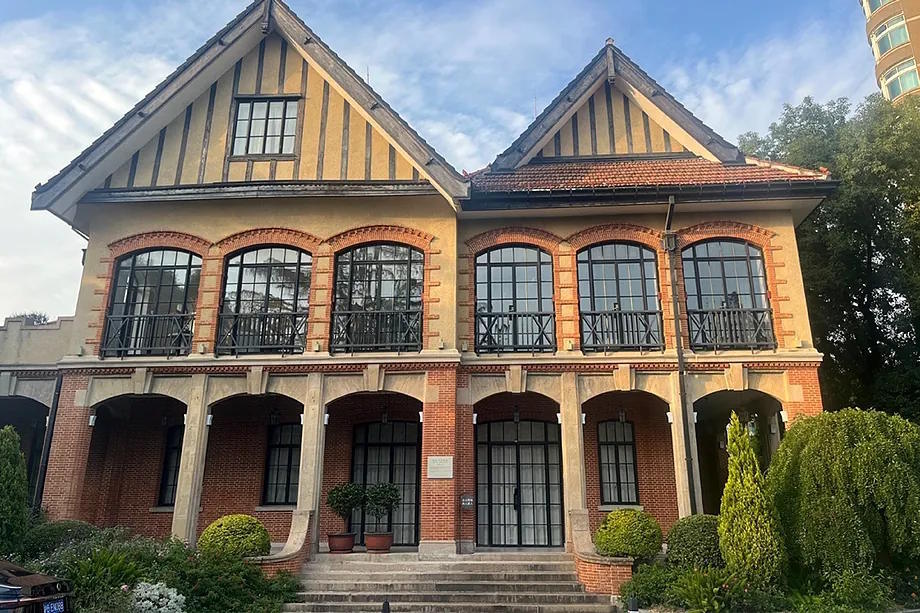
Hidden among the century-old gardens of Shanghai is a mansion that seems frozen in the golden days of the colonial era. It features sloping roofs of reddish tiles, two large pediments crossed by dark wooden beams, and a cream-colored facade with large windows framed in red brick. Its architecture resembles the elegant residences of the English countryside. Few would suspect that this tranquil corner of China's financial capital holds a connection to the international scandal over possible espionage currently shaking Nvidia, the American giant that manufactures the planet's most coveted chips.
The mansion, which for decades was linked to foreign fortunes dominating Chinese trade, recently hosted an exclusive private club where a 42-year-old influential businesswoman named Alice Huang welcomed investors, financiers, and tech magnates. She is the same woman now under suspicion from U.S. intelligence: she is believed to have been recruited by Chinese intelligence to spy on Jensen Huang, the founder of Nvidia, with whom she had an extramarital relationship.
"You are not the first one asking about her these days. People from the Government and the Police have also shown interest in her activities," says a source linked to Shanghai's financial clubs. "I don't think she is a spy as some reports suggest. I remember that in investor meetings, her husband and partner was the one who took the lead."
The man referred to by the source is Kang Wei, a 51-year-old Chinese financier who plays a key role in this story. He was the one who introduced Alice to the founder of Nvidia. According to people close to the couple, Kang knew that his wife was having an affair with Jensen Huang (63 years old). Far from being uncomfortable, he boasted to his circle about Alice's "close relationship" with the Taiwanese-American billionaire. That connection with one of the most powerful men in the tech industry also served as a lure to attract investors to his AI businesses.
The club where the couple hosted entrepreneurs and potential investors occupied one of the mansions in Xingguo, a complex located in one of the most elegant areas of the old French Concession of Shanghai, next to the current Radisson Collection hotel. The club has already closed its doors, but its story opens a window into one of the most secretive worlds of the city: the circles where great Chinese fortunes negotiate million-dollar investments, cultivate political contacts, and weave international alliances away from the spotlight.
In those meetings, Alice and Kang sought to attract capital for their tech businesses, primarily centered around two companies: Hexi Capital, a fund management firm founded by Kang in 2010 —Alice has been listed as a co-owner since 2026— and specializing in investments in tech companies; and Megaspeed, a Singapore-based firm that had moved away from video games to enter the AI data center business.
Businesspeople who knew the couple say they had been making their way into the city's most exclusive financial circles for over a decade. Kang also frequently appeared in the Chinese press as an economic analyst. However, his rise was marked by several scandals. Chinese regulators sanctioned him for irregularities in stock operations and for hiding information about his business holdings. His legal troubles went beyond fines. Earlier this year, he was detained in Shanghai, accused of manipulating the stock market, a practice that involves altering stock prices, for example, through coordinated buying and selling operations. Kang was released after the summer.
Alice's career, known in China as Huang Le, began as a reporter at a provincial television station before she jumped to CCTV, the state broadcaster. She then traded television studios for high finance offices. She moved to Hong Kong, where she studied communications, and began to carve out a path in the banking sector. Her professional profiles place her first at HSBC and later at CITIC Securities, one of China's major financial groups. However, Chinese and international media that have tried to reconstruct her trajectory have been unable to verify all the details of a biography filled with gaps.
Her major business leap came in 2023 when she participated in the purchase of 7Road International, a video game company based in Singapore, through a company registered in the British Virgin Islands, a well-known tax haven. The company was renamed Megaspeed and pivoted towards AI. Under Alice's leadership and with Kang's backing, it began acquiring thousands of Nvidia processors to install in large data centers in Southeast Asia and lease their computing power to companies, including Chinese firms. The business capitalized on an opportunity opened by Washington's restrictions: while the U.S. sought to prevent China from purchasing its most advanced chips, Chinese companies could access its processing capacity remotely, using servers installed in countries like Singapore or Malaysia.
According to an investigation by the private intelligence firm Tesari, the businesswoman and her husband were linked, through Hexi Capital, to a chain of companies that would have allowed Huawei to access the computing power of Nvidia processors. In other words, to use the capacity of those chips to develop artificial intelligence without needing to purchase them directly.
In early 2025, the couple organized several meetings at the Shanghai club to raise money from Chinese investors to finance data centers in Southeast Asia. Their main pitch was exclusive access to Nvidia. They also boasted of business ties with Alibaba, one of China's largest tech giants.
Megaspeed's growth was meteoric. According to the Financial Times, its balance sheet went from about $33 million to nearly $3 billion in 2024. Between June of that year and February 2026, a subsidiary of the company in Malaysia imported Nvidia technology equipment worth at least $4.8 billion.
But that business began to raise suspicions in Washington. U.S. investigators were trying to determine whether some of those processors had physically ended up in China, circumventing the export restrictions imposed by the U.S. An investigation published by The Information claims that the businesswoman leveraged her contacts with Nvidia to facilitate access to about 240,000 chips of the most advanced models for Chinese companies.
Singapore also opened an investigation into possible irregularities in the trade of Nvidia chips. Alice was detained and spent much of 2025 unable to leave the country after authorities revoked her passport, which she recovered in February 2026. Last Thursday, the Singapore Ministry of Home Affairs announced that she had been banned from returning to the country for providing "inaccurate information" to the police and attempting to downplay her role in Megaspeed, although authorities clarified that their investigation did not address espionage suspicions.
While her businesses were under scrutiny from Singaporean and U.S. authorities, the Chinese businesswoman maintained a close relationship with Jensen Huang, documented in several photographs. In December 2023, they posed together at an Italian restaurant in Singapore. In June 2024, they met again at a tech executives' meeting in Taipei. In May 2025, Taiwanese television cameras captured gestures of complicity between them during another dinner in Taipei. And in January 2026, Alice herself posted on her social media a photo of her toasting with red wine alongside the Nvidia founder at a restaurant in Shanghai.
Everything exploded at the end of October when the New York Times revealed that U.S. intelligence suspected Alice of providing information to Beijing. Subsequently, that newspaper and the Financial Times published new details of a confidential report that had circulated among senior officials in the Trump Administration. According to that document, the Ministry of State Security (MSS), China's main espionage agency, had recruited Alice to obtain strategic information. The FBI has been investigating Huang's extramarital relationship with Alice for at least a year.
The revelations triggered an unprecedented crisis at the top of Nvidia. Huang, married and a father of two, publicly acknowledged his infidelity, while the company announced an independent investigation to determine whether its founder had been the victim of a foreign espionage operation. The case worsened when it was revealed that he had two other extramarital relationships with Nvidia employees. The pressure ultimately cost him his job: on Thursday, Huang resigned as CEO of Nvidia.