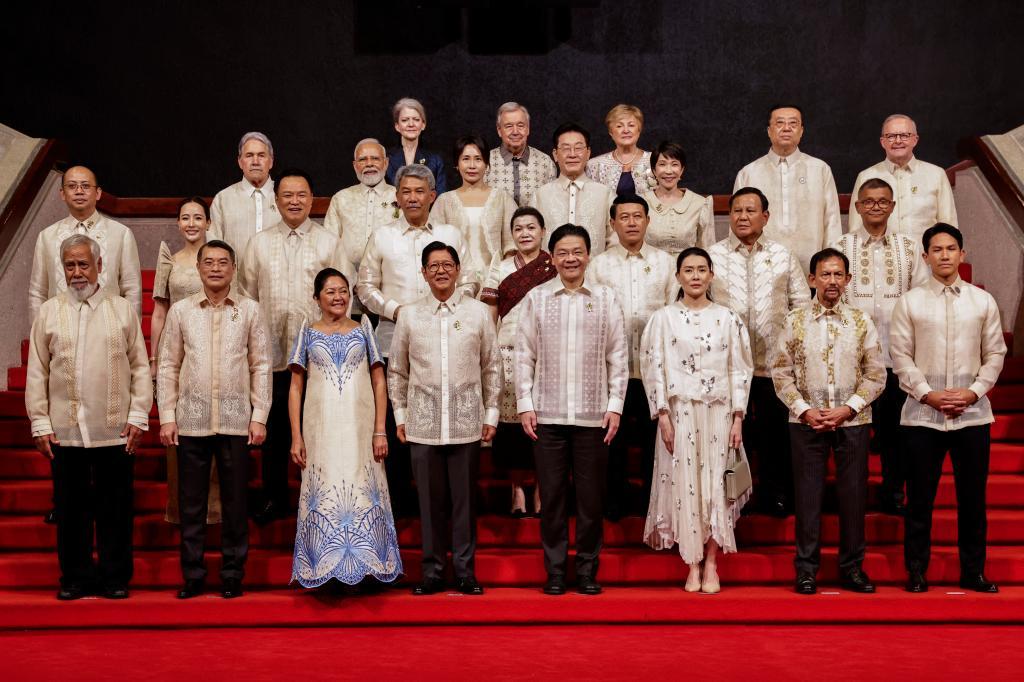
This week, the center of global diplomacy shifts to two major Asian cities. First Manila, the capital of the Philippines, focusing on the disputed waters of the South China Sea. Then Shenzhen, the technological hub of southern China, where Donald Trump, Xi Jinping, and Vladimir Putin will sit together on Thursday. On the official agenda: nuclear control, AI, and the Iran war. Two major summits, two mini-summits, and dozens of bilateral meetings.
The Philippines is currently hosting the ASEAN summit. On Wednesday and Thursday, Shenzhen will welcome the 21 members of the Asia-Pacific Economic Cooperation (APEC). Trump appears on both stages two weeks after the setback in the midterm elections. Weakened at home, he seeks to display authority in the Asian backyard.
The U.S. leader arrives in Manila on Tuesday for a visit of just 24 hours. But it is an important stop. The U.S. and the Philippines are celebrating 75 years of their mutual defense treaty. Their alliance has strengthened amid dangerous clashes between Chinese and Filipino coast guards in disputed reefs. Philippine President Marcos Jr. has expanded U.S. military access to his bases and authorized long-range missiles. He seeks protection against Beijing, although critics fear being caught in a potential war over Taiwan.
At the Southeast Asian summit, two fronts are dominating much of the discussions. The first is territorial disputes in the South China Sea, a crucial route for global trade where Beijing claims extensive maritime areas also claimed by several of its neighbors. The second is the civil war in Myanmar, where the military junta that seized power in a coup in 2021 is gradually emerging from its diplomatic isolation.
Beyond the more regional orbit, many eyes in Manila are on Tuesday's meeting of the Quad group, formed by the U.S., India, Japan, and Australia. Its origins date back to 2004, when the four countries coordinated humanitarian aid after the devastating Indian Ocean tsunami. In 2007, then-Japanese Prime Minister Shinzo Abe pushed for its transformation into a forum for economic and security cooperation, although it was practically paralyzed due to reluctance to provoke China.
Trump revived it in 2017, during his first term, aiming to counter China's growing influence in the Indo-Pacific. Now he will hold his first leaders' summit since 2024. From Beijing, this group is viewed with suspicion, presented as a kind of "NATO of the Indo-Pacific." They believe Washington aims to build an alliance to contain China's rise, strengthen its military presence in Asia, and unite its main regional partners in a common front against the Asian giant.
After the Quad mini-summit, attention turns to Shenzhen. This border city with Hong Kong, transformed since 1980 into China's great technological laboratory, has been chosen by Xi's government to host APEC, which brings together economies from both sides of the Pacific, including the U.S., China, and Russia. Established in 1989, this forum seeks to facilitate trade and investment in a region that accounts for about 60% of global GDP.
In Shenzhen, Trump and Xi are scheduled for a bilateral meeting and a working lunch. On the table will be tariffs, the future of the fragile trade truce, and the technological battle between the two largest global powers, especially U.S. restrictions on advanced chips and China's response with rare earths. All this with the Taiwan issue always present, one of the most delicate matters in relations between Washington and Beijing.
The main course will come later with a trilateral meeting on Thursday between Trump, Xi, and Putin. An unprecedented meeting among the three leaders that will leave a historic photograph. One of the main topics will be nuclear arms control. Washington wants to push for a new agreement to curb the arms race, after the New START, the last treaty limiting the number of deployed strategic nuclear warheads by the U.S. and Russia, expired in February.
However, Beijing is reluctant to participate in a three-way negotiation because it considers its arsenal still very inferior to those of the other two powers. According to the latest report from the Stockholm International Peace Research Institute (SIPRI), one of the world's leading research centers on armaments, Russia has about 5,420 nuclear warheads and the U.S. has 5,042, compared to China's 620.
Although the Asian superpower is rapidly expanding its arsenal, it insists that Washington and Moscow must first reduce their stockpiles before demanding similar commitments from it.
There may be more room for understanding on the military use of AI: the three leaders could agree that decisions regarding the launch of nuclear weapons should always remain under human control, preventing an algorithm from triggering a catastrophe.
The question is whether the war in Ukraine will also enter the discussions of this mini-summit, although Washington insists it is not on the agenda. What is expected, according to the White House, is to address the war with Iran, another conflict in which the three powers have very different interests and positions.
Putin will take advantage of the meeting to reinforce his role in international diplomacy, despite Western attempts to isolate Russia due to the invasion of Ukraine. Trump will seek to regain international initiative after his electoral defeat. But the greatest benefit may go to Xi: hosting both on Chinese soil and demonstrating that no negotiation among the great powers can ignore Beijing.