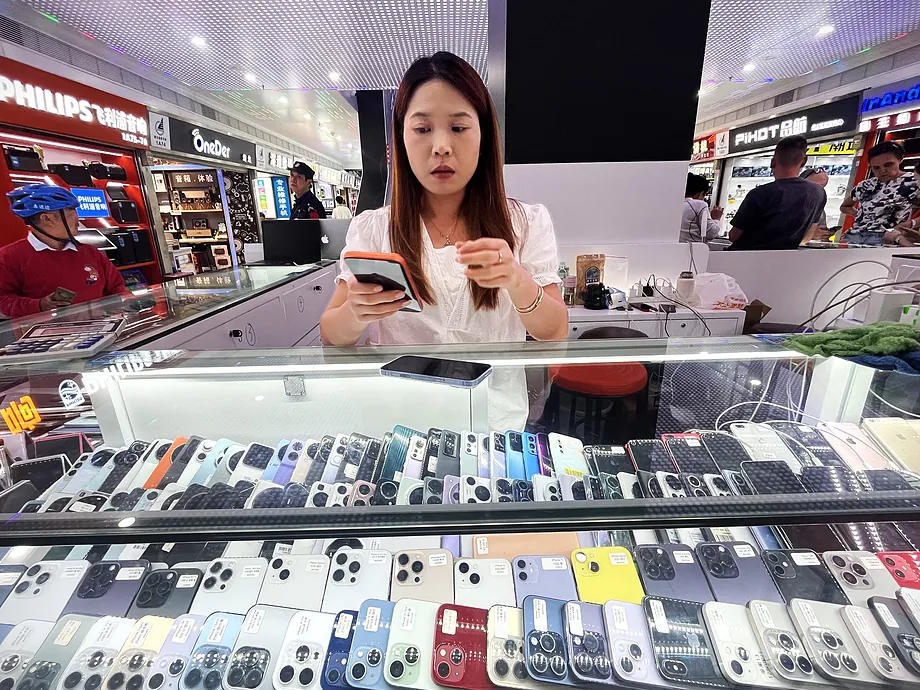
Raúl Martín, a 28-year-old Spaniard, had his iPhone stolen in London. One month later, Apple's locator placed his phone over 9,000 kilometers away, in Shenzhen, southern China. The trail led to Huaqiangbei, a massive maze of shopping galleries specializing in electronics. In one of its buildings, Feiyang Times, the fourth floor had turned into a large market for buying and selling stolen phones from various parts of the world. But these days, the shopping center is closed. The showcases filled with dubious iPhones have disappeared, along with the hustle and bustle of merchants negotiating amidst cigarette smoke.
In the surrounding streets, most of the small shops that usually sold second-hand phones also have their shutters down. "Since summer, the police have been inspecting the premises and have forced many businesses to close," explains the owner of one of the few establishments still open. "It has always been said that stolen iPhones are sold here, but not all of us operate that way. In my case, I buy phones from a trusted supplier who assures me they were legally acquired from their previous owners."
Shenzhen has been undergoing a cleanup operation to welcome world leaders participating this week in the APEC summit, which will bring together leaders from Asia-Pacific countries. The highlight will be on Thursday, when Xi Jinping, Donald Trump, and Vladimir Putin meet in a mini-summit that promises a historic photograph.
China wants to showcase the epicenter of its technological innovation to the world, but first, it has worked hard to hide its less shiny side: the underground business of stolen phones, smuggled electronic components, and counterfeit products. All of this has thrived alongside the growth of a megacity that, in just four decades, has transformed from a fishing village to a metropolis of 18 million inhabitants and one of the largest technological centers on the planet.
In the heart of Huaqiangbei, a wide pedestrian avenue flanked by shopping centers selling everything from drones to tiny motherboards, merchants claim that police inspections have multiplied ahead of the arrival of world leaders.
To understand what lies behind some of these businesses, one must return to London. One November afternoon in 2025, two hooded individuals on an electric bicycle snatched Raúl's iPhone 14 while he was on a call.
The Spaniard activated Apple's location system to try to recover the phone. But the thieves had put the device in airplane mode, preventing him from tracking it. For weeks, the map showed its last location in London. Until, at the end of December, the phone emitted a signal again. It was in Shenzhen. "I had already read news about organized gangs stealing phones in London and sending them to China," Raúl recounts.
The Metropolitan Police of London dismantled an organization last year that had sent around 40,000 stolen phones to the Asian country. A large portion of these devices ends up in the markets of Huaqiangbei.
Some can be unlocked, restored, and resold as used phones. Others end up dismantled to salvage their screens, casings, batteries, and internal components. "We don't sell stolen phones here," insists one seller. "I don't know where the phones come from, but my supplier assures me everything is legal," claims another merchant.
Inspections have also reached Luohu Commercial City, another massive shopping center famous for its counterfeit Prada and Chanel bags, watches, and luxury clothing. Many sellers removed counterfeits from their displays and replaced them with cheap unbranded items. Local media reported that some merchants have ended up in jail for selling counterfeit items of Western brands.
The facelift in Shenzhen is also affecting neighbors living near the convention center where the summit kicks off on Wednesday. According to the Hong Kong newspaper South China Morning Post, authorities have ordered to seal and cover the windows of some homes facing the official venues. One family was offered 10,000 yuan, about 1,200 euros, to leave their home between November 16 and 19 and stay in a hotel. Those who refuse to leave will have a police officer or security guard inside their home during those days, according to one resident.
Measures to secure the city extend to daily life. Authorities have banned drones, kites, and balloons. They have also suspended school activities and asked many companies to allow their employees to work from home. Officials claim the goal is to have fewer people and fewer cars on the streets during the arrival of foreign delegations. The municipal government has announced a 50% discount on public transportation.
While Shenzhen tries to clear its streets of traffic and reduce the activity of its counterfeit and stolen phone markets, a campaign has been launched to beautify the city with more technology. Robots have become the stars of the showcase, with humanoids dancing in the streets, playing the piano, and making coffee.
A robot playing the piano in Shenzhen.
The city wants to dazzle international journalists and the delegations participating in the summit. Also the many influencers from dozens of countries who have been accredited to cover the event and, in doing so, showcase the brightest side of China's technological capital. The main avenues feature new floral decorations and more bright screens than usual. Everything is meant to serve as a showcase of Chinese modernization. Although Shenzhen doesn't really need too many embellishments to boast about its transformation.
Less than half a century ago, this border territory with Hong Kong was a collection of fishing villages and small rural communities. In 1980, reformist leader Deng Xiaoping turned it into a laboratory of capitalism under communist control that opened its doors to foreign investment. The experiment was extraordinary. Today, it houses the headquarters of tech giants competing in telecommunications, AI, electric vehicles, and drones.
But proximity to Hong Kong, its port connections, and the concentration of thousands of suppliers also turned this city into a major international market where legal businesses coexist with smuggling. Now, as Xi Jinping prepares to host Trump and Putin, authorities want the world to see only the Shenzhen of robots, electric cars, and AI labs.