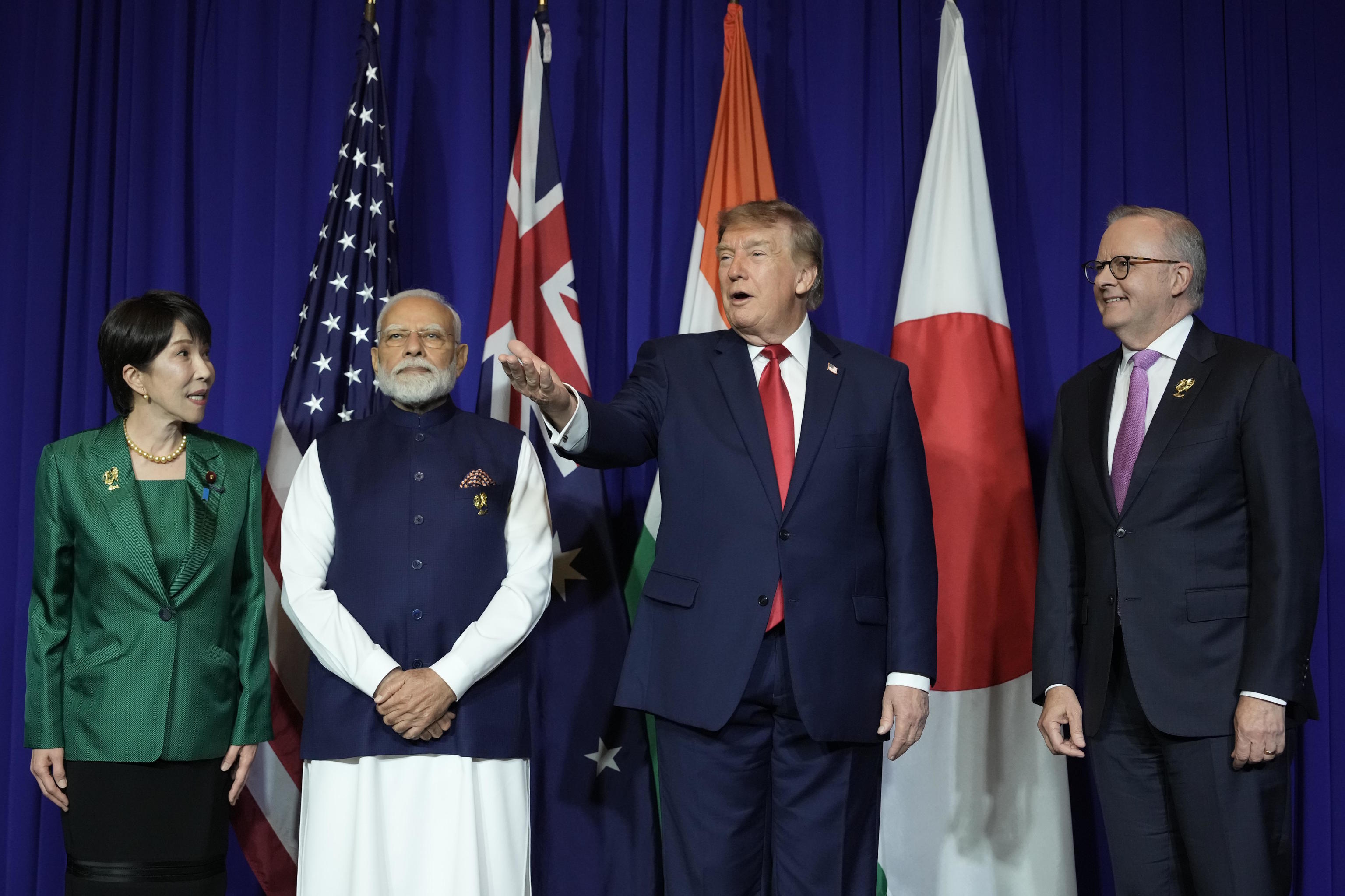
In Manila, protesters burn effigies of Donald Trump in front of police cordons. The banners denounce the Iran war and the hit to Filipino wallets from the blockade of the Strait of Hormuz. On the other side of the barricades, this Tuesday produced a very different photo: Trump meeting with the leaders of Japan, India, and Australia to revive the Quad, the forum that China labels as an attempt to create an "Asian NATO."
The meeting coincided in the Philippine capital with the ASEAN summit. But the spotlight will soon shift to Shenzhen, the Chinese city where the meeting of leaders from the most important economic forum in the Asia-Pacific (APEC) begins on Wednesday. The main event on Thursday will be the first trilateral meeting between Trump, Xi Jinping, and Vladimir Putin.
Before traveling to China, Trump wanted to showcase the support of his main Asian allies. Following the Republican setback in the midterm elections, the U.S. president seeks greater prominence on the international stage. Starting with demonstrating that the U.S. remains a decisive power in the region and is unwilling to cede ground to China's growing influence.
Shortly after the group photo in Manila, Trump announced new initiatives to strengthen cooperation among the four countries, both in military and technological fields. Under the slogan "protecting peace through strength", the U.S. president revealed that the Quad will organize a joint exercise with maritime patrol aircraft to "enhance surveillance and security in the Indo-Pacific waters."
One of the main announcements was a joint investment of over $85 million to boost AI development in the region. Trump, who prefers to refer to this technology as "superintelligence," defined it as "the greatest economic growth opportunity since the Industrial Revolution." The goal, he explained, is to ensure that the future of this strategic industry is "dominated by nations that share our values and common interests," in a clear reference to technological competition with China.
The other major priority is to reduce dependence on Beijing for critical mineral supplies, essential for manufacturing semiconductors, batteries, and advanced weaponry. Trump announced several agreements among Quad members to diversify supply chains and prevent their economies from being "vulnerable to coercion by a single distant supplier," referring to China's dominance in processing many of these raw materials.
The Quad photo from this Tuesday has a sense of returning to the past. It was precisely in Manila, during the 2017 ASEAN summit, when representatives from the U.S., Japan, India, and Australia decided to reactivate this quartet, which had been practically dormant for a decade. Nine years later, Trump is once again promoting this forum. The four leaders had not met since September 2024, when Joe Biden hosted them in Delaware.
The origin of the Quad (Quadrilateral Security Dialogue) is humanitarian. It was born after the tsunami that devastated the Indian Ocean in December 2004, when leaders of the four democracies coordinated aid. In 2007, then-Japanese Prime Minister Shinzo Abe sought to transform that collaboration into a broader security forum. But this shift lasted very little: reluctance (especially from Australia) to irritate China and differing priorities left it in limbo until Trump's first arrival at the White House.
From Beijing, state media have closely followed the Quad meeting, once again presenting it as a kind of "Asian NATO" designed to curb China's rise. The Chinese government believes that behind its defense of a "free and open Indo-Pacific," the slogan championed by the group, lies a Washington strategy to weave a network of military alliances around China.
"Washington needs to dispel the impression that it has neglected Asia while getting entangled in the Middle East. Meeting alongside ASEAN allows for a low-cost signal that the United States is still present," says Qian Feng, director of the Research Department at the National Strategy Institute of Tsinghua University.
Qian also highlights Washington's need to reduce its dependence on China for strategic raw material supplies. "The U.S. urgently needs to leverage the Quad to collaborate with Japan, India, and Australia in creating an alternative supply chain."
Although the four countries share an interest in countering China's growing influence, each has its own priorities. Japan, one of Washington's main military allies, sees the Quad as a tool to strengthen its security against Beijing, especially amid tensions surrounding Taiwan.
Australia, for its part, also watches China's expansion in the Pacific with concern. In addition to participating with the U.S. and the UK in the AUKUS security alliance, Canberra seeks to expand its exports of strategic minerals to the U.S. market. Both countries maintain defense treaties with Washington.
India is the most challenging partner to fit in. Prime Minister Narendra Modi has a border dispute with China but refuses to subordinate to any power. He buys Russian weapons and seeks to improve relations with Beijing without renouncing Washington. He also carries many trade frictions with Trump. "Tokyo wants more military space, Canberra new markets, and Delhi freedom to negotiate with everyone," summarizes Qian.
Trump's first stop on his Asian tour has been one of Washington's main military allies in the region. Philippine President Ferdinand Marcos Jr. has expanded U.S. troops' access to bases in the country and allowed the deployment of long-range missile systems.
But this close relationship has clashed with the noise of the streets. Trump has found a hostile welcome in Manila, with thousands of protesters demonstrating against his visit.
Authorities have arrested over 300 people. One source of indignation is closely related to the blockade of the Strait of Hormuz, which has driven up oil prices, increasing gasoline, transportation, and fertilizer costs in a country heavily dependent on energy imports.
Protesters also reject Pax Silica, an initiative promoted by Washington to secure the supply of semiconductors and strategic minerals and reduce dependence on China. The project involves building a large tech center about 120 kilometers from Manila, which, according to its detractors, threatens to displace indigenous communities and increase pressure on water and energy resources.
Trump will leave Manila after showcasing the unity of his Asian allies but also with the image of a capital fortified by police to contain protests against his visit. His next destination will be Shenzhen, where Xi Jinping awaits him. After gathering countries seeking to counter China's influence in Asia, the Republican will have to sit down to negotiate face-to-face with the leader of the power he aims to contain.