A line of FP-2 drones is mounted on a platform in an agricultural area. It's just past five in the afternoon, but it's already dark. The darkness serves to conceal the entire military deployment.
Members of the Magyar Birds ensure the area is secured. They have blocked the dirt roads leading to the site with their vehicles, located in northern Ukraine.
"We don't notify anyone. Not even the police. Our own men block the routes. Everything has to be very quick and work like a Swiss clock," asserts León, one of the spokespersons for the most emblematic unit of the Ukrainian Armed Forces' Unmanned Systems (USF).
Sappers like Revan, a 23-year-old Bolivian who chose that Star Wars character as his military nickname, are busy checking if the nearly 100 kilos of explosive payload each FP-2 carries are ready.
The unmanned aerial vehicles (UAVs) are linked to another half dozen long coils of cables stretched across the dirt road. Each connects to one of the devices.
The unit commander, Roland, 37, gives the final orders before the attack begins. The soldiers belong to the Seventh Deep Strike Center of the Magyar Birds, an elite group of the USF, led by Robert Magyar Brovdi.
The operation must be carried out swiftly. So many vehicles and soldiers are a valuable target for Russian drones that can scour the night with their night vision.
"We're close to the front. Here, the Shahid (Russian drones) and Cab bombs (hundreds of kilos devices) operate. If we detect the presence of any Russian drone nearby, the instructions are to run in different directions and drop to the ground. The same goes if our drones fail. If they explode here, shrapnel could hit us," warns Leon.
At 17:39, the launch begins. Another sapper, a 28-year-old American nicknamed Wildcard, is in charge of pressing the buttons. First, he checks the acceleration three times. Then, the sound of "plus, plus, plus!" is heard, and seconds later, the roar of the rocket propelling the FP-2.
The night lights up with a blaze of fire as the device ascends. It disappears into the darkness. "Plus, plus, plus!". One after another. The plain fills with the smell of smoke. "Plus, plus, plus!".
Roland's group is not the only one in the area. The same noise is heard a few kilometers away. Within minutes, the entire sky fills with the recognizable sound of these aircraft engines. It sounds like a swarm of motorcycles soaring through the sky.
"People think of small drones, but these are real planes. They weigh over 200 kilos, have six-meter wings, and can travel thousands of kilometers," León had pointed out earlier.
To learn the target of the action, one had to wait until the morning of the 13th. That day, the Russian Defense Ministry stated that its air defenses had shot down 1,198 long-range drones in the early hours from Thursday to Friday, marking one of the largest assaults of its kind since the war began.
The assault that day seems to have opened a Ukrainian offensive aimed at massively increasing the number of UAVs used in bombings against Russian strategic infrastructures. Two days later, in the early hours of the 15th to 16th, Moscow acknowledged that it had shot down 1,336 drones, marking another historical record.
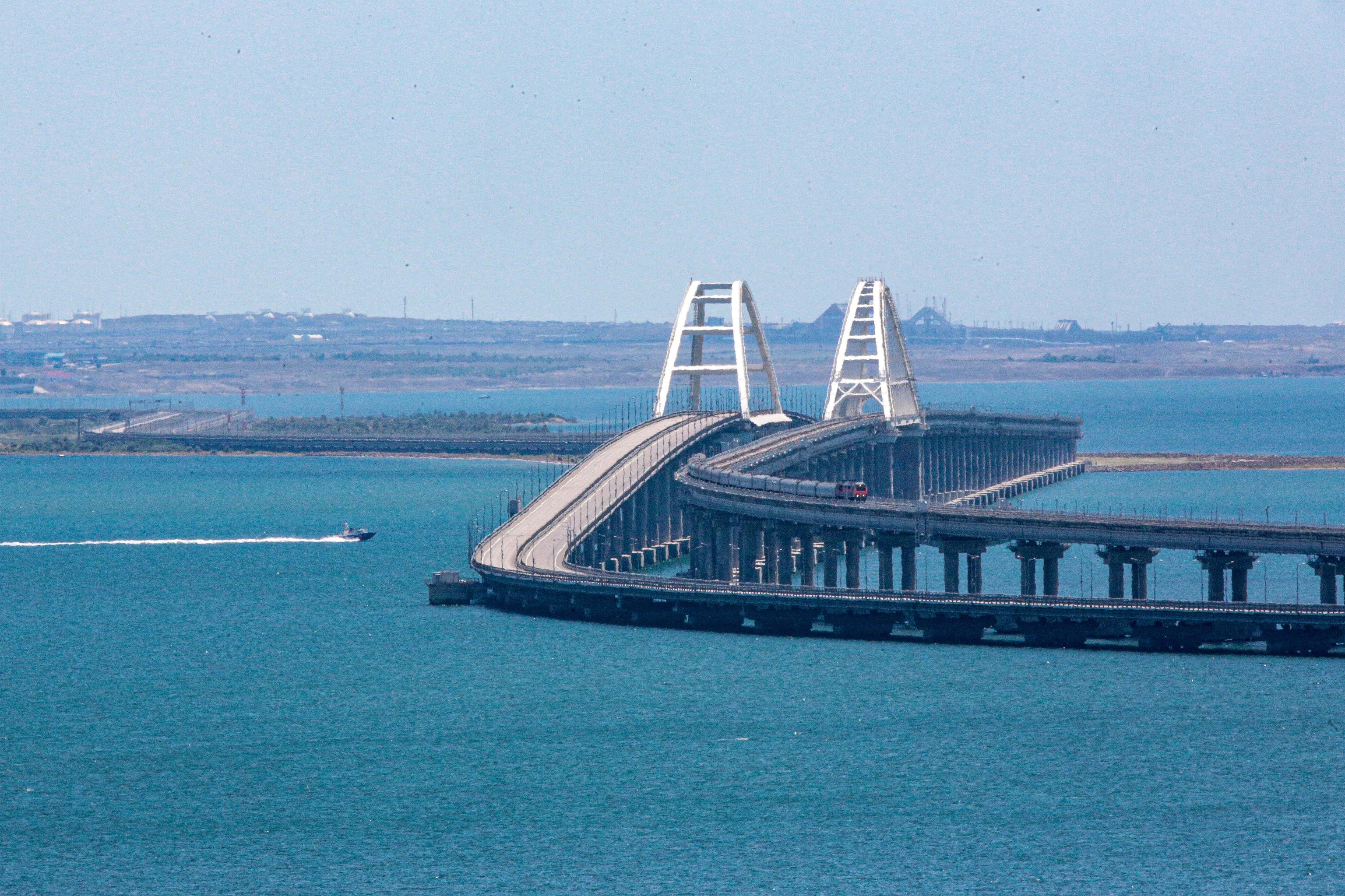
This Monday, Ukrainians caused significant damage to the Kerch Bridge in Crimea, an event mirrored in Kyiv, where two vital crossings over the Dnipro River were hit by Russian missiles.
The Ukrainian General Staff specified that the UAV wave on the 12th had struck one of the largest Russian refineries, located in the city of Volgograd. This complex processes nearly 14 million tons of oil, accounting for 5% of the country's total.
"It is one of the key gas stations for the Russian army in the south. From there, fuel is sent to the front and airfields," read the General Staff's message.
The same institution indicated that the massive bombing caused a huge fire affecting nearly 3,500 square meters and damaged numerous facilities of the complex, including six storage tanks.
Videos from that locality, located about 400 kilometers from the common border, showed the night illuminated by fires and the enormous smoke cloud generated by the incident.
Moscow authorities also confirmed the destruction of dozens of UAVs in that region, which led to the shutdown of its main airports. According to their statement, the assault left at least seven dead in three different regions, including a 12-year-old boy, reported the AP agency.
"The key to these attacks is to launch waves from different points. It requires very specific calculations: distance, wind speed, drone weight, etc. What you see is the tip of the iceberg. There are many hours of work behind it," León, a member of the Magyar Birds, had detailed.
Although Ukrainian attacks on Russian territory began in 2022 - the first known incident in which a refinery was damaged dates back to June 22 of that year, when the Novoshakhtinsk complex in Rostov was bombed - systematic long-range operations against the rear of that country did not become routine until 2024.
The Unmanned Systems of the Ukrainian Armed Forces led by Robert Magyar Brovdi have become the main pillar of this campaign, especially after establishing a specialized center for these operations in December of last year.
In an interview with this newspaper the day before, Brovdi referred to the logic behind the deep bombings, which have moved the war to the Russian rear. "In the European part of Russia, there is not a single square kilometer that can be considered a rear area. We have blocked their ghost fleet (the clandestine network of tankers that Moscow uses to try to evade sanctions) with drones. And we are restricting Putin's logistics, making it extremely difficult for supplies to reach the front," he stated.
According to the International Energy Agency, repeated Ukrainian attacks on these types of strategic infrastructures since late October have reduced Russian refining capacity by 30%.
Ukrainian President Volodymyr Zelensky even increased that estimate, stating last Sunday that his country's drones have "stopped more than 55% of Russian refining capacity."
Russian President Vladimir Putin himself admitted in September that the damage caused to the Russian economy by these recurring actions exceeds 1% of GDP.
One of the Ukrainian intelligence services, the Gur, estimated earlier this month that Moscow has recorded losses worth over $23 billion, solely due to attacks on refineries, to which should be added those targeting ports, commercial distribution complexes, data centers, military bases, or infrastructure of all kinds.
Brovdi designed a very specific project for assaults with UAVs against the air defense network protecting Russian airspace. "I calculated that to open a breach, we needed to destroy about 1,000 units: surface-to-air missile systems, air defenses, radar stations, and electronic warfare equipment. I was wrong. With 300, the door was already opened. We have demonstrated that their air defense system is absolute garbage."
The owner of the American satellite network Starlink, Elon Musk, has blocked the use of his terminals in the overflights of Ukrainian UAVs over Russia. Last Thursday, Zelensky again denounced that the American system, widely used by Kyiv's drones, has also imposed limits on its use that are affecting the performance of the units intercepting Russian drones.
"These are not random errors, but systematic speed restrictions. Unfortunately, this helps the Russians kill more Ukrainians," the president stated in a post on Musk's social network. "It's false, no changes have been recorded", Starlink replied in response to a question from Axios, an American media outlet. "We have been suffering these restrictions in Ukraine for many days," León clarifies.
For several weeks now, Russian experts and some Italian media have claimed that Ukrainian long-range UAVs are testing the Israeli-Italian Hisky satellite system as an alternative to the limitations of Starlink. This technology would allow for much more devastating precision in the airstrikes of Ukrainian UAVs. León clarifies that this would give them the ability to operate them in real-time "in hunter mode (right now they operate in waves, with more or less defined routes automatically) and modify the chosen impact location. That would cause more damage to the Russians. We could destroy the ballistic missile launchers, as we lack Patriot interceptors, and that would help us survive the winter."
The head of the USF, Brovdi, responds to the question about Hisky with a lengthy rhetorical detour, whose intent he does not hide. "This war develops in cycles. Each cycle opens a window of opportunity. Relying on a technology, especially one of foreign origin, like Starlink, which Musk constantly uses as leverage, forces us to seek other alternatives. And that is precisely what we are doing," he replies. He immediately adds, with another smile: "Was the answer vague enough for the Israelis not to get upset?"
The launch of FP-2 has concluded in less than an hour. Roland's subordinates hurry to gather their belongings and leave the countryside.
The group led by the 37-year-old Ukrainian is particularly unique. "It is the only one that has foreign fighters responsible for long-range attacks. Some with former comrades I met in the Foreign Legion (another Ukrainian group that drew from foreigners). We have French, American, Italian, a Bolivian, etc.," points out the group leader.
Like Brovdi and most members of the USF, Roland never had a relationship with the military establishment. He worked as a sales manager in a company. He enlisted at the beginning of the full-scale invasion in 2022. He fought in the infantry, but his hobby—drones—led him to join the Pájaros de Magyar earlier this year.
"Every morning, after the attacks, when we see the images of the burning refineries, we understand that our work has an impact on the war," he opines.