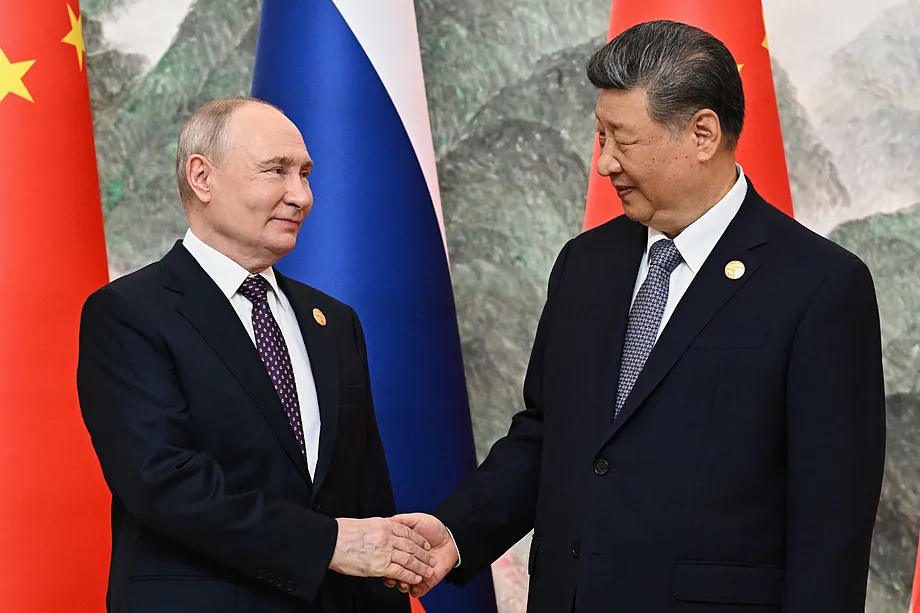
Vladimir Putin arrived at his meeting with Xi Jinping with the Crimean bridge collapsed and a war without an exit. But the scene awaiting him this Wednesday was far from the sound of bombs: an exclusive official residence surrounded by gardens and hills on the outskirts of Shenzhen, China's great technological metropolis. There, the two leaders held a meeting lasting over two hours in which they once again showcased the strength of a close partnership. It was the prelude to an even more significant meeting: the historic trilateral summit they will hold on Thursday with Donald Trump.
"My old friend", Xi greeted Putin, whom he was seeing for the fourth time this year. The Chinese president praised a bilateral relationship "as firm as a mountain, capable of bringing stability to an increasingly turbulent world."
His Russian counterpart highlighted the close diplomatic coordination between both powers and defended their commitment to building a "multipolar and fairer" international order. Behind these statements lies a shared ambition: to reduce U.S. hegemony and consolidate a new global balance in which Beijing and Moscow have greater prominence.
During the meeting, Putin revived a phrase they have used in previous encounters: Russia and China must move "back to back" to defend their shared interests. This complicity has been cultivated over more than a decade of visits and toasts. But behind the image of two equal partners lies a growing imbalance.
Moscow needs Beijing much more than vice versa. Last year, China absorbed about 27% of Russian exports and provided 36% of its imports; for the Asian giant, Russia accounted for less than 5% of its foreign purchases. The Kremlin supplies oil, gas, coal, and other raw materials, while Beijing has become its main supplier of cars, industrial machinery, and electronics that previously came from the West.
But the exchanges go far beyond consumer goods. Washington and Brussels have denounced for years that Chinese companies supply the Russian military industry with dual-use technological components, from semiconductors to equipment used in weapon manufacturing.
Putin and Xi discussed on Wednesday the prospects of expanding their economic, energy, and technological cooperation. The Russian leader noted that bilateral trade has been exceeding $200 billion for several years and expressed confidence that it will grow again this year. He also celebrated the improvement of transport connections between the two countries. Xi, for his part, urged deepening a partnership he presented as a model of relations between great powers "based on mutual respect and cooperation."
Before meeting Xi, Putin had participated in the business forum of the major Asia-Pacific economic summit, which this week gathers some of the world's leading political and economic leaders in Shenzhen. The Russian president addressed an unusual audience for an autocrat isolated from the West: top executives from major U.S. multinationals and Chinese tech magnates.
Putin took advantage of that platform to criticize Western sanctions and defend that the center of gravity of the global economy is shifting toward emerging powers, to the detriment of the U.S. and Europe. "The old tools of domination and economic coercion are a thing of the past", proclaimed the Russian leader, boasting of Russia's resilience against sanctions while ignoring the enormous costs that the prolongation of the war and international isolation are imposing on his own economy.
A significant part of that resilience Putin now exhibits is explained by China's support, which has become his main economic lifeline. An increasing dependence that has its origins in the major turning point of the alliance between Xi and Putin: February 4, 2022, when both took advantage of the inauguration of the Beijing Winter Olympics to proclaim a "limitless" friendship and assure that there would be no forbidden areas in their cooperation. Just 20 days later, Russian troops attacked Ukraine.
Beijing has never openly condemned the invasion and has rejected Western sanctions while tightening its economic ties with Moscow. But Xi seeks to maintain a delicate balance: he needs Russia as a geopolitical counterweight against Washington but avoids getting involved in the Ukraine war or assuming the diplomatic and economic costs of an open confrontation with the West.
The Ukraine war was also among the issues expected on the agenda for Wednesday's meeting, as the Kremlin had hinted. However, official Chinese statements about the meeting avoided any reference to the conflict.
Xi and Putin have also strengthened their diplomatic coordination in the UN and in forums like BRICS and the Shanghai Cooperation Organization, from which they promote an international order that reduces U.S. influence. This approach also has a military dimension: the Russian and Chinese armies continuously conduct joint exercises.
Putin landed early Wednesday morning in Shenzhen with a new military setback behind him. Ukraine had launched a devastating attack on the Kerch bridge, the massive 19-kilometer infrastructure connecting Russia with the Crimean peninsula, illegally annexed by Moscow in 2014. The offensive had caused part of the structure to collapse, striking one of the great symbols of Kremlin territorial expansion.
It was Putin himself who inaugurated the bridge in 2018, driving a truck before the cameras to celebrate a project that represented the definitive integration of Crimea into Russian territory. Beyond the propaganda impact, the damage also complicates a strategic route for supplying Russian forces deployed in southern Ukraine.
The attack comes at a time of renewed military escalation, with cross-bombardments against energy infrastructures, industrial facilities, and strategic targets, while diplomatic efforts to end the conflict continue to yield no tangible results.
The Ukraine war could emerge at the trilateral summit between Xi Jinping, Putin, and Trump. The U.S. president aims to reactivate stalled peace negotiations, but the meeting raises deep concern both in Kyiv and in European capitals, which fear being sidelined from discussions that will decide the future of continental security.
Another highly anticipated leader is Donald Trump, who is already in China. Xi Jinping personally welcomed the American upon his arrival at Shenzhen airport, where both will participate on Thursday in a tripartite meeting with the Russian leader.
After stepping off Air Force One, Trump shook hands with Xi on the red carpet while a group of people waved colorful pom-poms and Chinese and American flags. This reception is an uncommon gesture from the Chinese leader.