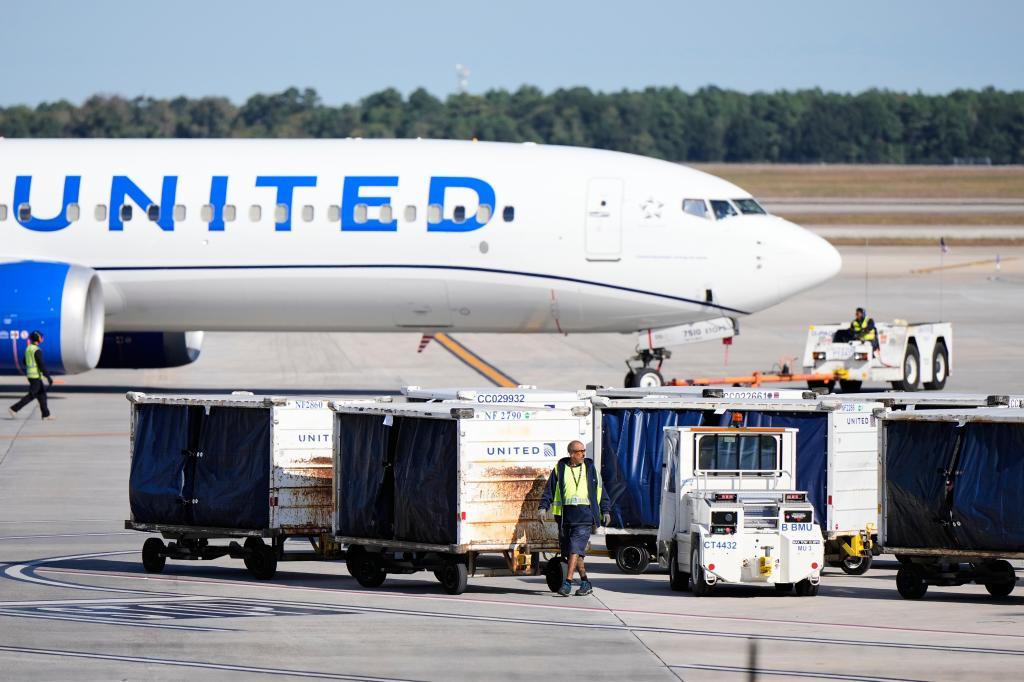
First, it was Microsoft services. Then, the nationwide airspace shutdown last Friday for nearly five hours, the most serious incident since 9/11. Just as normalcy had not yet returned, issues arose at JPMorgan Chase, which struggled to process transactions and provide some basic services on Monday. There was also an interruption of Zelle, one of the equivalents to Bizum. On Monday, United Airlines had to temporarily ground many of its flights again due to a computer failure. And this Tuesday, it was the communication network of the US national security agency, with which its employees share classified information internally. And the basic services of Apple for thousands of users.
The temporal coincidence of incidents in such different sectors (cloud, aviation, finance, consumer services) has sparked speculation about a possible coordinated attack, the growing vulnerability in the digital systems on which the US economy depends, exposure to artificial intelligence, or the precarious state of many infrastructures. There is no evidence of links between them, but anxiety is rising.
Fate has also aligned that all this coincides with a drill, mandated by law and planned for months, regarding possible national emergencies. A one-minute test message broadcasted via radio, television, and national cable and satellite networks. At the worst possible moment. Or the best, depending on how you look at it. "We've heard many rumors about the test, but there are no outages, no secret emergencies," said the federal emergency management agency, which has been vilified and threatened by conspiracy theorists for years. To the point that during hurricanes or floods, their technicians have stopped wearing identifiers or sometimes need escorts because misinformation campaigns have convinced many people that officials want to seize homes, for example.
In any case, while the public stockpiles cash, water, or batteries, the government seems little concerned. Official explanations currently point to a buildup of independent technical problems and not a common element. Homeland Security Secretary Markwayne Mullin stated this Tuesday that the incidents are not related to cyberattacks and attributed much of the problem to the coexistence of new technologies with very old IT infrastructures, unable to handle certain workloads.
"I can say with 98% certainty that we are not observing any cyberattack: no one has claimed responsibility, we do not see unusual traffic or traces of intrusion or data exfiltration; therefore, nothing indicates a connection between the incidents," he stated. "Stay calm. The country is safe. We are simply overwhelmed by technology, and our current world operates thanks to it. We used to have backup systems, but now those systems are overwhelmed by new technologies," he added.
"We don't see any crisis looming. But we must be prepared for anything," said Vice President JD Vance in a television interview on Monday. Vance confessed that several of his friends had asked him whether they should start building bunkers or stockpiling food and water. "My answer to that is no", he stated, adding that news about Pentagon bases preparing to operate disconnected from the power grid for 90 days, as well as similar news from European countries urging citizens to prepare supplies, are simply "basic good governance" measures.
The FAA, the aviation authority, has determined, for example, that maintenance operations at a center in a town in Arkansas, where copper wiring was replaced with fiber optics and a problem with a router, caused an anomalous flow of over a thousand connection attempts every four or five seconds, destabilizing its network. And the fear that it was something more serious led to the closure of all airspace.
Microsoft, for its part, has identified a software defect that had been installed for months and ultimately caused its servers to collapse under certain load conditions, while Chase indicated it was a software error in its systems. Authorities insist there are no signs of a common external threat, and President Donald Trump, traveling in Asia, doesn't even seem to consider what happened relevant, as he hasn't mentioned it in any of his social media posts.
But the succession of episodes, especially in light of hacks in Europe targeting supermarkets and hospitals, or bomb threats on airplanes, has opened a much deeper debate about how far the United States can afford to sustain its economy on aging digital infrastructures, interconnected and increasingly dependent on complex systems. While at the same time, dedicating hundreds of billions of dollars to investment in data centers and everything related to AI.
It is common for supermarkets in Washington, the capital, to have no coverage of any kind. Or for certain neighborhoods where providers have never heard of fiber or cable connections. Therefore, for many people, the main fear is not necessarily that someone is attacking the country, even though experts say that, thanks to AI, everything that was previously not easily hackable is now within reach of many more people with less knowledge. But rather that all systems, the system, may be much more fragile than previously thought.
Last Friday, in fact, the FBI issued a warning stating that "cybercriminals and hackers aligned with states are using ARTEX, a penetration testing framework powered by superintelligence to automate attacks against companies and organizations worldwide. ARTEX can accelerate intrusions, from the initial target selection to obtaining privileged access, in less than three hours. It was used in the compromise of the ConnectWise supply chain in October, which exposed Microsoft 365 customer environments and involved authentication attempts on over 2,250 customer tenants."