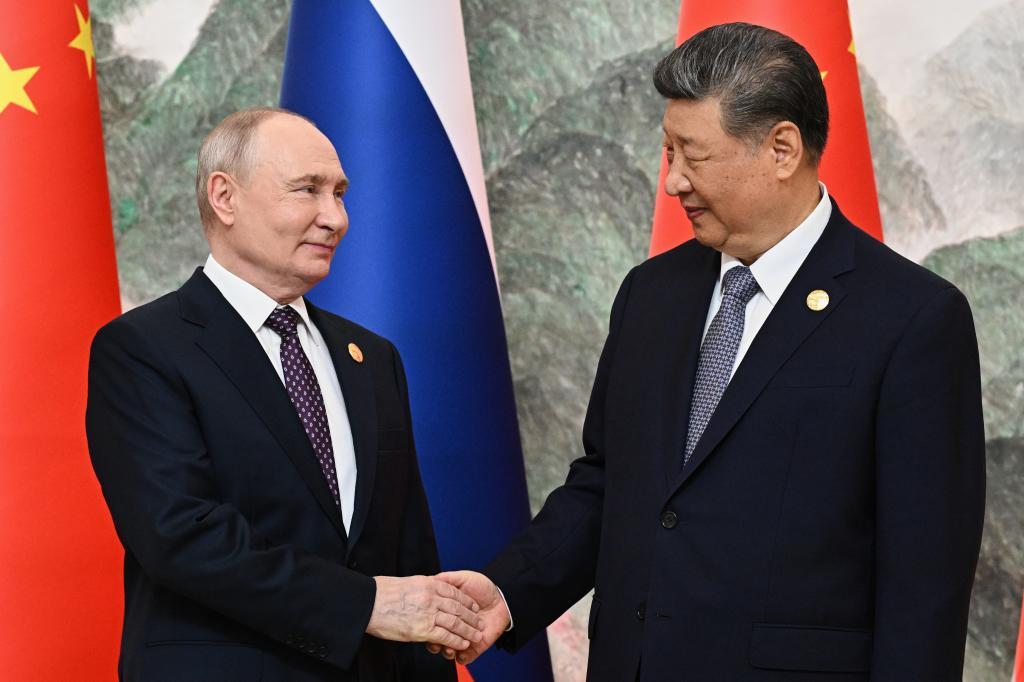
Vladimir Putin took the stage in Shenzhen on Wednesday before an unusual audience for a leader turned pariah in the West: top executives from major U.S. multinational companies and Chinese tech magnates.
The image had powerful political symbolism. More than four years after ordering the large-scale invasion of Ukraine, and with his country subjected to a barrage of international sanctions, the Kremlin chief appeared before several bigwigs of the global business elite.
The Asia-Pacific Economic Cooperation (APEC) business summit, the major economic forum in the region, accompanies the meeting of leaders from 21 economies that account for more than 60% of global GDP. Organizers stated there were about 2,000 attendees and representatives from 115 Fortune 500 companies. Among the participants were Michael Miebach from Mastercard; Ryan McInerney from Visa; Wang Chuanfu from BYD; and Lei Jun from Xiaomi.
Putin seized the platform to launch a harsh critique of Western sanctions and proclaim the decline of the old economic powers. "The center of gravity of the global economy is shifting," he asserted, before noting that this change "does not please those who were used to dominating" and who are now "trying to hinder the development of those countries that demonstrate success and progress."
The autocrat maintained that "the old tools of domination and economic coercion are a thing of the past" and argued that sanctions, tariffs, and trade restrictions have lost much of their effectiveness.
"They can slow down development, but they are no longer capable of completely halting growth or destroying economies," he stated. In his view, the old power structures are giving way to new centers of influence.
Putin directed his most forceful criticisms at Europe, asserting that the EU "is losing industrial capacity and competitiveness" and linked this deterioration to inflation, deficits, and, especially, the energy break with Moscow.
In contrast, he defended Russia's resilience, overlooking the high costs that sanctions and the prolonged war in Ukraine are imposing on its own economy. The Russian regime boasts of having strengthened its self-sufficiency, but much of that growth is driven by a war economy that consumes enormous public resources.
Putin's return to a major international economic showcase would not be understood without the backing of his host, Xi Jinping. Since the large-scale invasion of Ukraine began in February 2022, China has become Russia's main economic lifeline against the isolation imposed by the West. While the U.S. and Europe tightened sanctions, Beijing multiplied its purchases of Russian oil, gas, and coal, with Chinese companies filling part of the void left by Western multinationals.
At the end of the business forum, Putin and Xi held a bilateral meeting, another opportunity to showcase the close alliance between Beijing and Moscow.
Trade between the two neighbors has reached historic levels, exceeding $240 billion annually. This partnership, which Xi and Putin dubbed in 2022 as a "no-limits" friendship, has allowed the Kremlin to cushion some of the impact of sanctions. But it has also created an increasingly unbalanced relationship: Russia depends much more on China to sustain its economy than Beijing needs Moscow.
Xi Calls for Greater Cooperation in AI
Xi used the same Shenzhen stage on Wednesday to present himself as a champion of economic openness. "Openness brings progress; closing off inevitably leads to backwardness," the Chinese leader asserted. He warned of a "complex and volatile" landscape of protectionism and low growth. "We must firmly defend the multilateral trading system based on rules, with the World Trade Organization at its center," he proclaimed before business leaders.
The host also insisted that stability is essential for regional prosperity. "Only with stability can there be security; only with security can there be prosperity," he stated. Xi also called for greater cooperation in AI and the digital economy, two of the major engines of future growth.
The message resonated in a modern city that is China's showcase for electric vehicles, drones, and robotics. Xi's defense of open trade comes as Washington has just imposed new restrictions on China's access to advanced AI chips.
The big moment of this week in Shenzhen will come on Thursday, when Putin, Xi, and Donald Trump sit at the same table in a historic trilateral summit, the first of its kind among the leaders of the three largest nuclear powers on the planet. A highly anticipated meeting, with the war in Ukraine, the Iran conflict, trade tensions, and the future of international balance as the backdrop.