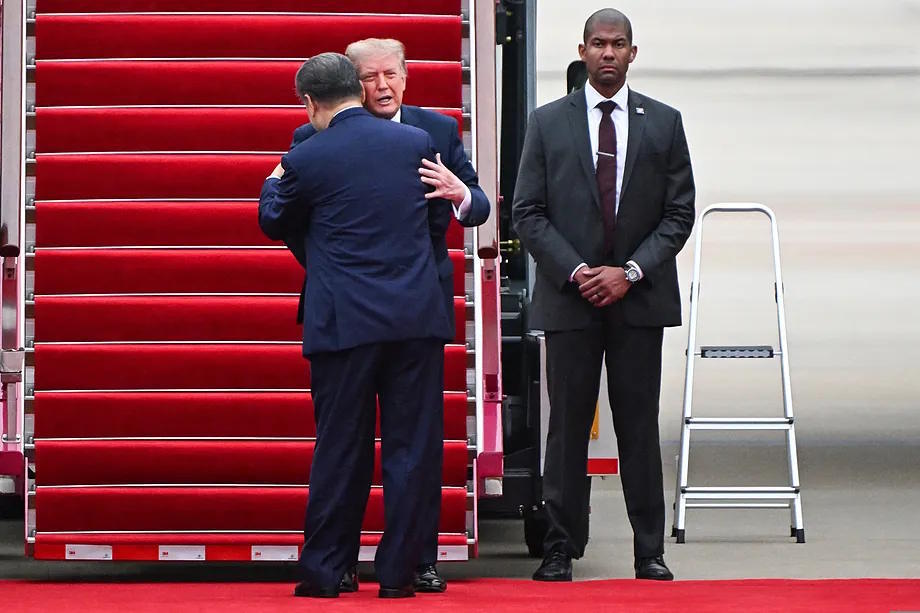
Donald Trump stepped off Air Force One raising his fist to the cameras. Waiting below was a surprise that in China is worth more than any cannon salute: Xi Jinping. The Chinese president, accustomed to receiving his guests in official halls, had come to Shenzhen airport to welcome him. They shook hands and the greeting turned into a brief hug, but unusual for the communist leader.
Around them, the protocol had turned into a spectacle. Young people dressed in pink and blue waved pom-poms and flags of both countries while chanting a welcome in Mandarin. Soldiers presented arms, the anthems played, and five fighter jets crossed the sky leaving trails of color. On the red carpet, everything seemed like the set of a diplomatic blockbuster.
Xi rarely alters the rituals surrounding his power. He calculates his handshakes and smiles, leaving little room for improvisation. He also does not usually hug other leaders. One of the few exceptions has been Vladimir Putin, whom he embraced in Beijing in 2024. But when Putin landed hours earlier in Shenzhen, Xi sent another senior official to greet him. Although they later shared a long meeting of over two hours.
The scene with Trump harkened back to another historic moment in China. In his 14 years in office, this is the first time Xi has welcomed a foreign leader upon their arrival at the airport. To find a comparable image in the history of the People's Republic, one must go back to 1959, when Mao Zedong welcomed Soviet leader Nikita Khrushchev at a Beijing airport.
At the Shenzhen runway, Xi took advantage of the reception to send a message of reconciliation. "I hope to maintain a deep exchange of opinions with you to promote a constructive and strategically stable relationship between our two nations, based on mutual respect, fairness, and reciprocity," the Chinese president stated, according to the official agency Xinhua. Trump responded with praise for his host, whom he again referred to as a great leader, and thanked him for the extraordinary welcome.
The entourages of Xi and Trump formed an extravagant procession, with more than twenty limousines and official vehicles. On Chinese social media, the American presidential vehicle (the Beast) stood out, a fortified fortress that seemed out of place in one of China's capitals of electric cars.
But let's return to the hug. In September, Trump had broken the usual American protocol by going to Andrews Air Force Base, near Washington, to greet Xi during his state visit. The Chinese leader seems to have not forgotten that courtesy. But it should not be forgotten that behind the hugs, a fierce rivalry remains open between the two largest economies in the world.
Washington and Beijing have just extended their tariff truce until January 10, 2027, but they are still negotiating a broader agreement. Trump demands greater purchases of American soybeans. Xi wants Washington to remove trade barriers.
The most decisive battle at the moment is being fought in technology: the US limits Chinese access to advanced chips, while Beijing has a powerful lever over the rare earths essential for Western industry.
Many of these topics will likely be discussed by Xi and Trump in a forthcoming bilateral summit before the American departs Shenzhen, where he is participating in the major Asia-Pacific economic summit (APEC). But all eyes are on Thursday, when the Chinese city will be the scene of an even more extraordinary photograph: the leaders of the three largest nuclear powers on the planet, Xi Jinping, Donald Trump, and Vladimir Putin, sitting at the same table for the first time.