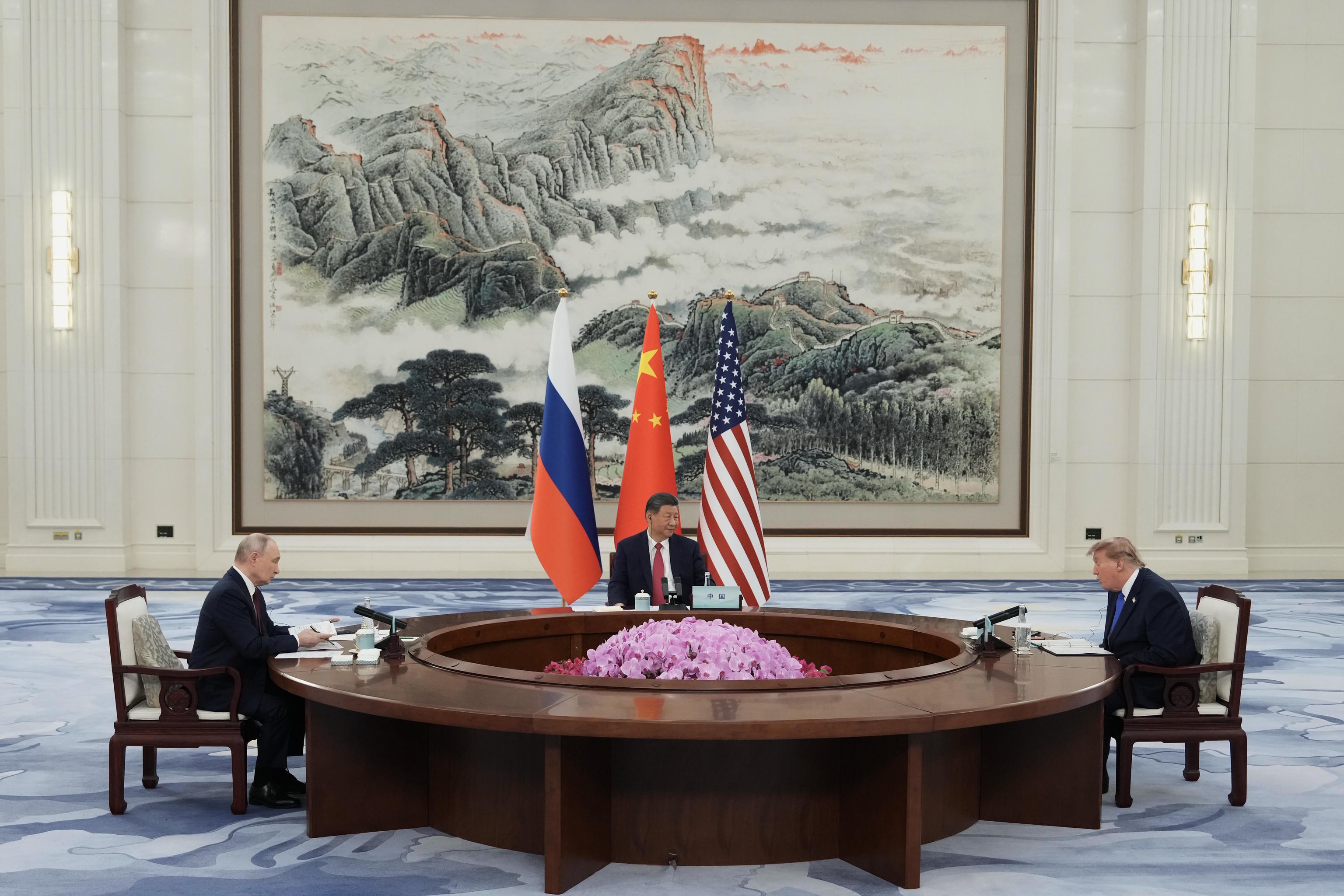
Donald Trump, Vladimir Putin, and Xi Jinping made headlines on Thursday with an unprecedented photograph: the three largest nuclear powers gathered for the first time at a trilateral summit, with wars, strategic rivalries, and the global balance of power on the agenda.
The setting was a complex with gardens and villas in French, Italian, and Spanish styles. Just a few kilometers away, Shenzhen is manufacturing the technological future. Under that Chinese roof, discussions were held about who will have more power to govern it.
Xi Jinping emphasized the exceptional nature of the meeting, attributing it with a "pioneering importance." The Chinese president argued that international stability largely depends on the relationships between major powers. "When the most important countries live in harmony, the world enjoys peace. When they confront each other, the world falls into chaos," Xi stated, reiterating the need for dialogue among Beijing, Washington, and Moscow as a tool to contain international tensions.
Putin, for his part, appealed to the shared history of the three powers. "Our three states are the victors of World War II, and we share the responsibility of maintaining international peace and security," the Russian leader noted. He also highlighted the existence of common interests in conflict resolution, particularly regarding Ukraine, a matter he explained he had already discussed with Xi on Wednesday and revisited with Trump on Thursday.
The meeting brought together leaders of three nuclear powers with very different interests. Xi aimed to project himself as a global arbiter. Trump sought a diplomatic success following an electoral setback. Putin needed to demonstrate that nearly five years of war in Ukraine had not condemned him to isolation. On the table: nuclear weapons, wars, trade, and the race for artificial intelligence.
Before the joint meeting, Trump held two bilateral talks: first with Putin and then with Xi. With the Russian leader, whom he referred to as "friend," he primarily discussed the war in Ukraine. According to the Kremlin, Putin left in "excellent spirits."
With Xi, Trump again displayed a strong rapport. The Chinese president had welcomed him at the airport on Wednesday with an exceptional embrace for the rigid protocol of Beijing. "I believe that as long as you and I are in charge, we will never have any problems," he told him during their bilateral meeting on Thursday.
Xi, 73, has been in power for 14 years and faces the future without a visible successor. Trump, 80, seeks more immediate results. The trade truce between the two largest economies in the world has not resolved the battle over tariffs, rare earths, and U.S. controls over the most advanced chips.
Washington fears China's military advancement; Beijing denounces attempts to curb its rise. AI has become a central front in the rivalry. And Taiwan remains the most dangerous red line: China claims the island and does not rule out the use of force, while the U.S. maintains its defensive support for Taipei.
Putin, 74, arrived in a different position. Russia retains nuclear weapons and vast energy reserves but lacks the economic weight of its counterparts. The invasion of Ukraine has consumed enormous resources, deepened its Western isolation, and tightened its economic dependence on Beijing. The Shenzhen summit returned him to a front-row seat in global diplomacy.
Xi and Putin had already taken advantage of Wednesday to strengthen their strategic alliance during a meeting lasting over two hours. "My old friend," the Chinese leader greeted him, describing their relationship as "firm as a mountain." They are united by the desire to reduce U.S. hegemony, although the "unlimited" partnership they sealed before the invasion of Ukraine does not constitute a formal military alliance. Xi seeks to support Moscow without directly bearing the cost of its war. Washington watches this alliance with concern.
Nuclear control was another major issue. The New START treaty, the last significant agreement limiting the strategic arsenals of Washington and Moscow, expired in February. Russia possesses 5,420 warheads, the U.S. has 5,042, and China has 620. Trump wants to include Beijing in new restrictions, but Xi's regime refuses to assume equivalent obligations. AI adds the risk of false alarms that could accelerate escalation.
Ukraine loomed over the trilateral discussions. Putin seeks an exit that does not force him to abandon his territorial demands; Trump needs an agreement he can present as a diplomatic victory; Xi insists on dialogue without breaking with Moscow. For Kyiv, freezing the front without guarantees entails the risk of another Russian offensive. For Europe, negotiating over Ukraine means negotiating the security of the entire continent.
The Iran war also surfaced in Shenzhen. Washington wants to impose its conditions on the Iranian regime; China fears rising oil prices and supply issues from the Strait of Hormuz; Russia maintains strategic ties with Tehran. Trump stated before the summit that he did not need help from Beijing or Moscow to end that conflict.
Behind each dispute reappears an old geopolitical game: spheres of influence. Trump claims his hemisphere; Putin, dominance over his neighbors; Xi aims at Taiwan and expands his military presence in the Pacific.
For many analysts, Thursday's mini trilateral summit evoked Yalta, when the victors of World War II negotiated the postwar. Shenzhen was not a formal division of the planet, but it raises an uncomfortable question: what space remains for the countries absent from that table?
The answer can also be sought in Berlin. Chancellor Friedrich Merz has summoned his European allies on Thursday to unite around Ukraine. Leaders from Germany, France, the United Kingdom, Italy, and Poland, NATO chief Mark Rutte, and community representatives attended. Ukrainian President Zelensky and Trump's emissaries, Steve Witkoff and Jared Kushner, are expected to explain what was discussed in China. Europe demands security guarantees and a voice in the negotiation.
The European fear is that Washington and Moscow will agree on conditions regarding territory and security without involving Ukraine or its allies. While Berlin sought to make its voice heard, Shenzhen has showcased the return of diplomacy in which great powers aspire to decide the world's course above their allies and smaller countries.