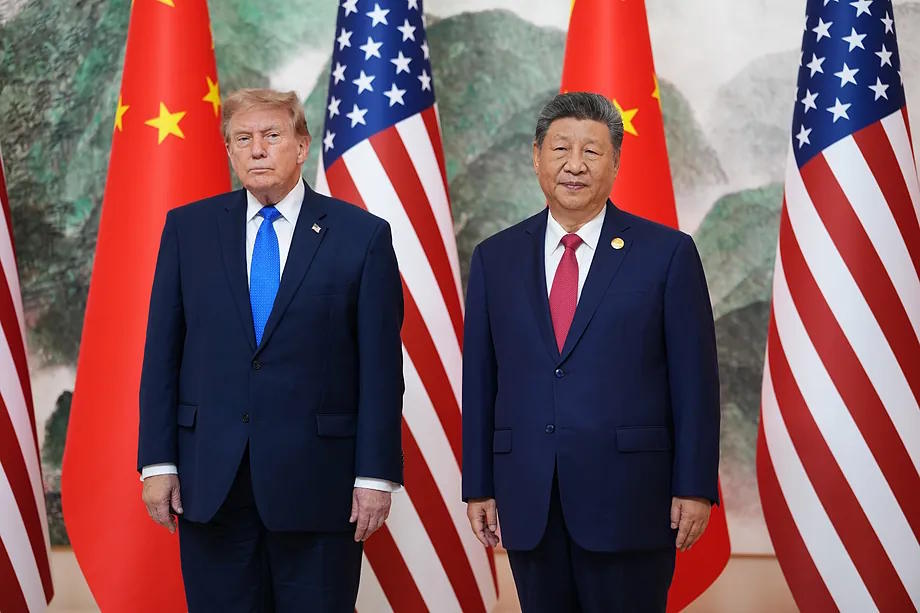
Donald Trump was already boasting about his rapport with Xi Jinping before meeting with him again. "I was with President Xi all night, sitting next to him, right at his side, and we talked throughout the evening," he told Fox News about the gala dinner on Wednesday. This Thursday, in Shenzhen, the two leaders met again amid gestures of cordiality and outstanding issues. Their compliments contrast with the rivalry of the two largest economies in the world.
Donald Trump again showered Xi with praise during their meeting this Thursday, before the trilateral meeting they would have with Vladimir Putin. "President Xi and I have forged an excellent personal relationship. Some dislike hearing that, but it makes me very happy," the American stated.
"It is an honor to be with you, my friend. We have a very special relationship," he added, before launching an unusually optimistic statement among leaders of two powers at odds on many fronts: "I believe that as long as you and I are in charge, we will never have any problems."
Beyond the compliments, the Republican laid out some of his main economic priorities. He announced that he would ask Xi to "do more for our farmers," referring to his insistence that Beijing increase purchases of soybeans and other US agricultural products.
"China has an insatiable appetite," he asserted. Trump also highlighted the tariff reductions agreed upon during his administration as proof of progress in trade relations between Washington and Beijing, although both governments continue to negotiate a broader agreement to solidify the fragile truce previously established.
The conversation also addressed one of the main focal points of international tension: the war with Iran and its consequences for global oil supply. Trump asserted that Washington and Beijing share the interest in ensuring the reopening and free navigation of the Strait of Hormuz, a strategic artery for global energy trade and especially important for China, one of the largest crude oil importers on the planet.
The US president maintained that both governments also agree on the need to prevent Tehran from developing nuclear weapons. "We both have an interest in ensuring that energy flows through the Strait of Hormuz and that Iran cannot have a nuclear weapon. We both firmly share that opinion," he stated.
This was their third meeting of the year, the fourth since the Republican returned to the White House. The sequence began in Busan (South Korea) in October 2025, with a trade truce. In May, Trump traveled to Beijing and was received with full honors. In September, Xi returned the visit to Washington. At this week's APEC summit (the main economic forum of the Asia-Pacific), they again demonstrated that personal understanding does not eliminate the dispute for global leadership.
Trump seeks economic concessions to present as victories after the Republican setback in the midterm elections. Xi wants Washington to treat China as an equal and stop hindering its rise. Both know that a rupture would be too costly, but neither wants to give up an advantage.
On the table was the fragile tariff truce, extended until January 10, 2027. However, the deeper battle is currently being fought in the technological arena.
The United States retains a privileged position in the design of advanced chips for artificial intelligence. China dominates the processing of rare earths, essential for manufacturing everything from electric cars to combat aircraft. Washington can restrict the supply of electronic brains; Beijing can cut off the flow of strategic minerals. Both sides have suspended some restrictions but retain their pressure tactics.
This standoff intensified on the eve of the meeting. The Trump Administration approved new rules to prevent Chinese companies from remotely accessing advanced US processors installed in foreign data centers. Until now, they could rent computing power in Singapore or Malaysia regardless of the chips. The new regulation requires licenses for certain shipments to countries deemed risky (like China).
Washington is thus seeking to close a gap in its technological blockade after the Nvidia scandal erupted. Jensen Huang, founder of the AI giant, resigned last week as CEO after several extramarital relationships were revealed, including one with Alice Huang, a Chinese businesswoman suspected of having ties to Beijing's intelligence services. The plot leads to Megaspeed, a Singapore company linked to Alice and examined for the possible diversion of advanced processors to China.
The case has intensified political pressure in Washington to tighten restrictions. Trump, close to the founder of Nvidia, downplayed the scandal. "I haven't heard he was a spy. He was a businesswoman buying chips, and who knows if she bought them well or poorly," he stated on Fox. He admitted that he briefly mentioned the matter during dinner with Xi, although the conversation mainly revolved around AI. "Whoever wins in artificial intelligence wins", proclaimed the Republican, asserting that Xi was surprised by US advancements.
The most delicate issue in the relationship between Washington and Beijing actually revolves around Taiwan. Xi considers the "reunification" with the self-governing island an unyielding historical mission.
On November 12, the Chinese leader spoke of peaceful integration, although China has never renounced the use of force. A few days earlier, according to Taiwanese security officials, the Chinese military had mobilized over a hundred military and coast guard vessels in the western Pacific, simulating attacks.
In Taipei, there are concerns about how far Trump will go to preserve his relationship with Xi. The US remains the island's main military backer but maintains ambiguity about how it would respond to an invasion. After his visit to Beijing in May, the US president suspended a $14 billion arms package for Taiwan and presented it as a negotiating chip.
Xi wants Washington to clearly oppose Taiwanese independence. The island's authorities fear becoming a bargaining chip in negotiations between the two superpowers.