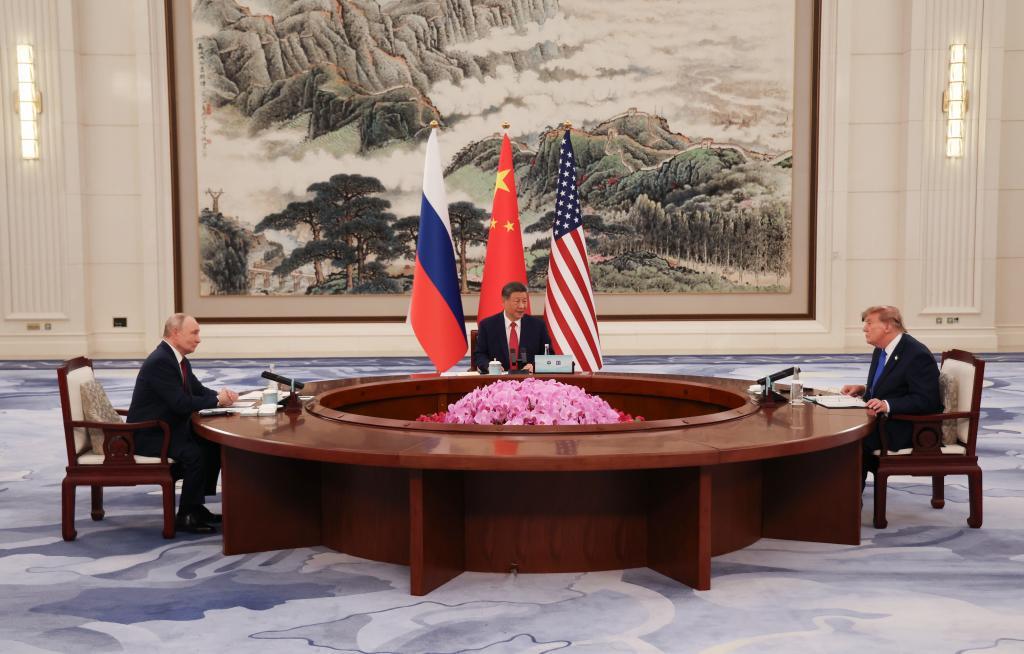
Vladimir Putin approached Donald Trump to greet him. In front of them was Xi Jinping, observing the meeting between his two most distinguished guests. Cameras captured the moment when the Russian president shook hands with his American counterpart and they exchanged a few words.
It was the first photograph of the three leaders together in Shenzhen, an image loaded with symbolism that anticipated the historic trilateral summit on Thursday. The scene took place Wednesday night during the gala dinner hosted by Xi and his wife, Peng Liyuan, for the leaders participating in APEC, the main economic forum of the Asia-Pacific.
Of the three, the Chinese leader arrives at the meeting in the strongest position. Trump (80 years old) has just suffered a severe setback in the midterm elections, which has reduced his maneuvering room in Washington.
Putin (74 years old), while maintaining a tight grip on the Kremlin, faces the consequences of an invasion of Ukraine that is nearing its fifth anniversary: an endless war that consumes enormous resources, burdens the Russian economy, and has deepened its isolation from the West and dependence on China.
Xi (73 years old), on the other hand, retains uncontested power within the omnipresent Communist Party and is on track to renew another term after a congress that will be held in Beijing at the end of 2027.
China is not without difficulties either. The entrenched real estate crisis, weak domestic consumption, and rising trade tensions with the West continue to weigh on an economy struggling to regain its former dynamism. But Xi projects stability and continuity in front of two weakened interlocutors.
Furthermore, beyond its borders, Beijing is expanding its influence with a trade surplus and leadership in forums like BRICS, particularly attracting the Global South. The Chinese president presented himself again on Wednesday as the great defender of multilateralism and mediator of conflicts.
For Putin, many analysts point out these days, sitting on equal terms with the leaders of the two largest economies in the world represents a diplomatic victory. Trump, for his part, seeks to regain international prominence after the electoral punishment.
Xi and Putin already showcased their harmony on Wednesday during a meeting of over two hours at an official residence on the outskirts of Shenzhen. "My old friend," the Chinese president greeted his Russian counterpart, praising a bilateral relationship "as firm as a mountain."
The meeting also served to coordinate positions before sitting down with Trump on Thursday. A meeting that Xi hopes to leverage to project the image of China as an indispensable power, without whose participation the major international conflicts can no longer be resolved nor the future of the world order decided.
Hence, numerous analyses in the international press insist on recalling the Yalta Conference of 1945 to draw parallels with the historic meeting in Shenzhen. Before the end of World War II, Franklin D. Roosevelt, Winston Churchill, and Josef Stalin met in Crimea to shape the post-war order. More than eight decades later, the possibility of three powers negotiating conflicts and spheres of influence behind closed doors worries many excluded countries.
However, beyond the narrative link, Shenzhen is not Yalta. There is no common war won. Washington and Beijing compete for technological and commercial supremacy. China and Russia maintain their strong partnership, although Moscow is increasingly dependent on its neighbor. Additionally, Chinese propaganda reminds that Xi's government publicly rejects the idea of three great powers governing the planet.
The nuclear issue, as Trump announced, will be at the center of the discussions. According to the Stockholm International Peace Research Institute (SIPRI), the U.S. and Russia each hold over 5,000 warheads; China has around 620 and is rapidly expanding its arsenal. Trump wants to negotiate tripartite reductions. Beijing resists because it considers it unfair to assume limits similar to those of its two rivals.
"The nuclear sword of Damocles hangs over all of us", warns Daryl G. Kimball, executive director of the Arms Control Association, an independent organization dedicated to arms control. The expert fears that, without new agreements, an unprecedented tripartite nuclear arms race may begin. "We need more than diplomatic theater and photo opportunities," he adds.
Kimball proposes that the presidents mandate formal and lasting negotiations, freeze the deployment of new strategic launchers—long-range missiles and bombers—and open discussions to prevent new nuclear tests. "One meeting is unlikely to produce significant advances," he warns.
Another issue on the table will be the danger of artificial intelligence intervening in decisions regarding the use of nuclear weapons. Major powers are incorporating AI systems capable of detecting potential enemy attacks, analyzing missile movements, and recommending military responses in seconds. The risk is that a computer failure, a false alarm, or a misinterpretation of data could trigger a nuclear escalation before policymakers can intervene.
Therefore, Kimball proposes that Xi, Trump, and Putin reach a binding agreement ensuring that the decision to launch atomic weapons always remains in human hands. "Their armies must create safety mechanisms to prevent an AI error from triggering a catastrophe", he concludes.
The Iran war will be another delicate issue. Trump wants to address a conflict that has cost him at home and shaken the Middle East. China has energy interests in the region, and Russia has close ties with Tehran.
The question of Ukraine will be much more sensitive. Initially, the White House had ruled out that the conflict would be on the summit's agenda. However, on Monday, Trump surprised by announcing that he would also address this issue with Xi and Putin: "We will talk about my favorite topic: Ukraine."
The correction fueled fears that Putin might try to negotiate the future of the invaded country without Ukrainians or other European countries. On this front, Beijing calls for a political solution without condemning the Russian invasion, but it is also wary of being dragged into that debate. Therefore, few concrete agreements are expected.
Taiwan, trade rivalries, and the technological battle could also loom over the discussions. Chinese Foreign Ministry spokesperson Mao Ning has announced a meeting of "transcendental importance." Perhaps no treaty or ceasefire will emerge from Shenzhen on Thursday. But Xi will have gathered the presidents of the U.S. and Russia on his territory to discuss the future of the planet. Before the statement, the host will have already achieved a victory: making China the center of attention.
Will Kim Jong-un appear in Shenzhen?
In anticipation of the trilateral summit, there is a fourth protagonist who, for now, remains out of the picture: Kim Jong-un. The possibility of the North Korean leader making a surprise appearance at the major diplomatic event organized in Shenzhen remains on the table. Trump has personally contributed to fueling the rumors. Before leaving Washington on Monday, the Republican reiterated his willingness to meet with Kim.
It has been more than seven years since they last saw each other. It was in June 2019 when Trump crossed a few steps over the military demarcation line separating the two Koreas and became the first sitting U.S. president to set foot on North Korean territory. That historic image seemed to open a new chapter in relations between Washington and Pyongyang. But nuclear diplomacy has since stalled. Kim has continued to strengthen his arsenal over the years.
Chinese authorities claim to have no information about a potential meeting between Trump and Kim in Shenzhen, while U.S. Secretary of State Marco Rubio has tempered expectations by warning that preparations for possible dialogue do not guarantee that it will ultimately take place.
Speculation has intensified after the Russian agency Interfax cited the Kremlin indicating that Putin could meet with Kim if he decided to attend the summit.