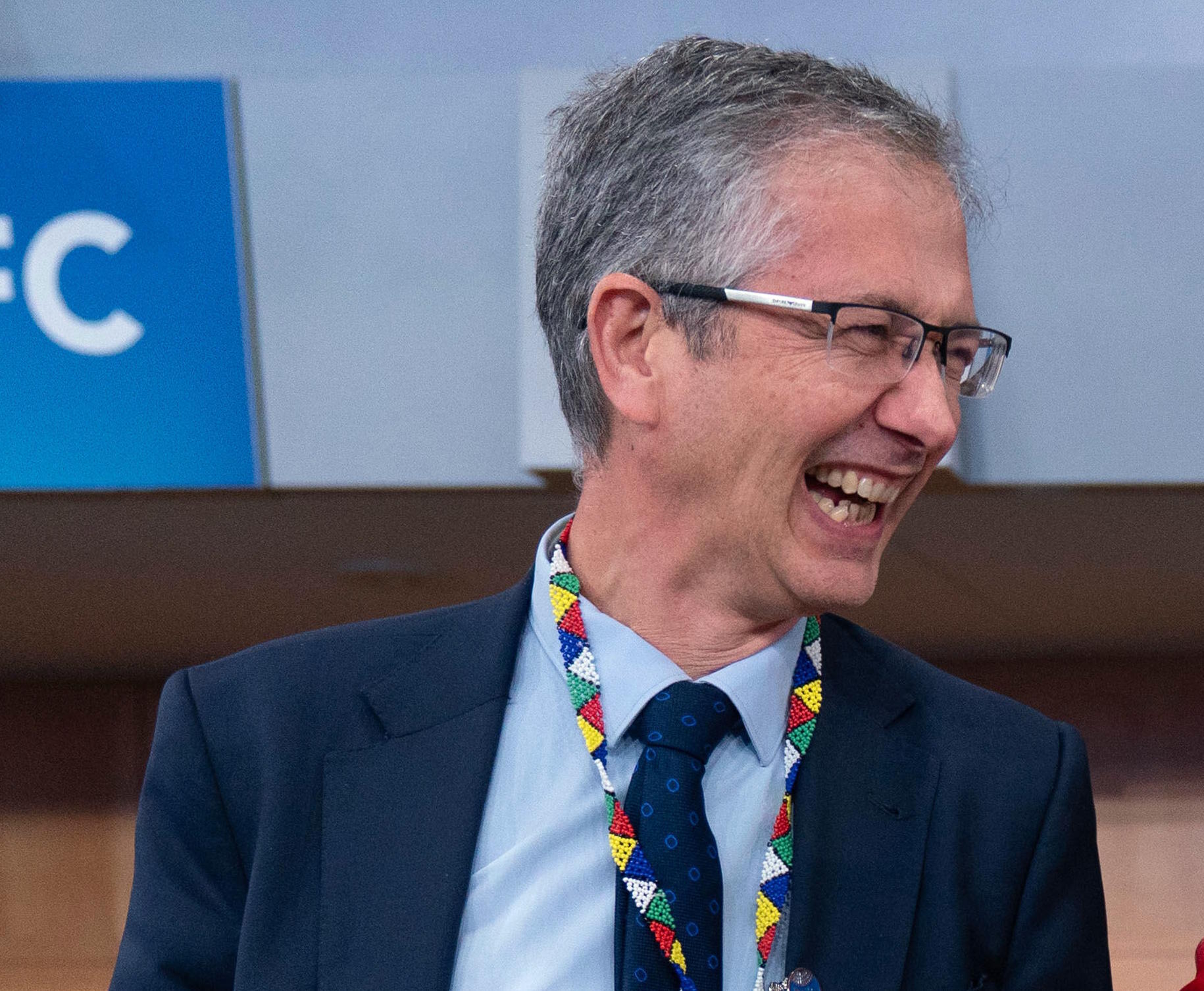
The Eurogroup has decided to extend the deadline until Friday, which was set to end this Wednesday, for presenting candidates for the renewal of the European Central Bank (ECB) leadership. Today was the deadline for countries to propose names to replace Chief Economist Philip Lane and Market Operations Head Isabel Schnabel. This was the final step needed for former Governor of the Bank of Spain, Pablo Hernández de Cos, to receive the definitive boost to secure the position, but it has been postponed without a clear explanation from either the organization or the countries.
The decision delays the potential appointment of Hernández de Cos, which was well advanced. However, sources familiar with the process confirm to EL MUNDO that this does not change or diminish the Spaniard's chances of being appointed, and that it is solely a bureaucratic procedure of the Eurogroup. They assert that the Spaniard will be the ECB president. Other sources add that it is a way to give time to the Dutch candidate, Klaas Knot, to submit his resignation so that countries do not have to vote.
"After consulting with member states, the deadline for submitting candidacies for two positions on the Executive Board of the European Central Bank (ECB) has been extended from today, November 18, to November 20, 2026," the Eurogroup reports.
Initially, Germany was to take the Chief Economist position, for which it appointed Markus Brunnermeier in Wednesday's Cabinet meeting. France would take the seat vacated by Schnabel. Paris renounced taking the position considered as number 2 of the ECB, which would be held by the German, in exchange for Hernández de Cos being the president instead of Knot.
The French economy carries a significant debt and faces serious deficit issues, and if a hawk like Knot were to become ECB president, his monetary decisions would put France in a very complicated situation. Hernández de Cos, on the other hand, is much more flexible and sensitive to the economic problems faced by the EU's second-largest economy. This distribution would balance the north-south weights of Europe, and sources consulted by this newspaper indicate that Italy has also given its approval to this arrangement, as Giorgia Meloni herself communicated on Wednesday.
For all these reasons, these same sources insist that Hernández de Cos's chances remain completely intact. He is the best candidate, it is only a matter of days, and in fact, the deadline for proposing new candidates for the presidency expired last week. There is no risk of a third name emerging, they add, which is something that some voices had suggested in recent days. If the current head of the Bank for International Settlements ultimately becomes ECB president, it will be the most powerful position a Spaniard has ever held at the European level.
He would be responsible for making significant decisions such as setting interest rates, and his role would be especially relevant in times of crisis. The greatest example is the work Mario Draghi did at the helm of the ECB during the euro crisis, when the survival of the common currency was in question and he stated that he would do whatever it takes to ensure its survival. And he succeeded with a speech in London.
The official designation is expected at the summit of presidents taking place next week in Brussels. The Vice President of the Government and Minister of Economy, Carlos Cuerpo, already indicated a few days ago that he was "optimistic" and that the work was already done. Only the arrangement of positions accompanying the presidency remained to be finalized. And events, despite the surprise this Wednesday, seem to confirm this.
The Sánchez government's support for Hernández de Cos's candidacy did not seem entirely guaranteed, as during his tenure as Governor of the Bank of Spain, he was very critical of the government's forecasts and many of its economic measures. However, his knowledge of the ECB and his good reputation within the institution made him the best possible option for Spain. And Moncloa has understood this.
Alberto Núñez Feijóo, for his part, has also defended Hernández de Cos's candidacy, as he did during the last European People's Party summit in Brussels last October. There, before German Chancellor Friedrich Merz, he conveyed to his popular colleagues that the former Governor of the Bank of Spain should be the ECB president. Something that, on the other hand, some suggest does not sit well with the current head of the Bank of Spain, José Luis Escrivá.