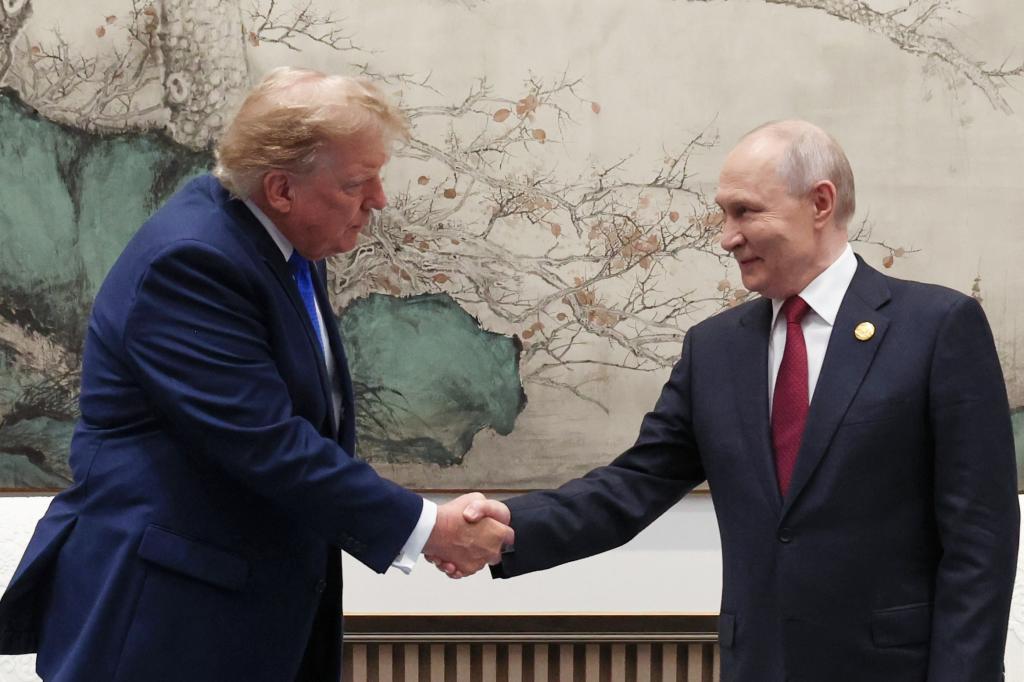
Thousands of kilometers away from the trenches of Ukraine, Donald Trump and Vladimir Putin met on Thursday to discuss a war that is about to reach its fifth anniversary. It took place in Shenzhen, the Chinese tech metropolis turned diplomatic epicenter. They met for 40 minutes before the anticipated trilateral summit with Xi Jinping.
Trump entered the room flanked by his Secretary of State, Marco Rubio, and Treasury Secretary, Scott Bessent. "Who is he? He is my friend," joked the U.S. president, pointing to Putin. The Republican then approached his Russian counterpart and extended his hand.
Trump then gave him a pat on the back while Putin held his elbow. Both initially maintained a serious demeanor, although the Russian ended up smiling when Trump leaned in to whisper something in his ear.
The scene, carefully captured by cameras before the two leaders took their seats, once again showcased the peculiar rapport between them. "I think many wonderful things can come from this, or at least lead to another meeting," Trump told reporters, hinting at his optimism about a meeting marked by difficult negotiations to end the war in Ukraine.
Isolated by the West since he ordered the invasion of Ukraine, Putin was once again sitting across from the U.S. leader, this time on the territory of his main strategic partner.
Putin emerged from the meeting in "excellent spirits," said his foreign policy advisor, Yuri Ushakov, in statements reported by the Russian state agency TASS. The senior Kremlin official explained that the war in Ukraine was the main topic discussed and described the conversations as fluid, although he avoided providing details on possible progress toward a peace agreement.
The last major meeting between the two took place in Anchorage, Alaska, in August 2025. Trump then extended honors to Putin that irritated Kiev and several European capitals. But the red carpet did not bring peace: the meeting ended without a ceasefire or territorial agreement.
More than a year later, this time in China, Trump is once again testing his personal diplomacy with a leader who has yet to abandon his military objectives. Washington speaks of negotiating opportunities; Moscow seizes every gesture of normalization without conceding on essential issues.
The main obstacle remains drawn on the map. Russia controls approximately one-fifth of Ukraine and also demands the Donbas areas that its troops have yet to conquer. For President Volodymyr Zelensky, withdrawing would mean surrendering Ukrainian cities and positions defended for years.
Contacts in Abu Dhabi this month allowed for progress toward a prisoner exchange, but did not resolve differences over territory and security. Envoys Steve Witkoff and Jared Kushner then traveled to Moscow to see Putin and to Ireland to meet with Zelensky.
The search for a peace formula has produced unusual proposals. According to the Ukrainian leader, U.S. negotiators suggested a withdrawal of Ukrainian troops from the Donbas in exchange for a possible NATO entry.
Putin continues to aspire for Washington to agree to discuss European security architecture. For Kiev, allowing Moscow to dictate its alliances would reward the invasion. Trump now seems to be seeking an exit that he can present as a diplomatic victory, while the Kremlin aims to consolidate on paper what it has conquered by force.
In recent weeks, Russia has intensified attacks on Ukrainian cities, power grids, and transportation infrastructure ahead of winter. Kiev responds by striking refineries and strategic targets in Russian territory. This week, a massive wave of drones attacked the Kerch Bridge, the connection to Crimea, disrupting traffic.
If Putin seeks to regain prominence in China, in Europe there is fear of being left out of the room where their future is decided. This Thursday, German Chancellor Friedrich Merz is gathering leaders from France, the United Kingdom, Italy, and Poland, among others, along with NATO Secretary General Mark Rutte. Witkoff and Kushner are also expected to participate. Europe demands to know Washington's movements and that Kiev has a voice.
The German meeting will address security guarantees following a ceasefire, reconstruction, and military aid. The European Commission has just proposed a loan of 45 billion euros for Ukraine, while London prepares new support with drones.
Zelensky is also watching with concern the photograph of the three presidents in Shenzhen. He has warned against a new Yalta, recalling the 1945 conference that redrew the European order.