The journey to the Troieshchyna district on the 14th became a perfect paradigm of the scenario that residents of Kiev face almost daily. Passing over one of the bridges crossing the Dnipro River, the visitor encountered the deployment of Ukrainian mobile units aiming their heavy machine guns at the sky.
The air raid alarm had just been activated. The sound of sirens echoed through the capital. At that precise moment, at 9:26 in the morning, the weaponry of a German-made Gepard armored vehicle began firing into the heights, generating sudden commotion among the drivers crossing the thoroughfare. After a few seconds, a huge explosion was heard. The Russian unmanned aerial vehicle (UAV) had been destroyed.
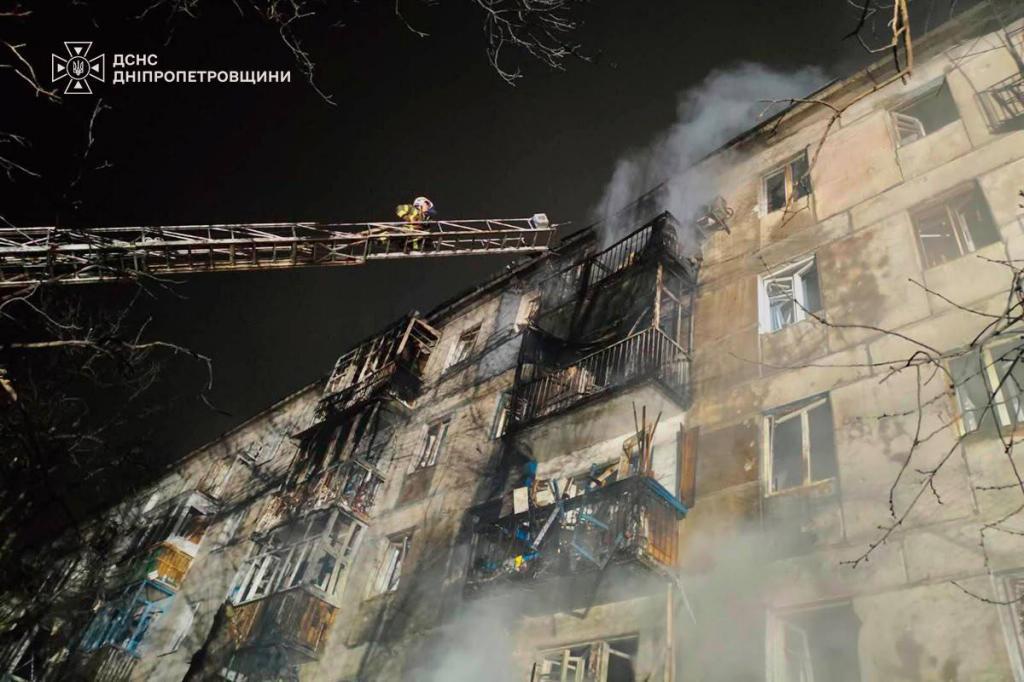
Despite renovation efforts, the building where Natalia Khodemchuk lived in Troieshchyna still shows the marks left by the incident that was exactly one year ago on this November 14th.
The fire left a clearly recognizable mark on the 6th, 7th, and 8th floors of the apartment block.
Tatiana Lukina, 72, met Natalia in Pripyat in 1985. Natalia's husband, Valerii, had started working at the Chernobyl Nuclear Power Plant that same year. On April 26, 1986, he was on duty at the facility. Ukrainian media identify him as the first victim of that brutal accident. His body was never found.
Natalia and Tatiana, like many tens of thousands of others, were hastily evacuated from Pripyat and 457 other towns in what is now Ukraine, Belarus, and Russia.
A Russian Geran-2 UAV that attacked Ukraine is displayed at the National Museum of Military History in Kiev.Kostyantyn Chernichkin
Ukrainian media estimate that over 62,000 were resettled in Kiev. Many in the suburb of Troieshchyna, in what are now called the Chernobyl Houses, right next to the park that commemorates that catastrophe.
On November 14, 2025, the remains of a Russian drone shot down by local air defense crashed into the seventh-floor apartment where Natalia lived, who was 73 years old. "She managed to walk out and get into the elevator. She had very severe burns. That's why she died the next day in the hospital," Tatiana specifies while walking through the area, showing the monuments that remember the tragedy of 1986 and the destroyed dwelling in 2025.
The Ukrainian alternates memories of 1986 with the new challenge that Chernobyl survivors must face once again due to Moscow's actions.
"You see the 'Shahed' (Russian UAVs) flying by while children play in the park. There are several buildings, not just Natalia's, that have suffered impacts," she explains.
In the same apartment where Natalia lived, Aalina Shynkaruk now resides. The impact of that incident ripped the door off her apartment.
The lady, who is also a displaced person from Pripyat, acknowledges the hardships caused by the Russian attacks. "Sometimes we only have two hours of electricity a day. We've been like this since October. We can look out the window and see the 'Shahed' flying. But this time we won't leave. We've had enough of fleeing from Chernobyl," she says.
Residents of the Chernobyl House climb the stairs using flashlights even at this hour of the morning. The supply was interrupted hours ago, and the interior of the building is dominated by darkness.
Tatiana Lukina is one of many neighbors in Kiev who are having to resort to ingenuity to cope with the increasing power and water outages that the village endures.
"I cook with candles placed in the kitchen sink, which I cover with a metal grate. I saw it on TikTok," she explains.
Her case is not unique. Figures like former firefighter Konstantin Yakymenko, 37, have become true media stars with millions of followers on that platform by offering all sorts of improvised solutions to the hardships anticipated this winter.
From recipes to create alternatives to powerful 100-watt lamps with a simple mixture of water, salt, milk, and dye, to recommendations on how to seal toilets to avoid flooding from sewage that could result from the collapse of the drainage system if power outages persist.
"The video on how to cook with candles has had over 30 million views (Ukraine has fewer than 40 million inhabitants). Fixing things around the house has always been my hobby, but now it's my only focus (the recordings for TikTok). Ukrainians want practical solutions to survive this winter," he states in a phone conversation.
After more than four years of full-scale war, and in the face of the incessant and growing Russian air offensive, services in Kiev—a urban center with nearly three million inhabitants—are beginning to suffer accelerated deterioration.
The image of the village almost in darkness at night—which here begins shortly after five in the afternoon—is already a constant. With the implementation of emergency cuts in the capital on the 6th, blackouts can exceed 12 hours a day.
Endless lines of pedestrians walking across the bridges that cross the Dnipro, illuminated by flashlights, have also become normal when these crossings are blocked or damaged by Russian attacks.
Water outages began to proliferate in October. According to the accounting of the BBC in Ukrainian, residents of the capital have faced power outages accompanied by interruptions in the supply of running water at least six times since last month and up to the first 10 days of November.
At the beginning of this month, one of the outages lasted more than 20 hours, impacting the precarious situation facing the water supply network.
Although limited—the city still has the comforts of any European capital—these increasingly frequent adversities intertwine with the recurring sound of air raid alarms, which forces businesses, transportation, and many other activities to come to a halt.
According to the accounting kept by specialized websites like Alerts Kiev, the population recorded 296 alerts of attacks in October, which extended over a total of 196 hours. In the first two weeks of November, there were already 81 alerts and more than 63 hours under that condition.
The premises of the Military Museum of Kiev have set up a new exhibition this year showcasing the latest advancements in military technology, which both this country and its adversary, Russia, are experiencing.
Alongside bows and arrows, sabers from the Cossack era, or machine guns and cannons from wars of the last centuries, the installation directed by Yuziy Bilovus displays everything from first-generation 'Shahed' drones—those that Russia imported from Iran—to their Russian modifications, the Geraniums, or several reactors of the latest models, which are overwhelming local air defenses.
"Telefly TF-TJ2000 from a Geranium-5 drone. This Chinese engine allows it to reach speeds of 450-600 kilometers per hour. Since early 2026, Russia has actively used them to attack Ukrainian civilian targets," reads one of the signs placed next to the device.
Bilovus spent the night before the journalist's visit sleeping on the floor of his apartment, alongside his daughter and wife. "Unfortunately, we have normalized this situation. Whenever there is an alert, we put the mattress in the hallway to be protected by two walls, and we sleep there. I just bought a gas heater to prepare for winter," he comments.
The Main Intelligence Directorate (GUR), one of Ukraine's intelligence services, reports that many of the components used in the UAVs and Russian rockets that are attacking Kiev daily are not only Chinese.
Displaying an array of integrated circuits and controls taken from the latest Geran-4 and Geran-5 models, Eduard—a member of the GUR (Ukrainian Military Intelligence) who specializes in analyzing such devices—explains that these UAVs operate using dozens of electronic components from firms such as the American companies Texas Instruments and Altera, as well as companies based in Switzerland, Germany, and the United Kingdom.
The agent warns that the Russians have begun developing an even more advanced version of the UAV—one that barely fits into that category anymore and effectively functions as a low-cost missile: the Geran-5 K5-5. "It reaches speeds of up to 600 kilometers per hour and flies at an altitude of over 6,000 meters. It is beyond the reach of our interceptor drones. One solution would be to develop low-cost interceptor missiles; using UAVs for interception is becoming increasingly ineffective," he adds.
"A new tragedy"
Although it may seem contradictory, the GUR asserts that of the 93 electronic components found in the K5-5, the vast majority (52) originate from the United States.
"They aren't exported directly—which is prohibited—but they are sold to China, and Russia manages to get them into its own hands," he explains.
The symbolism of Natalia Khodemchuk's death was not lost on any observer. It was also noted by Ukrainian President Volodymyr Zelenskyy, who described her passing as "a new tragedy caused, once again, by the Kremlin."
This metaphor came to mind for many on May 24, when a Russian missile partially destroyed the Chernobyl Museum—a site that had served as a memorial to the nuclear disaster since its opening in 1992.
The explosion brought down sections of the walls, and the resulting fire gutted the entire third floor of the building. "We had just reopened in April following three years of renovations. We are currently seeking funding for the restoration, as we need at least six million dollars to rehabilitate the entire facility," explains the director, Vitalina Martynovska, as she walks past shelves still piled high with debris.
On the floor of the second level, a twisted piece of metal from the missile still remains.
Like many residents of Kyiv, Vitalina seems to maintain her composure amidst this crisis, which shows no sign of ending. "We will rebuild it, and it will be even more beautiful. We plan to incorporate the piece of the missile that destroyed it, and we will dedicate a special section to Natalia Khodemchuk and her husband, Valerii," she declares.