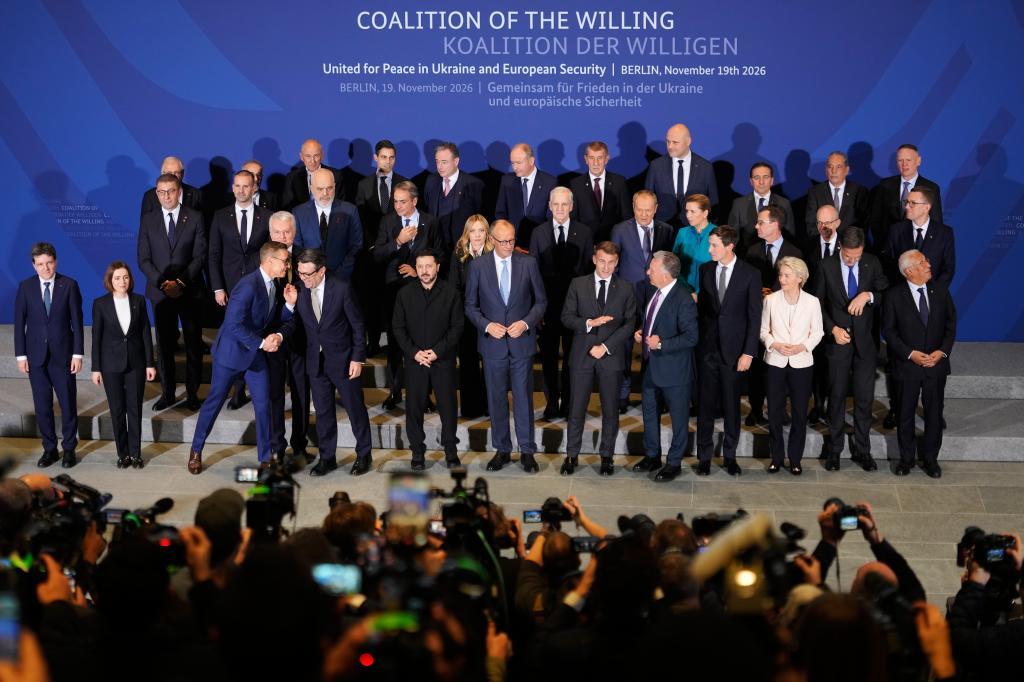
The Volunteer Coalition is a group of countries, mostly European, committed to ensuring Ukraine's security when the war ends. It was formed in March 2025 at the initiative of the United Kingdom and France, when Donald Trump's return to the White House raised fears in Europe of a peace agreement negotiated behind Kiev's back and without guarantees against further Russian aggression. It is no coincidence that these two countries, both heavily committed to Ukraine, are leading the deployment: both possess nuclear weapons to deter any country that might want to attack them.
This coalition consists of 40 countries, although today only 11 are interested in contributing troops to its contingent. Its roadmap is the Paris Declaration of January 6, 2026, which stipulates that once a ceasefire comes into effect and at Kiev's request, a Multinational Force for Ukraine will be deployed. It would be led by Europe, with a joint Franco-British command and headquarters in Paris (which will soon move to the United Kingdom), and with a ceasefire monitoring mechanism directed by the United States. This force would not act as blue helmets nor be on the front lines.
After the meeting, European leaders made clear their intention to be part of the peace negotiations. "We are ready to enter discussions. Europe has a clear and coherent negotiating position", stated British Prime Minister Andy Burnham. However, Europe watches with suspicion the trilateral meeting in Shenzhen, which indicates that the continent could be excluded and without decision-making power in resolving the war between Russia and Ukraine, which has been ongoing since the large-scale invasion in 2022.
German Chancellor Friedrich Merz, host of the meeting, rejected any attempts by other powers to divide Europe: "A 'Yalta format' will not bring peace. It is we who must determine our destiny", he declared. He referred to the World War II conference where the United States, the Soviet Union, and the United Kingdom "divided Europe," in his words. He also announced a meeting between Europe and the Kremlin in the United Arab Emirates, with no date set, according to EFE news agency.
"Once there is peace in Ukraine, Europe must be safer than before, with a strong European pillar of NATO, and not less safe, as Russian President Vladimir Putin demands when he unrealistically calls for allies to retreat to the 1997 borders," Merz said. "The proper sequence is needed now, the correct order: first peace in Ukraine, then agreements on Euro-Atlantic security," the chancellor noted, admitting that, "in due time," there will also be a need to "talk with Moscow about military communication channels."
It is striking that Spain participates with only seven officials, a very minimal contribution for a country of its economic weight that has been so involved in NATO's collective defense, with missions in the Baltic and throughout Eastern Europe.
U.S. President Donald Trump participated by phone in the meeting, according to several European officials informed about the conversation who requested anonymity, as Politico reported. During the call, the Republican leader harshly questioned the ongoing spending of allies in military support for Kiev. And, according to the same outlet, he expressed strong skepticism about the possibility that the so-called Coalition of the Willing would provide billions of additional dollars to Ukraine. Trump also told European leaders that Vladimir Putin is willing to negotiate to reach a peace agreement.
One of his two envoys, Steve Witkoff, stated at the public appearance following the meeting: "[Trump] sent Jared and me specifically to be part of the Volunteer Coalition, and he has instructed us to do everything possible to end this war and support that effort. And what I heard from him in today's call was that he mentioned these same principles to the other two leaders he met with."
The mission of the Multinational Force will be to help rebuild the Ukrainian army, monitor airspace, carry out all kinds of logistical and training work, and clear mines from the Black Sea to restore normal civil traffic. Between November 9 and 22, about 2,800 soldiers from 11 countries, including Spain, are rehearsing their deployment in Poland in the first exercises of the coalition. This means it is a full-scale exercise, with all participating countries making the deployment.
Plans to implement it are now progressing at a certain speed. For now, the European capitals participating in the deployment are ignoring Putin's messages, which warn that he will not accept foreign soldiers in Ukraine and that if they are deployed, he will consider them targets. However, coalition sources clarify that "this is not a combat force deployed on the battlefield seeking confrontation with Russia, but rather a contingent aimed precisely at deterring Russia once we have a ceasefire, so that it does not invade Ukraine again."
Those same sources admit that "Russia does not seem very interested in peace", although they acknowledge the United States' efforts to create conditions to end hostilities.