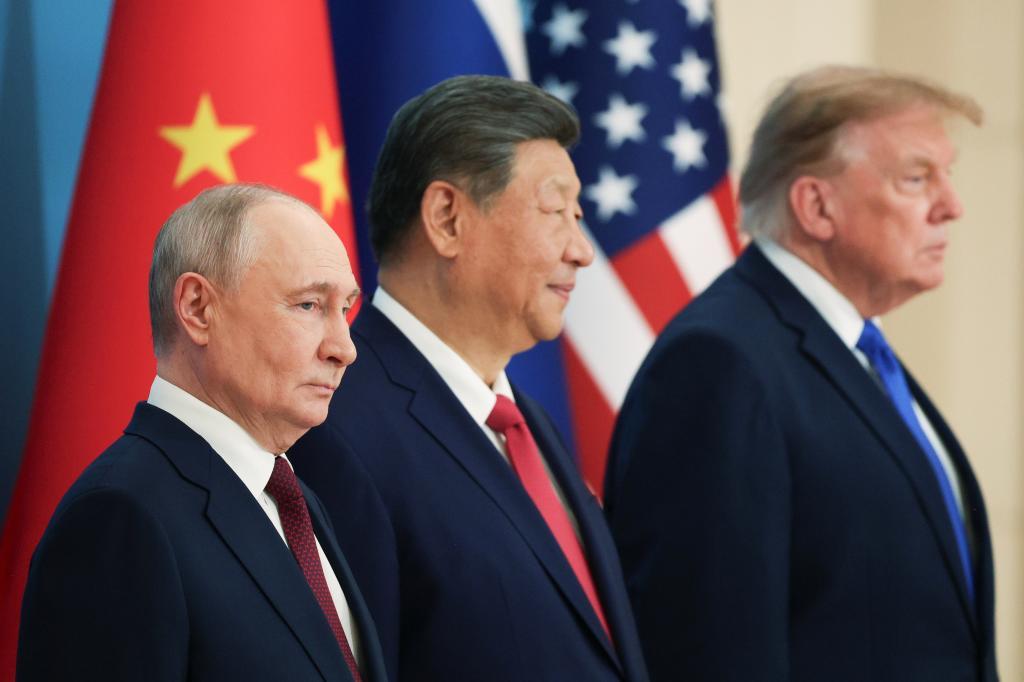
"We share the responsibility of maintaining global peace and security." This phrase was spoken by Vladimir Putin, the president who ordered the invasion of Ukraine, sitting next to Donald Trump and Xi Jinping. The Shenzhen summit produced an unprecedented photograph of the three largest nuclear powers meeting together. They discussed disarmament and peace while their wars and rivalries shake the world.
The meeting, lasting nearly an hour and a half, took place in a complex of gardens and villas inspired by European architecture. Xi was the host; Trump sought a diplomatic success following his electoral setback, and Putin aimed to break the image of isolation caused by the invasion.
"We are making history. We all have a lot to talk about," proclaimed Trump as he opened the discussions. He advocated for dialogue with his rivals. "Too often, past leaders avoided talking to countries with which they had disagreements. We think the opposite," he asserted.
Xi defended dialogue as a guarantee of stability. "When the most important countries live in harmony, the world enjoys peace. When they confront each other, the world falls into chaos," he warned. He evoked the fight against fascism: "In this global village, great powers have special responsibilities."
Putin referred to the same historical episode. "Our three states are the victors of World War II," he stated before assigning them the mission of preserving peace. The contradiction was evident: the one presenting himself as a guarantor of peace has been waging a devastating war against Ukraine for nearly five years. That conflict had overshadowed his previous meetings with Xi and Trump and loomed over the trilateral encounter.
Putin argued for the existence of common interests to resolve major international conflicts, including the war he himself initiated. Trump expressed optimism, though without announcing concrete advances.
"I believe things are happening. I think Putin, and I hope the other side as well, wants this war to end," the American stated. But the positions remain far apart. Moscow aims to retain its territorial gains; Washington seeks an agreement that Trump can present as a diplomatic victory; and Beijing insists on a negotiated solution while maintaining its political and economic support for the Kremlin. The great absentee from that table was Ukraine, whose future was discussed without the presence of its president, Volodymyr Zelensky.
The war in Iran was also on the agenda. "We will not allow them to have a nuclear weapon," warned Trump, who just hours before the trilateral summit had stated that he did not need the help of China or Russia to end the conflict.
Washington aims to prevent Tehran from developing atomic weaponry and to condition any negotiated exit, while Moscow maintains a close strategic and military partnership with the Iranian regime. Beijing, for its part, has significant economic interests at stake: it is the largest buyer of Iranian oil and fears that a military escalation in the Strait of Hormuz could threaten its supplies.
Trump raised the issue of reducing nuclear arsenals during the meeting. "As the three largest nuclear powers in the world, we are in a privileged position to discuss how to reduce the number of nuclear weapons and decrease the risks they pose," he maintained. But he acknowledged the difficulty: "Once you have nuclear weapons, it is very hard to get rid of them."
The New START treaty, the last major agreement limiting strategic weapons between Washington and Moscow, expired in February. Russia has about 5,420 warheads, the U.S. has 5,042, and China has 620. Trump aims to incorporate Beijing into a new system of restrictions, but Xi refuses to assume equivalent obligations.
"Nuclear weapons are the sword of Damocles hanging over humanity and should be banned and completely destroyed," warned Xi, who called for doing everything possible to avoid a nuclear war.
These words contrast with Beijing's policy, which is undergoing one of the fastest expansions of its atomic arsenal, with the construction of new missile silos and the development of increasingly sophisticated nuclear weaponry.
The summit concluded with a joint statement in which the three powers committed to maintaining discussions to reduce nuclear risks, prevent the proliferation of atomic weapons, and preserve international strategic stability. A commitment of principles that, for now, did not translate into concrete disarmament agreements.
Another commitment included in the joint statement was the reform of the United Nations. "As permanent members of the Security Council, China, Russia, and the United States commit to reforming the UN so that it can respond more effectively to global challenges and fulfill its fundamental mission of maintaining world peace and security," the three leaders stated.
However, the statement did not detail what changes they intend to promote nor did it establish a timeline for implementation. A particularly striking declaration given that the deep differences between these three powers have often contributed to paralyzing the Security Council, especially following the Russian invasion of Ukraine.
At the start of the meeting, one of the surprises was Trump's attack on the International Criminal Court, which ordered Putin's arrest in 2023 for the alleged illegal deportation of Ukrainian minors. He labeled it a "dishonest globalist organization" that "has gone out of control" and proposed studying how to protect the sovereignty of countries against similar institutions. Thus, he attacked the tribunal that demands the arrest of the Russian leader sitting next to him.
In the evening in Shenzhen, Putin appeared before reporters to assert the historic significance of the meeting. He revealed that it was Xi Jinping who proposed bringing the three leaders together. He also expressed no doubt that Trump "will sincerely strive to resolve international conflicts." Among the issues discussed, he revealed an agreement to monitor security risks related to certain artificial intelligence applications.
Putin also did not shy away from comparisons with the Yalta Conference of 1945, when Stalin, Roosevelt, and Churchill negotiated the post-war international order. "What was wrong with Yalta? What was wrong with it?" he responded defiantly. The Russian president defended that those agreements laid the foundations for the UN and helped prevent a new world war for eight decades.
More revealing was his interpretation of what a new Yalta should mean. Putin rejected that the three leaders had met in Shenzhen to divide the planet. "At Yalta, no one divided the world. They simply codified the realities that had emerged after World War II," he maintained. And he added a phrase that seemed directed straight at Ukraine: "Regarding current conflicts, the reality on the ground must be accepted".
Far from announcing progress toward peace, the Russian leader hardened his rhetoric regarding the new attacks on the Kerch Bridge, which connects Russia with the illegally annexed Ukrainian peninsula of Crimea in 2014.
He claimed that he had considered negotiating a ceasefire in certain areas under Russian control, but that the attacks had frustrated that possibility. "We do not use this bridge to transport military equipment or any kind of war material," he stated, presenting it as an exclusively civilian infrastructure. The Russian president promised retaliation: "Our response measures will be much more painful."
Putin also revealed that Trump had encouraged Russia to normalize its relations with the European Union, although he again blamed the Europeans for the deterioration of ties with Moscow. Regarding Trump's invitation to attend the G20 summit in December in Miami, he avoided committing and claimed he needed to consult his schedule.
The Shenzhen summit left a historical photograph, many handshakes, and grand declarations about world peace, but no relevant agreements. No concrete advances to end the war in Ukraine, no commitments to nuclear disarmament, nor a roadmap to resolve international crises. Trump, Putin, and Xi showcased their power before the cameras. Much diplomatic staging and few results for a summit that had raised enormous expectations.
Explained in Xi's words: "China, Russia, and the United States must be allies and friends, without conflicts or confrontations, respecting the fundamental principle of peaceful coexistence."