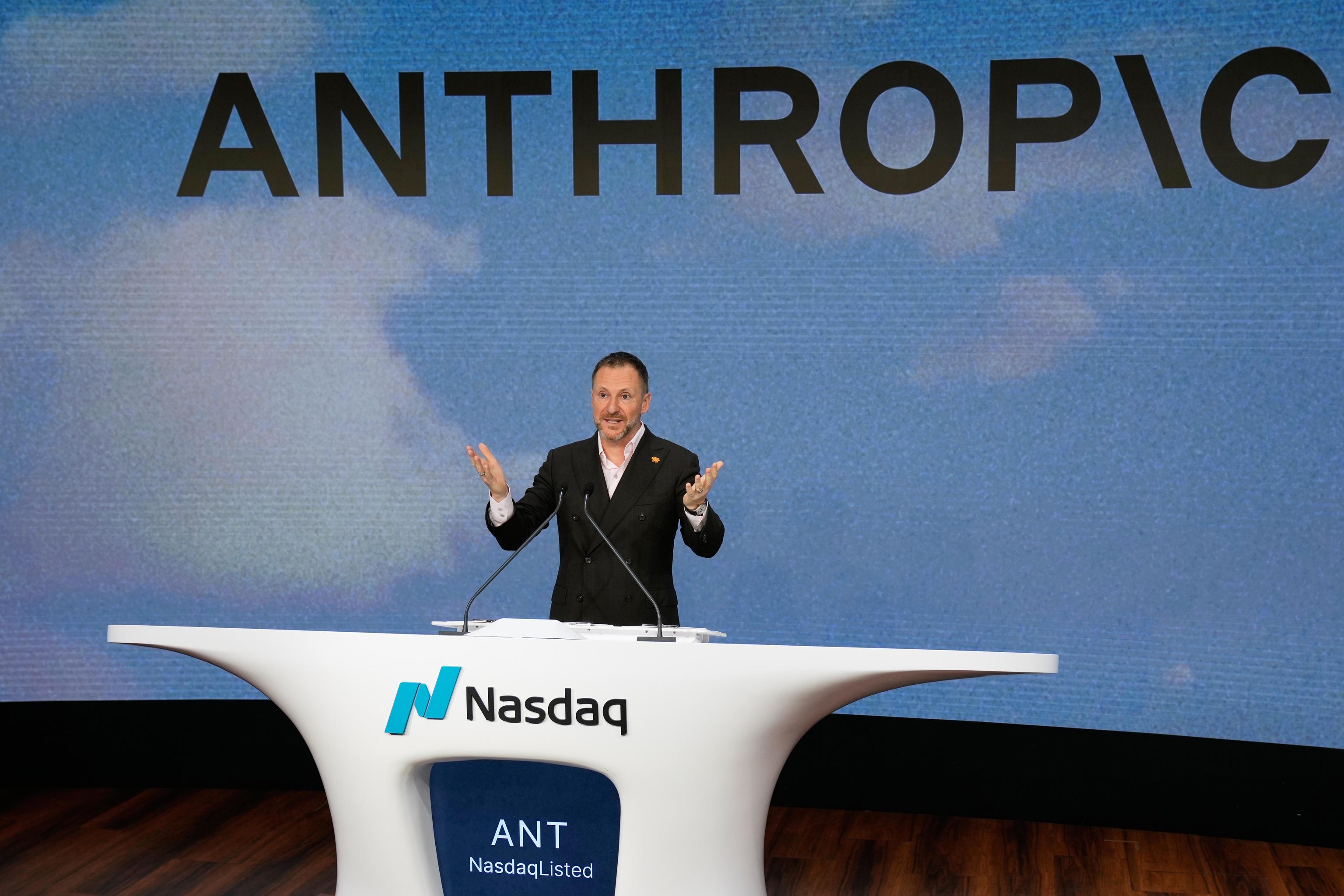
Anthropic solidified yesterday the era of mega-IPOs with its initial valuation of over $1.5 trillion. Not only did it achieve demand that multiplied the offered shares by 7, but on its debut, after selling more capital than expected (up to $107.3 billion), it surged. Its gains were 17% at the close of Wall Street, with peaks above 30%. But 24 hours later, the reality is different. In the global time zone relay that investors follow, Asian markets suffered drops of 5%; then it was Europe's turn, and in the afternoon (European time) on Friday, the sell-offs spread to Wall Street.
The fear of a bubble remains, following the mirage that Anthropic's bell ringing seems to have been. This Friday, the giant led by the Amodei brothers anticipated a drop of over 9% from early on. It is not the only company; others like SpaceX, Meta, Microsoft, and of course, Nvidia, the black swan in this exodus, have joined. Since the global semiconductor sector correction began, the company founded by Jensen Huang has lost 40% of its market capitalization, about $2.23 trillion, and 10 points more than the index to which it belongs. It has returned to June 2025 lows.
In any case, the Amodei brothers along with the other founders of Anthropic have joined the Billionaires Index compiled by Bloomberg, starting from position 100. Daniela Amodei has publicly revealed a net worth of $24 billion as she holds 1.3% of the company's capital. Her brother follows with $23.6 billion solely in Anthropic shares, along with the other five founders, Tom Brown, Jack Clark, Jared Kaplan, Sam McCandlish, and Christopher Olah, each with the same percentage.
The Philadelphia Index, a benchmark for global chip manufacturers, is struggling to recover after weeks where events have validated those who thought that the valuations of companies working in or for artificial intelligence might be somewhat inflated. Semiconductor companies, data center builders, energy suppliers for this industry, and cloud infrastructure creators have seen their stock trajectories sharply twist, not only due to fears about their trading multiples but also due to increased scrutiny of their sector. The U.S., the largest investor and driver of their business, has changed course after the Democratic victory and is now seeking to slow down and better analyze the development of artificial intelligence, partly because its direct impact on citizens is already being felt. This is the case, for example, of Americans living near data centers that are driving up energy prices for the population.
In this context, indices like South Korea's Kospi have plummeted another 8% in the last five days. There, Samsung and SK Hynix account for 80% of the local market capitalization, a bad sign when the correction is destroying the value of companies dedicated to chip manufacturing.
In Europe, the Ibex 35 is on track to close the week with declines exceeding 5.5%, having lost the 19,000-point level. The sell-offs are spreading to other major continental markets where the German Dax has lost more than 7% over these five days; meanwhile, Paris and Milan, more aligned with Madrid, have dropped over 5%. In the U.S., declines are steeper for the Nasdaq 100, reaching up to 6% not counting Friday's session of significant corrections.
This has also been the week in which Nvidia and its interim CEO, Colette Kress, have come forward to clarify that Huang will not return to the CEO position following scandals involving various women, including a Chinese spy and several subordinate employees within the company. Voices like that of U.S. President Donald Trump or Huang himself offering to return had raised doubts about the future of the world's largest chip company. Additionally, Nvidia reported record results, exceeding expectations, with revenues of $115.8 billion in just the third quarter, doubling last year's figures. And not only that. It also sought to reassure investors with a roadmap anticipating revenues of $130 billion in the fourth quarter.
"If such a solid earnings report fails to boost the stock, it is evident that investors are looking beyond the current quarter. Colette Kress has provided stability and confidence, but investors are still adjusting to a Nvidia without Jensen Huang (...) Nvidia's stock has lost its way," say sources from eToro, who believe that appointing a definitive CEO is necessary to restore stability to the stock price.
But none of this is enough... and has raised the question again of whether having companies of such magnitude in the market is positive for all investors. The issue is that Nvidia's weight in the indices to which thousands of funds globally are indexed is now a problem. And it's not just Nvidia; the same applies to other major American tech companies that in recent years have undergone a clear concentration process into a handful of names. Rivers of ink have been written about this, but once again: the U.S. represents 72% of the MSCI World, and tech companies as a sector account for nearly 30%. This means that when a Spanish investor buys a global stock ETF, they are essentially investing their money in Apple, Nvidia, Microsoft, Amazon, Alphabet, Broadcom, Meta, and Tesla. The top two alone account for 11%.
From the German manager Deutsche AM, they acknowledge that "it's easy to understand why some already consider the supposed AI bubble to have burst," after many of its companies have fallen 50% since June. However, they do not see panic selling at a general level nor do they believe it marks the end of investor confidence in artificial intelligence, but rather a certain rationality. "The recent corrections in some areas of the AI sector have less to do with the end of the investment cycle in AI and more with a healthy normalization process. In fact, the resilience of the overall market demonstrates that the story of equities goes far beyond AI," they assert.