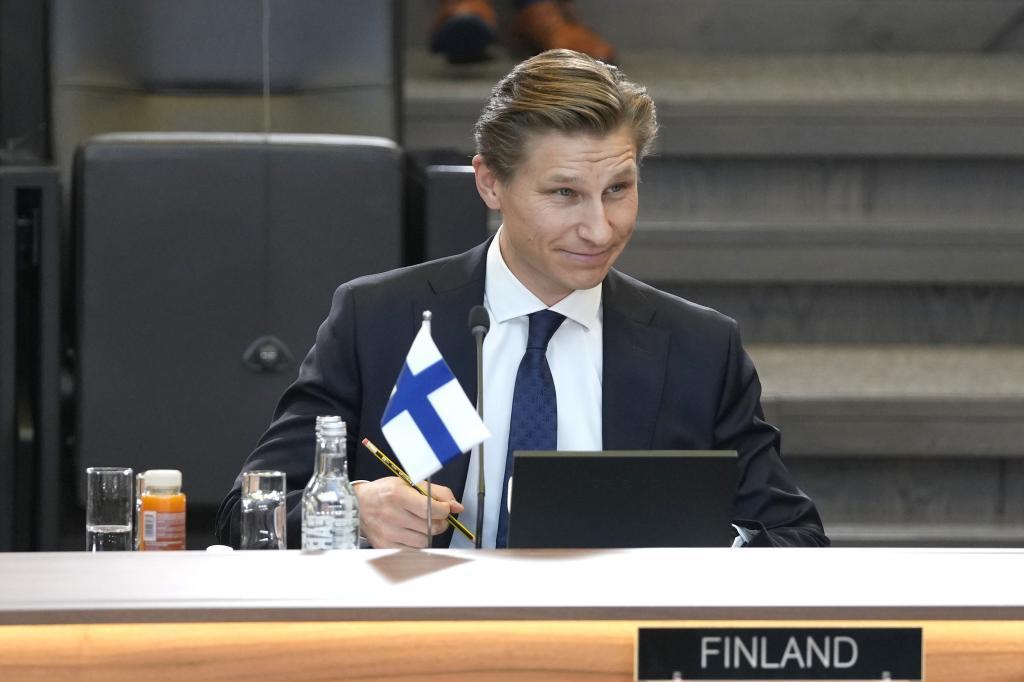
Antti Häkkänen (Mäntyharju, 1985) is the Defense Minister of Finland. He meets with EL MUNDO alongside a group of European journalists at his ministry's headquarters in Helsinki. From the very beginning, he is very firm about the threat posed by Russia. For his country, for Europe, and for the North Atlantic Treaty Organization (NATO).
"We are not surprised that Russia is behaving aggressively again. We have always tried to maintain diplomatic relations with them, but every so often they resort to violence. Usually, first against their own population and then against some of their neighbors," Häkkänen begins, highlighting the experience the Finnish people have accumulated after more than two centuries during which Finland has been first dominated, and then attacked and harassed by Moscow.
"The Germans started with their Ostpolitik, and for the last 50 years, especially the last 20, European countries thought they could reach an understanding with Russia through energy, trade, and economic relations. But Russia used European money to strengthen its army. First, it attacked Chechnya, then Georgia, then Crimea, maintained a war in Donbas for eight years, and finally launched a large-scale invasion of Ukraine four and a half years ago. We must learn the lessons of our relationship with Russia," Häkkänen continues. "And what we are seeing now, the way Russia is preparing, is also a consequence of what happened in Ukraine. They are preparing for a prolonged period of tensions, to confront the rest of Europe or threaten it, with significant backing from China and North Korea," he adds.
The support of China for Russia is a point the minister emphasizes multiple times during the interview, where he also discusses the "new nuclear era" the world is entering. "China is significantly increasing its capabilities, as are other countries, and Russia is using aggressive nuclear rhetoric. And this is not just rhetoric. Because, in nuclear politics, rhetoric is part of the use of nuclear weapons as an instrument of pressure and threat against Ukraine and the countries that support it," he points out.
With this last statement, Häkkänen directly refers to the threat that Russia made in a letter last September when it stated that it was "prepared to use all the arsenal of forces and capabilities at its disposal, including nuclear weapons, to defend its territory in case NATO countries undertake any attempt to isolate the Kaliningrad region from the rest of the country." That shook Europe and prompted a response from the Alliance itself, which firmly condemned "the threat of the use of force, including any irresponsible nuclear rhetoric." "That is also part of the nuclear strategy", the Finnish official reiterates.
"That is why we modified our legislation and removed those absolute prohibitions to allow nuclear weapons when necessary for defense and for NATO in critical situations," Häkkänen continues. It was in June of this year when Parliament approved the reform with 125 votes in favor and 61 against, which came into effect on July 1. "I know that there are some political parties that still hold a Cold War mindset in this area. But we must wake up and understand that if we do not have our own deterrence, we put our ability to withstand Russian pressure and coercion at risk," he adds.
The minister also highlights the strong commitment of the Finnish citizenry to the defense of the country. "More than 80% of Finns say they are willing to defend Finland. It is the highest figure in Europe. Normally, in other European countries, that willingness hovers around 15% or similar figures. People are not as willing to defend their countries."
And in the conversation, he does not forget what the role of Western European countries should be in the face of Russia. Including Spain, of course. "The United States has made its political position clear: the leadership of conventional defense must fall on European countries. And that is something very important for all of us, including Western European countries," he points out.
Question. Do you have a message for Belgium, which does not plan to increase its defense spending above 2% of its GDP until at least 2029?
Answer. I don't have specific messages for individual countries or politicians regarding how much they should spend. But let me put it this way: is there anything more important for which we need European unity than confronting a war against European nations? Is there anything more important? That is why investing in defense—as a NATO and European Union member—is now a fundamental issue for defending all European values. And if we don't do this together, I don't see the point of European unity. This is the gravest threat. Russia poses a military threat to European countries and is endangering all our values. If Russia were to trigger some kind of military crisis against specific European nations, all of Europe would be plunged into total chaos.
Q. And would that affect Spain as well?
A. Spain, too. Both Belgium and Spain.