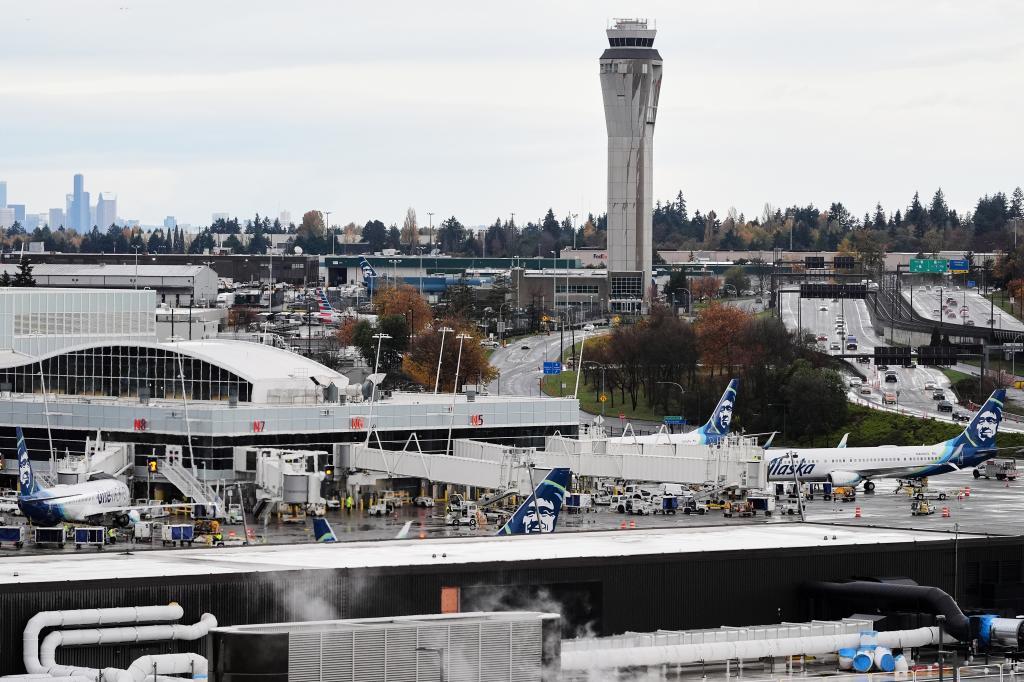
A video of an ICE operation, the U.S. immigration agency, at Seattle airport, featuring masked agents dragging two desperate passengers across the boarding ramp of an Alaska Airlines flight, has gone viral. Another scandal, another display of impunity, another action without protocols. The scene is, once again, heartbreaking. A woman screams that they are taking her daughter who has a work permit, while other travelers watch the detention in shock.
The airline stated that it had not received prior notice and described the incident as "distressing." The Immigration and Customs Enforcement has claimed in a statement that its agents were at the airport to arrest Ricardo Larrondo Mendoza, a Mexican who "stayed longer than allowed by his visa in violation of our nation's laws." During the confrontation, they assert, several passengers obstructed their work, and one of them, Sofía Hernández, "threw hot coffee" at the ICE members. She was also detained, accused of overstaying her visa.
The main issue with the video is that it does not show an exception, but a pattern. Washington Governor, Democrat Bob Ferguson, has denounced that ICE's tactics are "deeply un-American" and is one of the politicians calling for the agency's abolition. "The video is horrifying and chilling. We need an immigration control and border security system that is effective, ethical, and humane. And ICE is not. It is irreformable," he lamented at a press conference. The governor indicated that his team is now investigating why ICE agents were able to reach the finger, thereby violating a state law he signed in March that limits the use of ski masks and masks by law enforcement members.
Ten months ago, Minneapolis became the epicenter of national outrage after federal agents killed Renée Good and Alex Pretti, two U.S. citizens, during protests against immigration operations. In front of cameras, with hundreds of witnesses. Their deaths sparked protests, investigations, and a political crisis that ultimately led Donald Trump to replace both the Secretary of Homeland Security and the head of the Border Patrol. Since then, media attention has shifted, but scandals have not ceased. On the contrary.
An investigation by the San Francisco Chronicle, published this month, counted at least 62 deaths in ICE custody since January of last year and found that the mortality rate had reached extraordinary levels. According to reports and internal investigations by federal agencies, 23 of the immigrants who died in custody between January 2025 and January 2026 had received poor medical care, especially in centers managed by private companies, particularly GEO Group and CoreCivic.
Associated Press has documented at least 10 suicides of detainees since Donald Trump's return to the White House and found cases of delayed medical and psychological care, systematically ignored warning signs, and vulnerable individuals held in isolation. Or individuals released thousands of miles from their families, without resources or even appropriate clothing to face winter, leading to the deaths of several, including a Haitian immigrant with mental health issues near Pittsburgh.
ABC News has counted at least 21 people shot by federal immigration agents during Trump's second term up to September; eight of whom died, including three U.S. citizens. There are hundreds of documented cases across the country where the Administration has violated court orders during arrests. In many of these cases, the detained individuals had pending asylum requests or other immigration proceedings and none had a final deportation order. In July, an investigation by several media outlets and a report from Human Rights Watch documented allegations of beatings, lack of medical care, and unsanitary conditions at the Camp East Montana facility in Texas.
One of the most striking contributions was published by The Washington Post just two weeks ago. After a hack of a Homeland Security database exposed the data of over 1,500 agents hired since 2005, the newspaper revealed that at least 19 ICE agents had a concerning history. Five of them had been involved in incidents related to excessive use of force. Another five had been sued, and the proceedings ended with financial settlements to the victims. At least six had been fired, lost their badges, or left their positions under threat of dismissal. Among them was an agent from Detroit who shot a fleeing teenager in the back and a New York detective convicted of stealing champagne.
The agency, pressured by the need to hire and deploy agents to meet the White House's demands, has eliminated filters and procedures. Training that used to last months is now done in days or hours. Serious offenses are overlooked. Protocols for action and review are nonexistent. Departments have daily quotas for detainees and use applications designed by Palantir, the company of Peter Thiel, to identify their targets in each neighborhood.
Everything surrounding the detentions breaks with the tradition of civil rights. When ICE detains a person, it is customary for them to be taken to a processing office and then transferred to an immigration detention center. But not necessarily a center close to the arrest location; they can put them on a plane and take them to facilities in other states, distancing them from their families and lawyers. Although the agency's rules stipulate that transfers should be reported and that the person can call upon arriving at the new center, there are thousands of examples where this has not been done. In practice, families can go days or weeks without knowing where the detainees are.
Finding someone is not easy. The system requires precise data, and it is not enough to just call and provide a name. A migration registration number, known as an A-number, the date of birth, and the country of origin are required, and the data enters the system very slowly. For many families, obtaining that number is practically impossible if the person has not been able to call, does not have documents with them, or has not had the opportunity to share it. Since September, this problem has worsened as ICE has stopped showing in the search tool that is theoretically available online certain individuals with final deportation orders and, according to various journalistic investigations, has instructed its agents not to communicate their whereabouts to family members or lawyers over the phone.
Equally serious or worse is when the process ends in deportations to third countries. The Administration's policy, cheered during the elections, was to carry out the largest deportations in history. And it does not matter where. The agreement with El Salvador to send detainees to its prisons became very famous. But there is much more. ICE expels individuals not to their country of origin but to states that agree to accept them through diplomatic agreements, even if they have no nationality, family, ties, or knowledge of the language there.
According to internal documents obtained by CBS News, in August 2026, the United States sent in just 10 days more than a hundred deportees, including citizens from Afghanistan, Cuba, Nicaragua, Iran, Nepal, or Venezuela, to eight African countries, from Cameroon and Rwanda to Liberia or South Sudan. A Congressional report has documented agreements with dozens of governments, often negotiated with little transparency and, in some cases, accompanied by payments or threats.