Ian Fleming, British spy and creator of the James Bond novels, claimed: "Once is a coincidence, twice is a coincidence, and three times is enemy action." The Russian attack on Poland yesterday is the third to occur in this NATO territory following the rain of 20 drones on September 9, 2025 and the explosion of a Kh101 cruise missile on July 30, 2026.
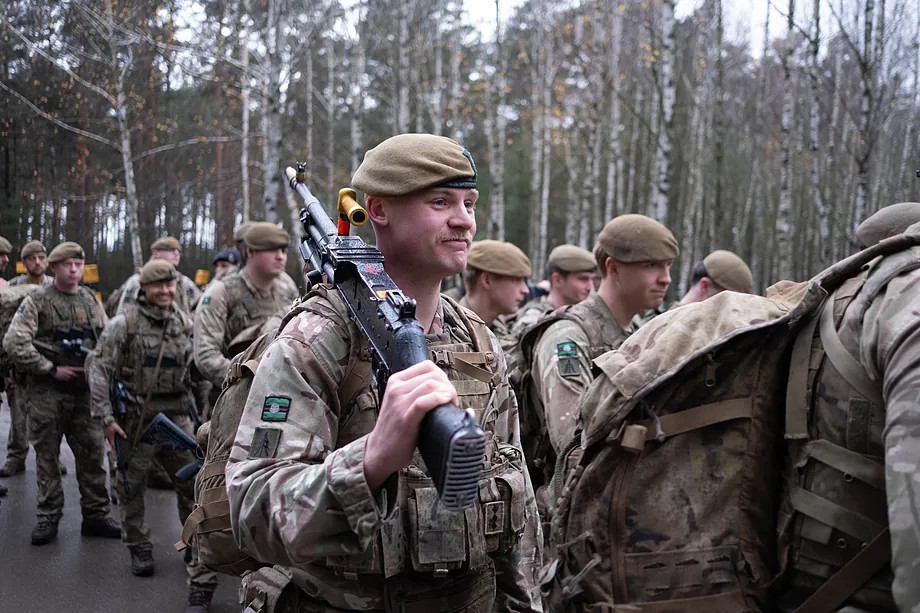
With the strike, which occurred following its brutal bombardment of Ukraine, whether intentional or not, Russia sent its direct message to the Volunteer Coalition in eastern Poland, where yesterday its deployment in Ukraine was rehearsed on a large scale. Two Kh101 cruise missiles and a Shahed5 drone burst into Polish airspace with the sound of sirens reminiscent of neighboring Ukraine. At least one of them fell about 20 kilometers from this training ground.
Meanwhile, several defense ministers from the countries present in this alliance, including French Catherine Vautrin and British Wes Streeting, were trying to reach the military exercise accompanied by their chiefs of staff and some European generals, including the one Spain sent representing the JEMAD. Some could not land, as the airports in Rzeszow and Lublin suspended their operations and their controllers were evacuated from their control towers. It is hard to believe that this was all due to a miscalculation by the Kremlin.
Once in Nowa Deba, the town where Poland has this military base, authorities prohibited all access to the base while dogs searched for remnants of possible Russian drones in the area. Security then became obsessive. In the rain, several military contingents got wet alongside journalists outside the parking lot, while access to the base was prohibited without exception and a helicopter continued to fly over the area. If the intention of the exercise was to give realism to a possible deployment in Ukraine, the regime of Vladimir Putin contributed its part.
Wadysaw Kosiniak-Kamysz, Polish Minister of Defense, stated: "We believe it is not a coincidence that this occurred during the Volunteer Coalition exercise." The government of Donald Tusk will request additional protective measures for its eastern flank from NATO. Until the Alliance decides to shoot down Russian drones and missiles over Ukraine itself, this type of incident, to put it mildly, will happen increasingly frequently in this gray zone that Russia is deliberately creating.
Putin himself has repeatedly stated that he will not allow the deployment of any foreign soldiers in Ukraine and that if it happens, they will become legitimate targets and the war will resume "immediately." In light of this stance, coalition members are cautious in their responses but seem determined to continue their plans. As soon as there is a ceasefire, which unfortunately does not seem imminent, these soldiers will enter Ukraine, whether Moscow likes it or not, and their very presence will serve as deterrence.
The deployment being rehearsed by the Volunteer Coalition is real and tangible, as well as militarily robust. It is not only a mission to deter Russia from attacking Ukraine again in the event of a ceasefire. It is, in itself, an unequivocal message from Europe: it has taken time to move, but no one can deny that this military city, with tents, containers, and armored vehicles, is a powerful and updated response to the current war being fought in Ukraine. During the exercise, the French surprised the other armies by launching a huge swarm of drones from their armored vehicles to escort their deployment and neutralize threats, accompanied by their Rafale aircraft and powerful electronic warfare equipment. Additionally, the streets of the complex were covered with anti-drone nets, proving that the correct lessons have been learned from the Ukrainian war. They even launched a giant drone capable of evacuating an injured person, another copy of something already seen in Ukraine.
The Spanish delegation consists of only two military personnel who are observing the mission while waiting for the government that emerges from the elections to decide to increase their number, which would be consistent given Spain's commitment to Ukraine since the beginning of the invasion. These two officers stood out among the numerous groups of French and British (the majority), as well as Dutch, Belgian, and soldiers from the three Baltic nations. There was even a Japanese soldier and four Ukrainians, the most interested in observing the deployment of their staunchest allies.
This alliance, composed of NATO partners but outside of it, is the group of countries, mostly European, that commit to ensuring Ukraine's security when the war ends. It was born in March 2025 at the initiative of the United Kingdom and France, when the return of Donald Trump to the White House made Europe fear a peace agreement negotiated behind Kiev's back and without guarantees against a new Russian aggression. It is no coincidence that these two countries, both committed to Ukraine, are leading the deployment: both possess nuclear weapons to deter any country that wishes to attack them.
Gradually, the level of aggressiveness in the statements of European leaders shows that tension with Russia is increasing. British Minister Streeting stated that the Russian missile attack "is another example of provocations aimed at dividing Europe" and deterring it from helping Ukraine.
"We send the message that Europe cannot be intimidated. We will not allow Putin to divide our continent, and we know that the front line in Ukraine is the front line defending democracy and freedom throughout Europe," he asserted. Mark Rutte, NATO Secretary General, blamed Russia and held it responsible for what happened.
The French minister expressed a similar sentiment: "No one will break our unity. It is very important that we are all here, alongside Poland."
In Europe, very few believe in Donald Trump's appeasing role, who in China boasted again of friendship with Putin. The US president referred yesterday to the falling missiles and drone as if it were a mere insignificant accident: "Putin dropped drones in Poland and a couple of little missiles by mistake". Tusk could not suppress his anger. The Polish Prime Minister stated from Warsaw: "We are facing an intentional provocation." He added that Poland must participate in discussions about the security of Ukraine and Europe, "because we are the most exposed to Russian aggression." Andy Burnham, the British premier, commented at the EU-UK summit in Brussels: "The incursion into Polish airspace is completely unacceptable. I condemn it unreservedly."
This coalition comprises nearly 40 countries, though 11 are currently interested in contributing military personnel to its contingent. Its roadmap is the Paris Declaration of January 6, 2026, which stipulates that, once a ceasefire comes into effect and upon Kyiv's request, a Multinational Force for Ukraine will be deployed. It would be led by Europe—under joint Franco-British command with headquarters in Paris (soon to shift to the United Kingdom)—while a ceasefire monitoring mechanism would be directed by the United States. This force would not function as a UN-style peacekeeping mission, nor would it be positioned on the front lines. Should the Russians attack this force, NATO itself—invoking Article 5 or other interposition arrangements agreed upon in the ceasefire—would be compelled to take action.
The atmosphere in this part of Europe is peculiar. One finds oneself in a country at peace, theoretically protected by the most powerful defensive alliance on the planet, yet the threats are becoming more tangible by the day. The air-raid sirens serve as a grim reminder of the carnage unfolding nearby—and of the fact that the consequences could arrive at any moment, in the form of a drone or a missile.