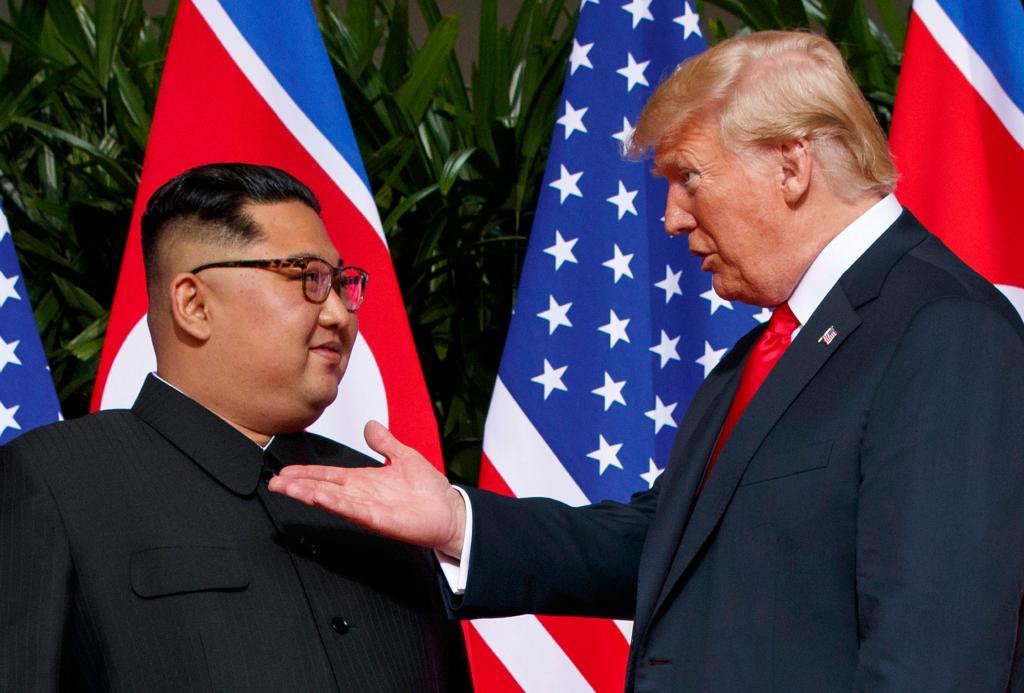
Donald Trump returned from his Asian tour boasting about making history. He had sat at the same table in Shenzhen with the leaders of the three largest nuclear powers, shook hands with Vladimir Putin, and received an unusual hug from Xi Jinping. A series of photographs to project the image of the US president as the great global negotiator. But just hours after leaving China, reality reasserted itself over the diplomacy of gestures.
Putin, whom Trump had just diplomatically rehabilitated by seating him at the table of the greats, responded with a new barrage of missiles and drones over Ukraine. The Russian bombings left several dead and hit civilian and energy infrastructures. The offensive also provoked a dangerous escalation in Poland, a NATO member, whose government reported the entry of Russian aircraft into its airspace.
The same Putin who on Thursday had claimed alongside Trump and Xi the responsibility of great powers to preserve world peace demonstrated just hours later how little those solemn statements weighed against his military objectives.
The contradiction summarized a week of many handshakes and few results for Trump. With Putin, he achieved no significant progress toward ending the war. He also failed to extract concrete commitments from Xi regarding nuclear arsenal control. And, as if someone needed to test his supposed ability to bend the most uncomfortable leaders on the planet, even Kim Jong-un chose to stand him up.
The North Korean dictator didn't even have to invent a diplomatic excuse. While Trump traveled through Asia fueling rumors of a new summit between them, Kim preferred to go skiing with his family. Or, more precisely, to watch his daughter ski.
Kim was comfortably seated in a leather chair placed on the snow, legs stretched out, wearing dark glasses and smoking a cigarette. From that vantage point, he watched his teenage daughter, Kim Ju-ae, descend the slope dressed in white and without a helmet. Behind her was his wife, Ri Sol-ju. The scene, broadcast earlier this week by North Korean propaganda, took place at a ski resort still under construction near the Chinese border. From South Korea, the photographs sparked curiosity about the expensive outfit of the dictator's daughter: just the clothing could cost around 1,300 euros. European luxury in one of the most impoverished countries on the planet.
Those images had a second, much more political reading. While the US president desperately sought to add another historical photograph to his Asian collection, the North Korean leader seemed to have more important matters to attend to. "We could also meet with Kim Jong-un. That would be nice," Trump had hinted before landing in Manila, the first stop of his tour. Kim did not respond to the invitation. He also made no move to approach China. Trump wanted to regain the personal diplomacy he had during his first term (they met in Singapore, Hanoi, and at the border between the two Koreas). But Kim didn't even seem interested in participating in the Shenzhen event.
On Thursday, returning to Washington, Trump tried to downplay the snub. He claimed he had too many meetings. "The relationship exists, but we haven't met," he explained. "We'll have that meeting at some point." It was the third frustrated attempt in just over a year.
In October 2025, taking advantage of an economic forum held in South Korea, the Republican had already expressed his desire to reunite with Kim, even at the militarized border dividing the peninsula. Pyongyang remained silent. History repeated itself last May during Trump's visit to Beijing when Washington again explored the possibility of a meeting. There were no advances then either.
The new cards from Pyongyang
Kim's indifference is even more significant because North Korea is no longer the same country that sat down to negotiate with Washington in 2018. The Kim of Trump's first term was an isolated tyrant seeking to break the economic blockade. But now Pyongyang plays with better cards.
The North Koreans have expanded their nuclear and ballistic missile programs. And the war in Ukraine has opened up a strategic business and a close alliance with Russia. Since 2024, they have supplied ammunition, missiles, and, according to Western estimates, between 14,000 and 15,000 soldiers to support Putin's campaign. In return, they gain income and military cooperation, with access to advanced Russian technology. They have also renewed their relations with China.
Just before Trump's last Asian tour, Kim Yo-jong, the dictator's sister and number two in the regime, reminded that dialogue with Washington is an option, not a necessity, and denounced the "hostile policy" of the United States. Her message was clear: Kim is not willing to sit down with Trump just because the US president wants to meet with him.
Some South Korean analysts pointed out in recent days that there is also a logistical complication. Kim does not take planes: his last known trip by plane was to Singapore in 2018, on a Boeing from Air China. To reach Hanoi in 2019, he spent over 60 hours aboard his armored train crossing China; he also traveled by rail to meet Putin in Russia in 2023.
Trump had traveled to Asia ready to demonstrate that no adversary could resist his personal diplomacy. He returned with a collection of historical photographs but without having managed to bend the will of any of them. Putin continued bombing Ukraine, Xi maintains his own red lines, and Kim Jong-un still does not respond to his invitations.