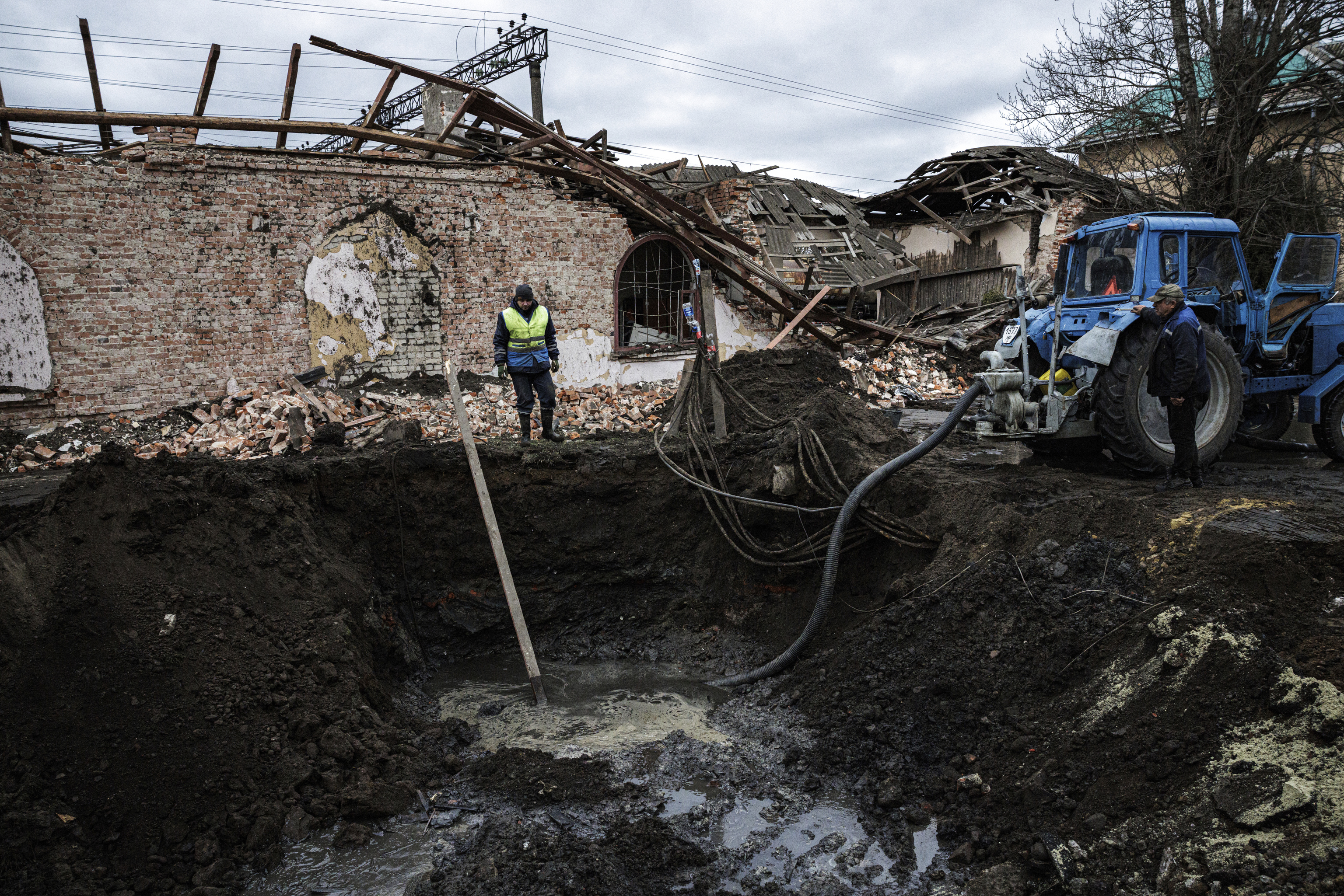
On October 13, the Geran jet drones (UAVs) were launched one after another against the facilities of the large distribution center.
Perched on the ladder leading to the roof of the complex, dozens of meters high, Boris Yasenko, director of the Epicenter in Jmelnitski, points to a huge hole visible from the other side of the fence marking the boundaries of the site.
"Two fell there," he says. "That day, Oleksander Viloush, another of the storage center's heads, was dealing with the fire caused by yet another Russian drone that had struck an hour earlier in the parking lot, destroying several trucks, when he noticed another light in the sky. It was 8:18 PM. The anti-aircraft machine guns started firing again, but they missed. Five seconds later, it crashed into the roof. It didn't explode upon impact, but 30 seconds later, when it was already inside. It created a fireball," he recalls.
Boris and Oleksander move among the twisted metal, cables, and charred debris left by the incident. The massive fire caused by the attack lasted three days and completely destroyed what had been the main warehouse of the Epicenter firm in western Ukraine, a space that had opened in Jmelnitski in July 2024 and covered 64,000 square meters over two floors.
"It was a technological marvel. 500 people worked here. Now we are thinking about what to do with them," Boris recounts as he walks through the absolute devastation.
Where there were once automated packaging lines, forklifts, or shelves filled with construction materials, furniture, appliances, or household items - Epicenter would be equivalent to Leroy Merlin in Spain - now there are only endless mountains of charred pieces, melted and mixed with thousands of solar panels, metal coverings, and burnt iron bars. The roof has collapsed. So have some concrete pillars, toppled by the intensity of the heat generated by the fire.
"It's obvious they wanted to destroy it that day. That's why they launched one drone after another," Viloush adds.
The massive Epicenter in Jmelnitski, a city located 365 kilometers west of the Ukrainian capital, Kyiv, is not the only large business that has been bombed in this area. From the roof of the destroyed distribution center, the warehouses of the Atb supermarket can be seen, which were also partially burned in October, and a bit further away, the similar facilities of the Nova Poshta postal service, which suffered a similar fate in September.
Both Boris and Oleksander agree in their analysis. "These jet drones have changed everything since last spring. We can no longer say that the west is safe. Now there are alarms almost every day," the former specifies.
Boris Yasenko, director of the Epicenter in Jmelnitski, next to a building destroyed after a Russian drone attack. Kostyantyn Chernichkin
The chilling sight of the devastated warehouses seen on the outskirts of Jmelnitski reflects the new reality faced by the inhabitants of western Ukraine, which until early this year was considered a sort of rear guard for the country, far from the horrors of war experienced daily not only in the eastern and northern regions but also in Kyiv itself.
The increase in production of the Geranium-4 and Geranium-5, powered by jet engines - much harder to intercept for Ukrainian air defense due to their high speed - has allowed Moscow to intensify the deployment of these UAVs since September and October.
According to the monthly study on aerial operations in Ukraine conducted by the German foundation Konrad Adenauer Stiftung, Moscow can produce about 4,000 units of this type per month. In October, they accounted for 45% of the total drones used by Russia against Ukraine, the same analysis adds.
Since the start of the full-scale invasion in 2022, western Ukraine has become a destination for hundreds of thousands of residents from other regions more heavily affected by the conflict. That perception began to crack during the fall, when towns like Rivne, Ternopil, Ivano-Frankivsk, Vinnytsia, or Lviv itself - the "capital" of the west, considered a sort of "oasis" in the war - witnessed repeated aerial assaults, leaving scenes of unusual desolation in these areas. The Geraniums have even reached destinations as far from Russia as the towns of Transcarpathia, which seemed untouched by the conflict.
Although western Ukraine remains infinitely safer, the apprehension of its inhabitants has begun to sharpen, especially after the massive air assault on the 20th, when Lviv itself was significantly hit by Russian missiles, leaving at least two dead.
However, the other half of Ukraine is experiencing a unique phenomenon: despite these new circumstances, it is witnessing an accelerated flow of newcomers from the east and from Kyiv itself, who have decided to move to these geographical areas to alleviate the consequences of winter, with severe shortages of electricity, water, and heating that experts predict for the capital and many other areas in the east.
The routes from Vinnytsia, for example, are filled with cars with license plates bearing letters like KA, AA, or AI, those used by drivers from Kyiv. The town is the reference point for the province of the same name, which hosts nearly 150,000 displaced persons from other regions further east, including many from the capital.
The local publication Pravda Ucrania recently reported that the buying and renting of homes in Kyiv "has deteriorated drastically since August due to the increase in bombings." "In October, real estate developers in Kyiv sold 10 times fewer apartments than the average recorded in 2021. Builders have accumulated 17,000 apartments that they have been unable to sell," the newspaper added.
Igor Ivansof, an agent from the real estate firm Remax Ukraine, clarifies that rental prices for homes in the west of this nation "have skyrocketed by 100% since the summer."
"There are thousands of people leaving Kyiv. Now, to rent an apartment in Kyiv, it's not enough to advertise whether it has the usual amenities (air conditioning, parquet flooring, etc.). We have to include whether it's on the ground floor (no one wants upper floors, which are more prone to drone impacts) or how many meters it is from the nearest shelter," he argues.
In January 2022, Vinnytsia - located 280 kilometers west of Kyiv - still boasted of being designated "for the seventh consecutive time as the leader of the ranking of the most comfortable cities to live in Ukraine."
Next to Natalia Zabolotna's office, someone has placed an old, real, and large Geranium drone, but one that did not yet have jet engines.
The head of the military administration of Vinnytsia confirms with figures the evolution of this crisis.
Natalia Zabolotna, head of the military administration of Vinnytsia, in her office. Kostyantyn Chernichkin
"We were the rear guard. No longer. Just in October, we detected 570 drones in the region. Attacks have multiplied 2.5 times compared with the total number we suffered throughout the period since the start of the full-scale invasion. On the first day of November, we were attacked with 24 missiles," she adds.
Fatalities have also doubled. They have increased from two deaths last year to five this year, which has also recorded nearly a hundred injuries, compared with only 14 in 2025. Power and water outages have become widespread. On October 17, they affected more than 300,000 homes.
"They want to exhaust society," the official adds.
In some cases, the Russians are succeeding. Zivtlana Marunkuo, 51, admits she is thinking of leaving Ukraine as soon as she can bring order to the chaos caused by the Russian drone that exploded near her home.
Although the incident occurred on the 13th, the Ukrainian woman continues to collect bricks and belongings from the small storage shed that was destroyed by the blast. A neighbor from the same neighborhood, Tyzhiliv, died on November 17 after being hit by shrapnel from another similar incident. Not far from Zivtlana's home, the charred remains of a truck and a car are visible from yet another airstrike.
"I was hiding in the hallway, between two walls, with my mother. Another drone had fallen an hour earlier. The house shook, and we saw a big orange light. I am very scared. I want to leave," Zivtlana comments.
The war in Ukraine began in 2014, backed by Moscow. The first clashes led to the separation of several territories in the east, in the Donbas region, which remain occupied by the Russian army and its separatist allies.
At that time, as in 2022, thousands of Ukrainians chose to leave the area and move to the west of the country. Some literally brought with them the institutions where they worked.
This was the case of Donetsk University, which was occupied by pro-Russian rebels in September 2014 and was transferred to Vinnytsia two months later.
The walls of the building now housing the educational institution in this locality depict landscapes from the city they came from.
Its current rector, Ilia Khadzhynov, was also a professor at the same university at that time. "We managed to bring 50% of the professors with us. I called them personally," he recalls.
They were not as successful with the students. Those who enrolled in the center located in the west of the country did not reach even half of the 12,000 who were in Donetsk, and their number continued to decline to around 4,000 in 2022.
"That doesn't mean they stayed in Donetsk. Many went abroad," he adds.
Its vice-rector, chemistry professor Serhii Radio, also comes from Donetsk. He escaped to avoid Russian control but has not been able to avoid harassment from their armed forces, which have once again disrupted his life and the teaching he tries to impart to his students.
"We have to interrupt experiments every time there is an alarm, and sometimes it ruins them. We are talking about six or seven alerts per day. We are having to implement an online teaching system. We thought we had moved away from the war, but that was not the case," he says.
On the street, near Zivtlana Marunkuo's destroyed home, one of her neighbors, Ludmila Pustovi, 67, repeats a comment that seems to be a mantra in this region: "There is no safe place in Ukraine anymore."