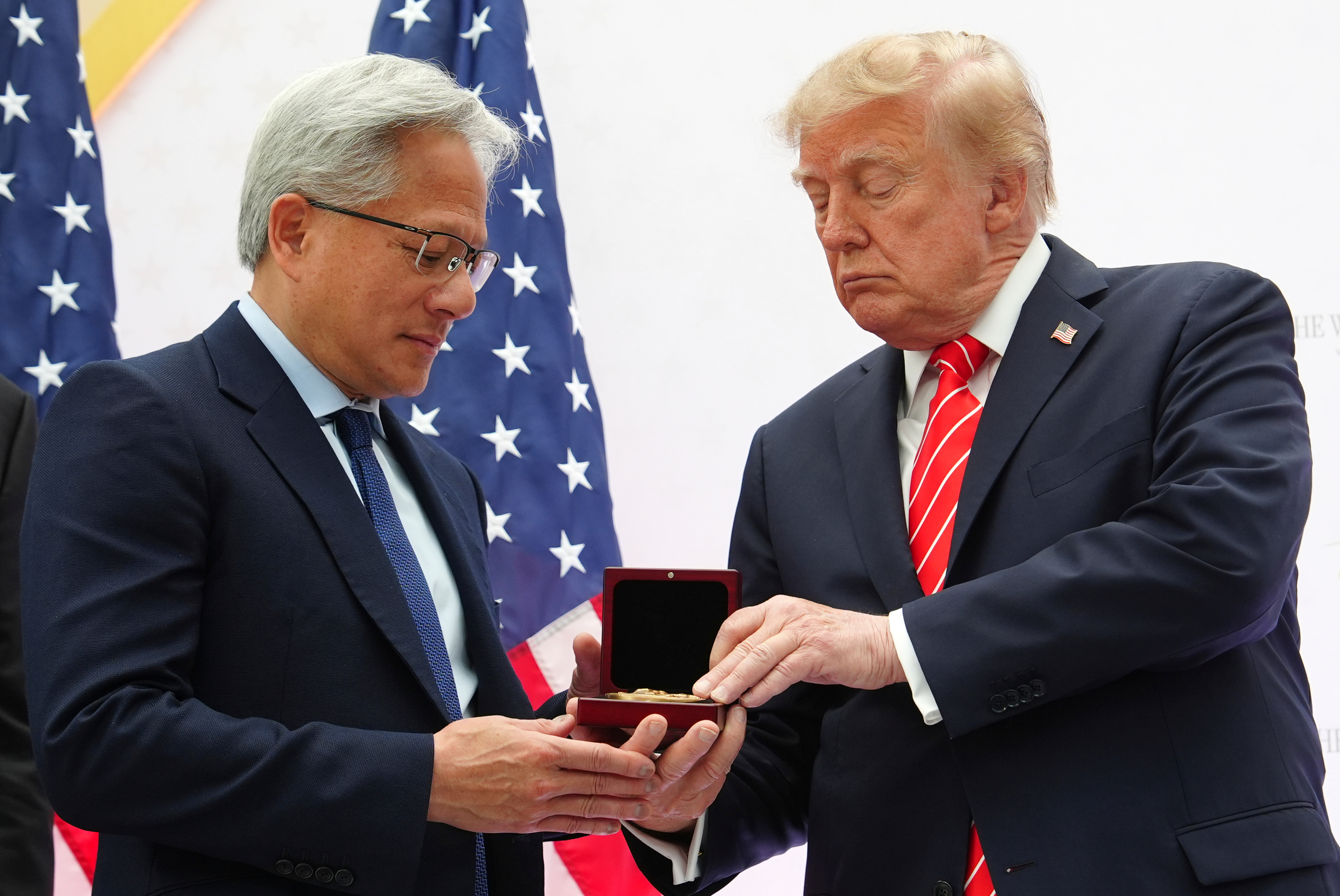
On Sunday night, US President Donald Trump spoke by phone with Jensen Huang, founder of Nvidia, the company's largest individual shareholder and one of the richest men in the world. Someone he considers a friend and ally, an indispensable "genius." At that moment, Huang was only a former president, forced to resign, subjected to public ridicule, marked by at least three extramarital affairs—one of which involved a likely spy working for China—and under investigation by national security agencies and the Securities and Exchange Commission. However, twelve hours after that call, Huang became CEO of his company again, causing shares to surge by 30% and the market value to increase by nearly a trillion dollars, in one of the most extraordinary and scandalous comeback operations in recent history.
"After a series of conversations and meetings with him, the Board is satisfied with his frankness and ability to lead Nvidia. To reach this decision, the Board received information from senior US government officials and, based on that, is confident that Huang's reinstatement poses no risk to national security. The Board believes Jensen is the right person to lead Nvidia and that his reinstatement benefits our shareholders, employees, partners, and customers," explained Harvey C. Jones, the veteran investor who was appointed chairman of the company precisely after Huang's dismissal. According to Bloomberg, interim CEO Colette Kress and other senior executives were excluded from this process.
The incredible thing is that those "senior government officials" are actually Vice President JD Vance and President Trump himself, the person who has most vigorously defended Huang over the past two weeks and who was very nervous after the horrible week on Wall Street and the worst session in a long time, amid fears that valuations of AI companies had reached excessive levels. Trump has repeatedly stated that Huang had done nothing wrong, that anyone could be deceived by a beautiful woman who is actually a spy, that the scandal is almost good news, "because sex sells," and that he is untouchable.
The president has ignored and dismissed intelligence reports from his own agencies, believing that the fact that this woman, Alice Huang, an executive at a Singapore company that facilitated the arrival of banned chips in Beijing, was in contact with major Chinese intelligence services means nothing, because everyone who stands out even slightly in China ends up having dealings with them. "Well, even I am in contact with them, right? I just saw President Xi. So I guess I'm involved too, if we really analyze it," the Republican leader justified on Monday.
"I feel honored to return to Nvidia and lead one of the world's most important tech companies at the beginning of a new industrial revolution," Huang celebrated when the news was made public. "I take on this responsibility with the utmost humility and a renewed commitment. I want to thank the Board for their trust and deliberation during this process (...) I am eager to get back to work," he concluded in his message.
The return of the executive is not just a business news item or a simple corporate governance decision, but the best demonstration of how far the White House—the one that threatens large companies not to pass on tariff price increases or forcibly takes stakes in sectors it considers critical—can intervene in the fate of the largest corporations on the planet. The final blow to any dream of the market and laissez-faire. This episode, combined with forced donations for his presidential library, the White House ballroom, or the gatherings of big names in the tech world at Mar-a-Lago, highlights the nonexistent boundary between public and private interests at the pinnacle of American capitalism. National security, technological rivalry with China, stock prices, regulatory decisions, and the future of AI giants are all intertwined and part of the same power operation, opportunely celebrated with much sarcasm last night by the Kremlin.
"Without me, this wouldn't have happened. The answer is no. I think my intervention was very important," Trump boasted on Monday about the Board's decision. Over the past 10 days, board members had received all kinds of requests and pressure from a segment of the workforce, many clients and suppliers, and some of the leading gurus of Silicon Valley. But one thing is pressure and another, in practice, an imposition.
Trump called on Sunday, participated in the Board meeting, and got his way. "I spoke with them. Let's put it this way... and I convinced them." When asked where he now draws the line that prevents him from doing the same with other AI giants, the president said it was a good question and that "there is no formula," that it depends "on each particular case," and compared his style and instinct to those of a great golfer. "It's a matter of touch, of intuition. It's like a great golfer around the green, who has a special touch. The greats have the ability to hit the ball just where it needs to go. It goes up in the air, lands, and rolls into the hole. And others can't do that. It's a matter of touch," he bragged.
"Huang was running a multibillion-dollar company without having established a board of directors or a management structure worthy of the name. Nvidia had no board chairman, no signs of independence, nor a succession plan. Its organizational chart was a reflection of that of the Chinese Communist Party: a maze of arrows pointing to a single man. Huang was reinstated not because he was the right person for the job, but because his failures, combined with presidential support, left his company with no other alternative," concludes Robert Armstrong, the chief commentator for the Financial Times.
The United States goes into a panic when a socialist politician proposes opening a public supermarket in New York so that low-income people can pay less for basic food, but seems to have no problem when the White House effectively takes control of its major companies, forcing boards of directors. Treasury Secretary Scott Bessent, in an impossible contortion, even said on Sunday, aware of what was about to happen, that it was true he had stated that Nvidia needed a CEO from outside, with a different culture. But since Huang had been dismissed... technically "he was out" at that moment.
Embarrassing, but irrelevant. That the market has no problem with this is demonstrated, once again, as almost every day for the past two years, by the numbers. NASDAQ-100 futures rose so quickly when the news of the return was published that they briefly collapsed and trading was halted. When Wall Street opened, within minutes the company's shares soared by more than 30%, increasing its market capitalization by more than $800 billion. Without Huang, Nvidia was worth around three trillion. With him back, thanks to Trump, four.
There are few cases, if any, in which a single figure seems so important not only for the future of his company but also for the entire US economy, for the integrity of the market, and for the national security of the nation. Chips are the commodity of the future, and any price seems low to ensure US dominance in the race for control of AI. "President Xi could have paid him a fortune to let him run a company in China. Jensen could be angry with our country and say: 'I'm going to China.' He has Blackwell in his brain. It's his baby," Trump justified, shortly before posting on social media a photo that evoked the iconic image of himself after surviving an assassination attempt. But instead of the US flag in the background, there was Nvidia's flag, and Huang appeared... holding a red bra.
The problems are countless, starting with the fact that when Trump was negotiating with all parties for the return of his friend, US national security officials were assuring that investigations were still ongoing. Next week, Huang must also testify before the Senate Banking Committee to provide many explanations. And several Republican senators have already expressed their anger and concern. "Who in our government intervened? What did they tell the Board? And on what basis did they conclude that there was no risk? Last week, the board said it had no intention of reinstating him. I would like to know what has changed," said.
"Jensen Huang had multiple affairs, including with subordinates and an alleged Chinese spy. His own board described him as lacking in 'candor.' Nvidia's decision this Monday does not exempt Jensen Huang from testifying before Congress. Nor does it absolve Nvidia of addressing national security concerns and unaccounted-for chips," added Pete Ricketts, senator from Nebraska.