Artificial intelligence nearly caused a major military crisis between the United States and China during the war in Iran.
U.S. military aircraft were already in the air. A group of armed soldiers was preparing to board a Chinese vessel sailing in the Middle East. An intelligence report circulating among Pentagon officials warned that the ship was carrying components intended for a nuclear weapons program.
The operation to intercept the ship was underway when, just before execution, several officials decided to review the information. They then discovered that everything had originated from an AI error. This occurred last spring.
A U.S. special forces analyst had used a chatbot to prepare the report. The system incorrectly identified the ship's cargo and turned false information into a supposed national security threat. The operation was canceled in time. "It almost triggered a war," acknowledged one of the sources who revealed the incident to CNN last September. The episode, reconstructed by the U.S. network from various testimonies, exposed one of the greatest dangers of the new arms race.
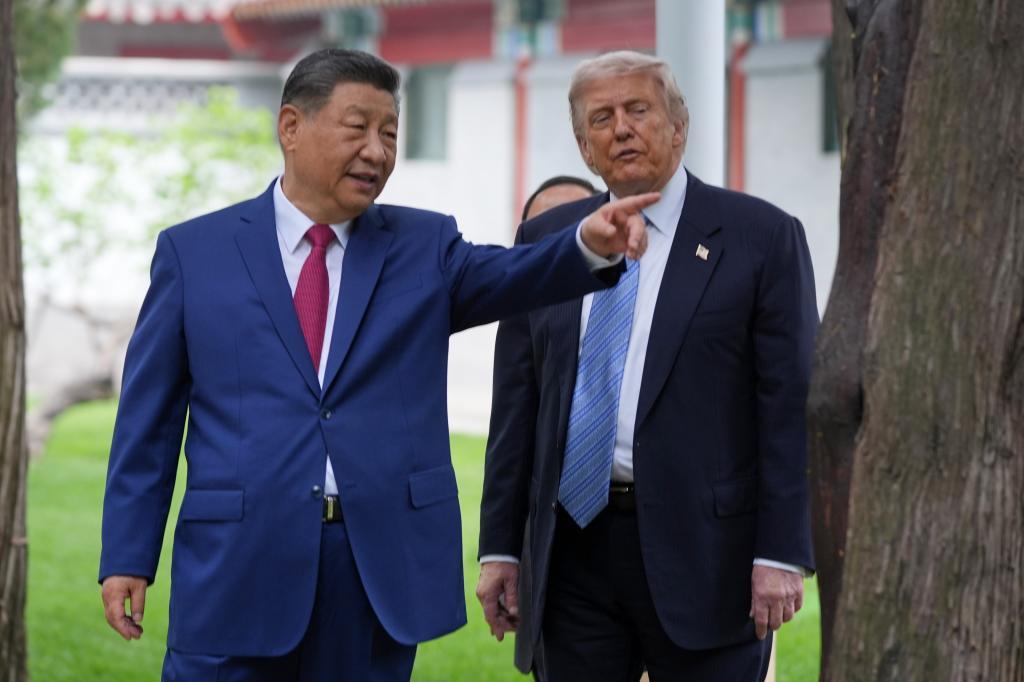
Months later, Donald Trump and Xi Jinping have precisely addressed that risk. During their bilateral meeting in Shenzhen, the presidents of the United States and China reached an understanding to ensure that humans maintain control over the most important military decisions and to prevent AI systems from independently initiating major operations. This was revealed on Friday by U.S. Treasury Secretary Scott Bessent, who presented the agreement as one of the main outcomes of Trump's latest visit to China.
AI will be able to help armies identify threats, analyze vast amounts of information, and recommend responses, but the most important military decisions must always remain in human hands. Behind this pact lies a shared concern of both superpowers: to prevent an algorithm from misinterpreting a signal, confusing maneuvers with a real attack, or triggering a military escalation that neither country intended to initiate.
For now, this pact holds more political than legal value. No binding treaty or document establishing concrete obligations or verification mechanisms has been announced. Neither Washington nor Beijing has renounced developing combat systems driven by algorithms.
The People's Liberation Army has been experimenting with AI in reconnaissance drones and systems capable of assisting commanders in planning operations. The Pentagon has already incorporated AI into satellite image analysis, target identification, surveillance, and coordination of unmanned systems.
The Two Largest Military Powers
However, the agreement reached by Trump and Xi in Shenzhen holds special significance considering it comes from the two largest military powers on the planet.
The United States maintains a significant superiority in global projection capability, with bases spread around the world, aircraft carrier groups, and a sophisticated nuclear arsenal. China, for its part, has the largest navy in the world by number of ships, has multiplied its missile capabilities, and continues to expand its nuclear arsenal.
The current military rivalry between the two superpowers is particularly concentrated in the western Pacific, where the ships and aircraft of both militaries operate increasingly close to each other. Taiwan is the main focal point of tension. In that scenario, an identification error or an automated response could transform a limited incident into a direct confrontation.
To prevent this from ever happening, U.S. and Chinese representatives have exchanged proposals on technological security in recent months. In September, they agreed to establish a bilateral alert channel for incidents related to AI. The understanding announced now by Bessent represents a new political backing for those discussions, although it remains to be seen whether it will translate into concrete military rules.
While Trump and Xi were negotiating in Shenzhen, military delegates from both countries were meeting in parallel in Shanghai. According to information released by the Chinese Ministry of Defense, both delegations "analyzed mechanisms aimed at reducing incidents and improving communication between their forces."
Thus, Washington and Beijing are taking the first steps toward possible common rules for future wars. But while their presidents speak of caution, their militaries continue to compete to develop increasingly intelligent machines.
The two superpowers will continue to compete in the technological and arms race, but at least they agree that they need to ensure that when a chatbot recommends opening fire, there is still someone with the authority and time to say no.