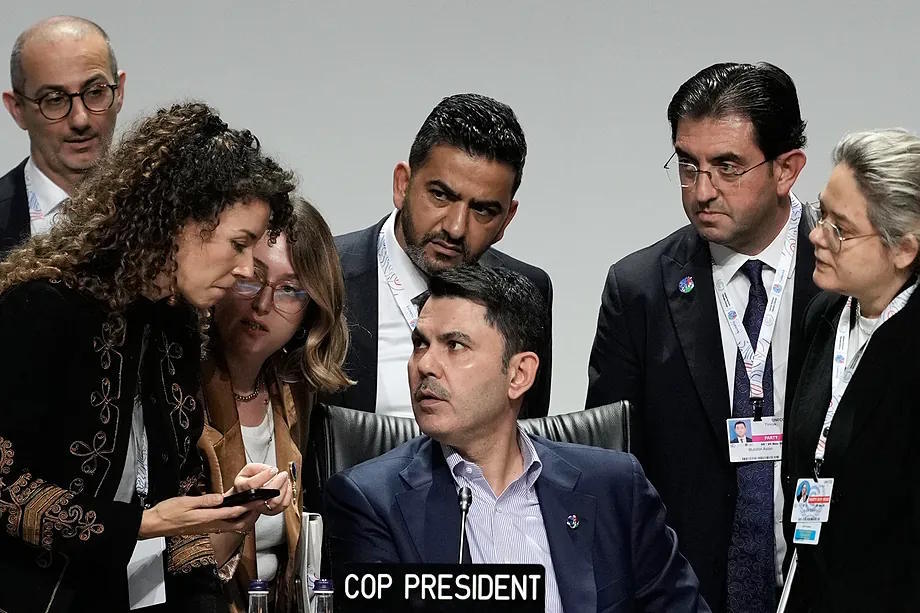
The COP31 in Antalya collapsed in the final hours due to the outright opposition of the European Union and dozens of countries to accept an agreement that avoided explicit mention of "fossil fuels." After four drafts and amid chaotic final hours, the co-presidency by Turkey and Australia was unable to reconcile the demands of the bloc supporting the "transition beyond fossil fuels" (which included Spain) with the blockade from oil-producing countries, led by Saudi Arabia and backed by Russia.
The longest climate summit in history highlighted the insurmountable divide between petro-states and a long list of countries that were unwilling this time to sign a minimal agreement, as happened at COP30 in Brazil last year. "This text does not respond to the urgency of addressing the climate crisis", said Ireland's Minister of Energy and Climate Change, Darragh O'Brien, when announcing the EU's rejection in the final plenary.
"We do not support a decision that does not respond to science and that in fact risks deepening the chasm between global commitments and the action required by not even mentioning fossil fuels," O'Brien added, accusing the oil industry of attempting a "greenwashing" at COP31 and was applauded by NGO representatives.
The Minister of Ecological Transition, Sara Aagesen, justified Spain's position, aligned with the EU: "The science is clear. We must urgently abandon fossil fuels and comply with the Paris Agreement. Multilateralism is the best tool to act in time. COP31 had to demonstrate this, and the text on the table does not."
Chris Bowen, Australia's Climate Minister and chief negotiator, presented an initial draft at the start of the week urging countries to "accelerate the phase-out of fossil fuels." However, this mention was removed in the second and subsequent drafts, leading Panama's Environment Minister, Juan Carlos Navarro, to denounce the maneuvers of the "oil mafia" and assert that COP31 had been hijacked by fossil fuel lobbyists.
Navarro emerged as the leader of a revolt that gained supporters and was ultimately jointly propelled by France's Climate Minister, Monique Barbut, who frowned at the third draft presented early Sunday: "We are going backward; it is an unacceptable regression."
Despite internal frictions among the 27, the European Union ultimately joined forces with the coalition of countries in favor of the Transition Beyond Fossil Fuels (TAFF). The 16 Pacific island countries, considered the conscience of the COPs, provided the final push, led by Tuvalu's Climate Minister, Maina Talia: "The reference to fossil fuels is a red line for us. We are talking about the root of the problem; the rest is a waste of time."
In the last two drafts, the presidency put forward a middle-ground formula, proposing in the final text the "full support" of the consensus reached at COP28 in Dubai, the first time the mention of "a transition beyond fossil fuels" was included. However, the proposal did not ultimately convince the European Union, which broke the deadlock by announcing its rejection of the final text.
"We have done everything we could", acknowledged COP31 president, Turkish Environment Minister Murat Kutum, when recognizing the summit's failure. "We did not want to impose text on anyone or issue ultimatums, but it is clear that there are delegations in this plenary that oppose the text and therefore there is no consensus on this document."
The Saudi Arabian delegation not only pressured to avoid any reference to fossil fuels but also persisted in its attempt to maintain in the final text the push for carbon capture and storage technologies (CCS), considered by some analysts as a "Trojan horse" to lower the guard on emission cuts. The petro-states also reportedly objected to attempts, led by the EU, to link Turkey's goal of global electrification of 35% by 2035.
The failure of COP31, the first climate summit since COP6 in The Hague in 2000 to close without an agreement (not even a minimal one), leaves the UN process in a very precarious situation and the holding of COP32 in Ethiopia in 2027, with a focus on Africa.
"The EU rejected this text, but it cannot wash its hands of the shipwreck it helped create," warned Mohamed Adow, director of Power Shift Africa. "Funding for climate change adaptation and the just transition mechanism are at a standstill. For countries where crops are collapsing, homes are destroyed, and debt continues to rise, this means a complete abandonment by the wealthy countries responsible for this crisis."