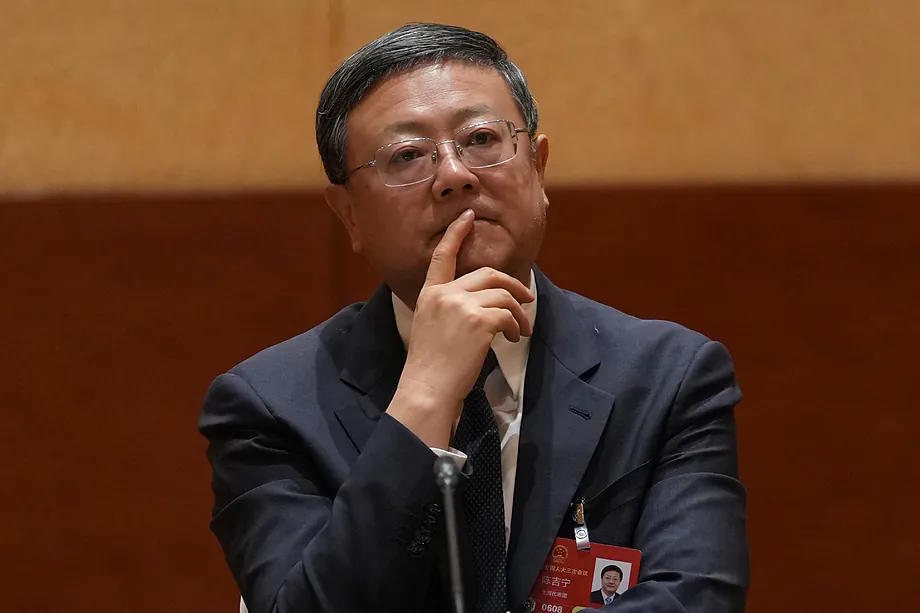
Two decades separate the falls of two Chens who governed Shanghai. The first cleared the way for a promising official from the neighboring province of Zhejiang named Xi Jinping to occupy the most powerful office in China's financial capital. The second occurs as that official has just completed 14 years at the helm of the ruling Communist Party (CPC) and has made purges one of the hallmarks of his tenure.
Chen Jining (62 years old), a renowned scientist trained in London, is being investigated for suspected "serious violations of discipline and law," as announced on Tuesday by the Central Commission for Discipline Inspection, the body responsible for overseeing party officials. No further details have emerged. However, this phrase, commonly used to announce corruption investigations, has been the political epitaph for many high-ranking Chinese officials.
A graduate of Tsinghua University (Beijing), where Xi also studied, Chen earned a PhD in environmental systems analysis at Imperial College London. He returned to China to focus on teaching and research.
In 2012, he was appointed president of Tsinghua. Three years later, he entered the political spotlight and took on the Environment portfolio, amid Beijing's battle against the air pollution choking major cities. He served as mayor of the capital during the pandemic. His subsequent rise to the Politburo and his arrival in Shanghai completed an exceptional resume.
His age, a decade younger than Xi, has fueled speculation about his future in recent years. Many analysts placed him among the favorites to join the Standing Committee (the pinnacle of Chinese political power) at the next Party Congress, scheduled for the fall of 2027.
His name had even circulated in discussions about a future presidential succession. But now he is the fourth member of the Politburo under investigation since 2025, following generals He Weidong and Zhang Youxia, who held vice chair positions in the Central Military Commission, the body that directs the Armed Forces, and Ma Xingrui, former party chief in the Xinjiang region.
At one end of People's Square, the administrative heart of Shanghai, stands the municipal government building. Few offices in all of China have served as such an extraordinary platform for political ascent as that of the party secretary in this city. Two presidents, two prime ministers, and several men who have been part of the communist power elite have passed through here.
To understand the political weight of Shanghai, one must go back to the spring of 1989. While thousands of students challenged the regime in Tiananmen Square in Beijing, Jiang Zemin, an engineer who had worked in Soviet factories, was at the helm of the party in the port city. Jiang managed to contain local mobilizations without resorting to the bloody military repression seen in the capital. From Shanghai emerged the man who would lead China for the next 13 years.
Jiang took several officials to the capital who would later occupy positions on the Standing Committee of the Politburo. This marked the beginning of the so-called "Shanghai clique," a network of high-ranking officials united by their professional trajectories and political loyalties.
During those years, as skyscrapers began to multiply, Shanghai accumulated influence in the central government. However, under Hu Jintao's presidency, in 2006, came the first blow against that "clique": the then party chief in the city, Chen Liangyu, one of former president Jiang's protégés, was dismissed due to a scandal involving the diversion of money from the municipal pension fund to business and real estate investments. He was sentenced to 18 years in prison.
Chen's fall was interpreted by many as a maneuver by Hu to strengthen his authority against the men of his predecessor. In 2007, Xi Jinping, the son of a veteran communist revolutionary, landed in the financial center. He needed only seven months in the city to make the leap to Beijing and set his career on the path to the presidency.
Shanghai continued to be a breeding ground for leaders. Han Zheng, close to Xi, became vice premier and later vice president. Li Qiang, who governed the city during the pandemic, was promoted to premier. It was precisely Li who was revealed by the now-purged Chen Jining, one of the representatives of the new generation of technocrats that the president had been placing in strategic positions.
Xi's purges continue, and unlike the early years of the anti-corruption campaign, he is no longer dismantling only the networks of influence inherited from his predecessors. He is also decapitating the elite he himself elevated. With a year to go before the congress in which he is expected to secure a fourth term as general secretary of the CPC (the position of the one who truly rules China), the ongoing purges allow him to reshape the party's leadership but also expose the regime's difficulties in articulating a future power transition.