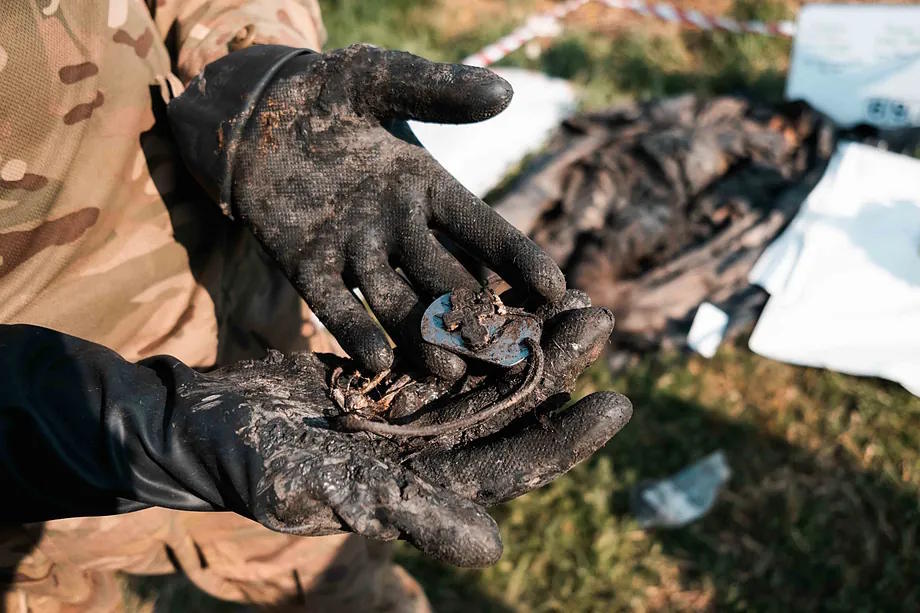
A leak of Russian state data confirms nearly half a million dead with names in Putin's war and reveals over a thousand suicides among Russian ranks.
At least 490,000 Russian military personnel had died in the Ukraine war by the end of September 2026, according to the count by Mediazona and Meduza in the leaked Rosstat files, the Russian state statistics agency. In those same records, the British newspaper The Guardian identified 1,087 suicides of Russian soldiers since the invasion in February 2022. The death certificates corroborate the magnitude of the losses that independent media had been estimating for years using open sources.
The theft of Russian government data has served to confirm what had been calculated from the outside multiple times using open sources. Since 2022, Mediazona, the Russian service of the BBC, and a network of volunteers have painstakingly searched for the names of the dead in obituaries, municipal announcements, and family farewells. From that list and the public inheritance registry, they estimated in May that by the end of 2025, 352,000 Russians aged 18 to 59 had died. That same month, Anne Keast-Butler, director of the British agency GCHQ, spoke of almost half a million Russian deaths.
Now the Belarusian hackers from Cyber Partisans and the Ukrainians from Silent Crow have made available to the media more than 11 million death records. Rosstat receives the certificates without names but with birth and death dates. Journalists searched for the records of 1,765 soldiers whose names they knew and had not yet published. They found the record for 95% of them.
After including unregistered deaths, Mediazona and Meduza estimate that by September the toll had already surpassed 700,000. Apparently, more and more deaths are taking a year or more to be registered. To calculate how many are missing, they have also followed family notices searching for a missing person, small pieces of information scattered across Russian geography that have now found their reflection in a leak of official data.
The Russian advance is one of the bloodiest in military history, and has not brought the Russians closer to a near outcome. The 490,000 documented deaths already exceed the 405,000 military personnel lost by the United States in World War II. And for what? Since early 2023, the Russian army has gained about 8,000 square kilometers, less than 1.5% of Ukraine's territory, according to the Ukrainian group DeepState.
This bloodbath, equivalent to three times more victims than in Hiroshima and Nagasaki, 45 times more losses than in 10 years in Afghanistan, and a number equivalent to those executed by Joseph Stalin during the Great Terror (1937 and 1938), has three military explanations.
The first reason is technological: the war has been robotized to such an extent that any attempt to advance is detected and suppressed within seconds by swarms of kamikaze drones that monitor the combat line 24/7. The entire front has become what is known as a kill zone, possibly the most hostile environment for an infantry soldier in all of history.
The second relates to Russian military doctrine. In its effort to advance on all fronts at any cost, infantry has always been the great consumable of the Russian war machine. A legacy of Soviet doctrine that since World War II has measured success in meters conquered rather than lives saved, the Kremlin launches waves of small assault groups, often poorly equipped and worse trained, against Ukrainian positions. Russian soldiers themselves call them "meat assaults": their mission is to exhaust the defender's ammunition and reveal their positions, even if few return. This is how the battle of Bakhmut was forged, where the Wagner group turned recruited prisoners into cannon fodder, and this is how the front in Donbas continues to operate.
The third reason relates to the false reports presented to appease Putin. The chain of lies starts at the front and reaches the Kremlin. Out of fear of reprisals or ambition, Russian commanders report nonexistent advances, and the Chief of Staff, Valery Gerasimov, presents them to the autocrat as victories. Announcements of conquests of cities that were never actually taken, such as Sviatohirsk or Konstantynivka, are common. But the most flagrant case is Kupiansk. Gerasimov announced its conquest in November 2025, and Moscow claimed it was taken again in December, January, February, March, and May, while the city remained in Ukrainian hands.
The problem goes far beyond propaganda. As the maps from the Ministry of Defense already depict those areas as Russian, commanders stopped requesting reinforcements and Ukrainians were able to isolate and counterattack the infiltrated troops. Moreover, the reserves that were "not needed" to take and clear the city were moved to other sectors. Even Russian military bloggers have begun to denounce on their Telegram channels that these false victory reports trigger absurd assaults to conquer places that the maps already show as Russian. Soldiers advance toward villages that, on paper, are theirs, and encounter enemy trenches. The Institute for the Study of War (ISW) warns that this false image likely pushes the Russian leadership to increasingly "unrealistic" demands, which are once again paid for with the lives of infantry.
Over time, even data that usually remains in the shadows after hostilities end is coming to light. In 2025, Rosstat recorded 365 suicides of Russian soldiers, an average of one per day. Ukrainian social media has been filled since last year with videos captured from drones showing Russian soldiers, isolated from their comrades and wounded in the battlefield, taking their own lives before the Ukrainians reach them. Of the 1,087 cases documented by The Guardian during the invasion, at least 614 occurred in occupied Ukraine or in bordering Russian regions. In the war zone, 43 of the soldiers who took their lives were 18 or 19 years old.
In the records of another 885 soldiers who died from gunfire in Ukraine or near its border, the expression "undetermined intent" appears, but in reality, several of those men had committed suicide. Military analysts like Rob Lee report that some commanders beat or torture their men to force them to advance. The contracts do not allow soldiers options to resign.
Why have not as many Ukrainian soldiers died as Russians? Simple: Ukraine does not have surplus men and is not invading any country. Defensive strategies are much more conservative.