On August 1, 2023, Paco, a retired teacher from Madrid, turned 79. When his friends called to congratulate him, he thought, "Okay, okay, whatever you say." That discouragement was uncharacteristic of a man who is usually positive, ironic, and has a sense of humor. Forgive him if he wasn't in the mood for celebrations, but that very day he began treatment for his prostate cancer. Now, at 82, he has regained his usual character. Thanks to a novel form of radiotherapy, there are no signs that the disease has returned. "I think they burned it well," he jokes in the oncologist's office.
In the same office, Joaquín, a retired civil servant from A Coruña, shares a similar story. He underwent radiotherapy in 2025, but in 2022 he had already undergone prostate removal surgery, and the cancer had returned to the prostate bed. "The diagnosis is scary, of course it is, but from the very beginning, the doctors encouraged me and said there were possibilities, that I shouldn't throw in the towel." Today, at 72, his PSA levels—the prostate-specific antigen, a protein produced by the prostate whose blood levels are used to detect abnormalities and monitor its evolution—remain low.
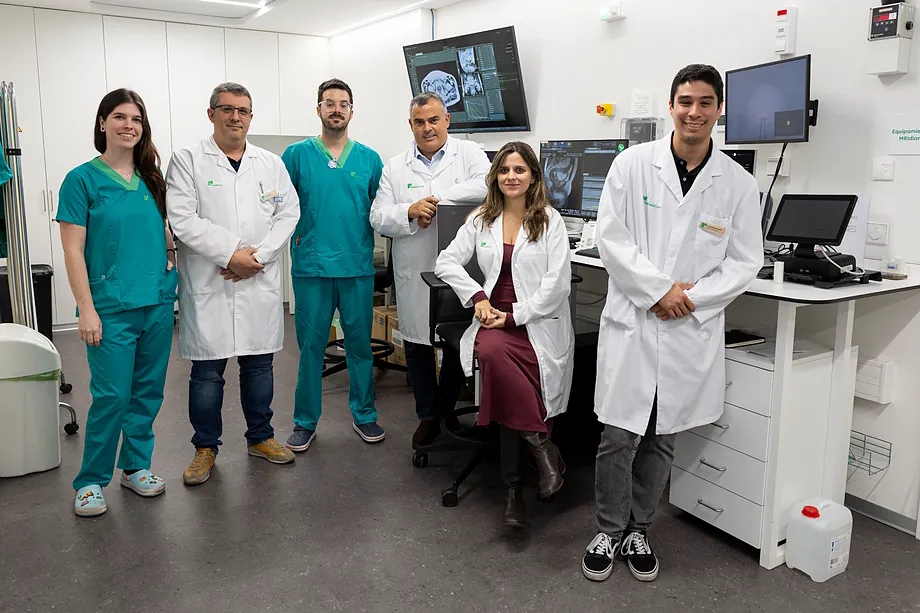
Paco and Joaquín owe their good prognosis to two types of intelligence: artificial and natural. The former is in the MRIdian MR Linac machine, which combines radiotherapy and magnetic resonance imaging with AI algorithms. The latter is in the human team led by Felipe Couñago, medical director of GenesisCare at Vithas Madrid La Milagrosa University Hospital. From here, two pioneering studies on the results of adaptive radiotherapy in prostate cancer patients have been published in the country, the most diagnosed tumor among men in Spain, according to the Spanish Society of Medical Oncology (SEOM).
Dr. Abrahams Ocanto states that "adaptive radiotherapy is a much more precise and safer treatment than conventional." Its main advantage is that it allows for adjusting the irradiation to each patient's anatomy and the changes that occur in their body during each session. With the patient lying inside the machine, the medical team pre-defines on-screen the area to be treated and the healthy organs to be protected. During the session, the specialists monitor in real-time what happens. "We see respiratory movements and those of the bladder, rectum, or intestines, and that allows us to better direct the radiation," explains the oncologist.
Joaquín, who poses in the photo, underwent a prostatectomy and subsequently radiotherapy to treat the cancer that had returned to his prostate bed. Now, his PSA levels remain low. He, who didn't throw in the towel, shares his testimony to motivate other men.
If the anatomy changes and a risk organ shifts toward the area intended for irradiation, the AI-powered system automatically stops. "With conventional radiotherapy, we take a sort of photograph before treatment, but we can't see everything that happens during the session," compares Ocanto. Oncologist Daniela Gonsalves uses a common image to explain the difference: "Imagine you have a suit for several events and you can't lose or gain weight to wear it. That would be conventional radiotherapy. In adaptive radiotherapy, you have a tailor behind you who, if one day you're heavier, adjusts it for you, and if you're thinner, she takes it in."
While a linear accelerator, the traditional radiotherapy machine, usually requires between 25 and 30 sessions of about 10-15 minutes each, adaptive radiotherapy concentrates treatment into about five sessions, each lasting between 30 minutes and an hour. The difference comes from precision. This technology is also used for tumors whose location and movement make irradiation difficult, such as some located in the lung, kidney, or pancreas.
The balance is between delivering a high dose to the tumor with radiation and the minimum to risk organs. And we calculate that with an AI that the program itself has.
The reduction in the number of sessions positively impacts the psychological aspect. As Dr. Couñago shares, "When a patient receives a prostate cancer diagnosis, what they feel is fear, worry... They don't know if they will be cured, they don't know if they will die. So the sooner they can resolve one of the most dramatic situations of their life, the better for them and their family." More than 460 people have undergone treatment with this machine, 60% with prostate cancer.
In each session, the patient is protected by a team consisting of an oncologist, a medical physicist, and two technicians. The technology helps facilitate their work. For example, with the help of AI, it offers three treatment plans, automatically identifying each organ, so the oncologist and medical physicist can decide which is the best option, being able to readjust it if necessary. "The balance is between delivering a high dose to the tumor with radiation and the minimum to risk organs. And we calculate that with an artificial intelligence that the program itself has," details Ocanto.
34,800 Diagnoses Per Year in Spain
In November, the month of awareness about prostate and male health, it is worth noting that around 34,800 diagnoses are registered in Spain each year, according to SEOM. This represents one in five cancers diagnosed in men. But Couñago offers reassuring data: "In patients at low or favorable intermediate risk, the chances of cure and maintaining controlled PSA levels at five years are around 95%, whether opting for surgery or radiotherapy. In those at unfavorable intermediate or high risk, that probability can drop to 85-90%." Thus, when it comes to fighting this disease, "the therapeutic arsenal is enormous." With a high probability of cure, Couñago asserts that there is another important aspect: "Treating the patient while maintaining their quality of life."
And precisely, quality of life is one of the aspects that have been analyzed in the two prospective studies conducted by the medical team to measure the treatment's efficacy. The results have been published in the international medical journal 'Clinical and Translational Radiation Oncology (ctRO)', linked to the European Society for Radiation Oncology (ESTRO). The first was based on adaptive radiotherapy in the prostate bed. This research involved 31 patients, including Joaquín.
We are on the path to curing an immense majority of patients.
In the second study, the results of the same technique were analyzed in 108 patients with localized prostate cancer, including Paco. Both studies evaluated the safety and tolerability of the treatment based on symptoms reported by the patients themselves. The follow-up lasted up to a year, although for some participants, the period was shorter. "We have found that genitourinary and gastrointestinal adverse effects are extremely low," celebrates Couñago. Moreover, they decrease even further as the months go by after completing the sessions.
This is a significant achievement, as the proximity of the prostate to the bladder and rectum means that radiotherapy can cause urinary and digestive discomfort. Dr. Ocanto estimates that around 40% of patients experience genitourinary effects with conventional techniques—such as burning or stinging when urinating and incontinence—and about 20% suffer digestive problems, such as diarrhea. He explains that adaptive radiotherapy allows for reducing these complications: "Genitourinary events drop by half, to 20%, while digestive issues drop to 1 or 0%."
In both studies, a decrease in PSA levels was observed after treatment. In patients with localized cancer, the median dropped from 8.56 to 0.76 ng/ml at 12 months. In those who received radiotherapy in the prostate bed after surgery, it fell from 0.31 to 0.02 ng/ml at six months. Doctors Ocanto, Gonsalves, and Couñago, co-authors of both studies, agree that the initial results are promising, although more follow-up is needed to understand the efficacy and long-term evolution and thus be able to speak of a cure.
Regarding erectile dysfunction, Dr. Gonsalves explains that "there are blood vessels and nerves surrounding the prostate that facilitate erections. When focusing radiation on the prostate, it is possible to affect these vessels—a risk that is higher with conventional radiotherapy, where they may receive a larger dose. With adaptive radiotherapy, however, the dose can be precisely focused and contained, which better preserves the neurovascular bundle." The oncologist notes, however, that this also depends on whether the patient is simultaneously undergoing hormone therapy.
Hormone therapy
"Hormone therapy complements radiotherapy," Dr. Ocanto points out, and it is typically administered for a period ranging from four months to two years. Its purpose is to lower levels of testosterone—the male hormone that, in a sense, "feeds" prostate tumor cells. "This causes men to experience something similar to menopause in women: hot flashes, muscle and joint pain, fatigue..." Paco recalls this well, remarking with a touch of irony that "the hormone blockade was just 'delightful'." He speaks of his erectile dysfunction with the same wry humor, noting that, at age 82, it is hard to say whether it stems from the radiation, the hormone therapy, or simply his age: "As for that... well, things aren't exactly working as they should..."
Paco mentions that he experienced some urinary discomfort early in the treatment, which was resolved by increasing the interval between sessions. Joaquín, by contrast, experienced no urinary or digestive issues. "The only real discomfort was being inside the 'tube' [the machine's interior]; I felt absolutely no physical pain. It didn't interfere with my daily life at all. I even remember being advised to use a moisturizer after the treatment, as the skin might be affected—but that didn't even turn out to be necessary." Both patients express their appreciation for the "kind" treatment they received at the hospital. "From the very first moment, Dr. Couñago knew how to put me at ease—he looked me in the eye and said, 'This is serious, but it's not going to kill you,' and he said it with a very convincing, steady confidence," says Joaquín. "It's wonderful that the medical team is so humane; when you're already feeling distressed, being treated poorly—as if it were somehow your own fault—is just awful. A little bit of human warmth goes a long way," adds Paco.
Dr. Couñago highlights the significance of the studies published in *ctRO*. "We are on the path toward curing the vast majority of patients," he predicts, though he clarifies that "in terms of efficacy, these data are still very preliminary—with cancer, you have to wait at least five years to speak of solid, robust efficacy." He also confirms that research will continue. "In five years, we will also have data on sexual quality of life—which is very important for men—and we believe that these types of adaptive radiotherapy treatments can help mitigate the impact on patients' sexual well-being."
For now, Paco's PSA level has dropped from 8.3 to 0.6 ng/ml. "I've got a few more years of life ahead of me," the 82-year-old patient predicts. "Enough time to keep giving politicians a hard time—and to collect a few more pension checks!" he jokes. He also offers a piece of advice for other men: "Don't settle for a urologist who skips the digital rectal exam. That's what I did, and it ended up delaying my cancer diagnosis." As for Joaquín, his PSA level is currently 0.04—a significant drop from the 19 it reached before his prostatectomy. He encourages others to stay positive and hopeful, and he has a good feeling about his future: "If I do pass away, it'll be from something else entirely."